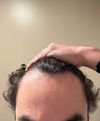
A new topical medication, Clascoterone, shows promise for hair loss, improving hair count significantly. Trials for Breezula are ending, but sign-ups for PP405 trials are available for 2026.
Clascoterone 5% topical solution shows promise for treating male-pattern hair loss by blocking DHT at the follicle without systemic absorption, potentially offering fewer side effects than oral treatments like finasteride. While results are promising, long-term safety and effectiveness need further study, and it may serve as a starting point for developing more effective treatments.
Clascoterone 5% solution showed a 539% improvement in hair count compared to placebo, but the actual increase in hair growth is minimal. Users express skepticism about the effectiveness of hair loss treatments.
Clascoterone phase 3 results show promising improvements in hair count, but concerns about high costs and lack of detailed data remain. Users compare it to existing treatments like Minoxidil and Finasteride, expressing skepticism about its accessibility and effectiveness.
Insulin resistance may increase DHT production, contributing to hair loss, and addressing it through diet, nutrients, and natural DHT blockers like saw palmetto and pumpkin seed oil could help reverse hair loss. Some users prefer medications like finasteride for more effective results.
Clascoterone in Winlevi, a topical AR antagonist, is being re-examined due to concerns about HPA axis suppression in adolescents, but it's unlikely to be banned for adult use in androgenetic alopecia (AGA). The European Medicines Agency recommended refusing Winlevi for acne vulgaris, but this may not affect Breezula's approval for AGA.
Clascoterone, an acne treatment that blocks DHT, is being developed for scalp use against hair loss. The conversation also mentions Minoxidil, finasteride, and RU58841 as treatments.
The user is considering minoxidil, clascoterone, and fluridil for hair loss, avoiding finasteride and RU58841. They are also contemplating a hair transplant and exploring the resilience of transplanted hair without finasteride.
A user is participating in a phase 3 trial for Clascoterone, a topical acne medication that may stimulate hair growth, and will share results after 6 months. They will have a section of their hair shaved and marked with a tattoo for the study.
The conversation is about the approval of Clascoterone (Winlevi) in Canada for hair loss treatment. One user expressed skepticism about its effectiveness due to low concentration.
Clascoterone cream was submitted for review to Health Canada in August 2022, with hopes of approval within 3-6 months. It may potentially enhance finasteride's effects for hair loss treatment.
Clascoterone lotion, being tested in Germany, is as effective as Minoxidil and Finasteride for hair loss but without serious side effects. About 400 men participated in the trials.
Clascoterone (Breezula) showed positive results for treating hair loss without affecting cortisol levels. Opinions vary, with some users optimistic about its potential and others critical of its effectiveness compared to existing treatments like finasteride.
Winlevi (clascoterone 1%) is being discussed as a potential hair loss treatment. Users are considering its use despite concerns about its delivery method.
The conversation discusses using Musely's classic formula for hair loss, which includes minoxidil, dutasteride, tretinoin, ketoconazole, and hydrocortisone. Concerns are raised about hydrocortisone and the high concentration of dutasteride, with a preference for using research-backed concentrations without hydrocortisone.
People are humorously discussing unconventional hair loss remedies like pig lard and raw liver, while also mentioning treatments like Minoxidil, finasteride, and RU58841. They mock the idea that seed oils cause balding and criticize misinformation.
Winlevi (clascoterone), a DHT blocker, is being considered for hair loss treatment, though it's primarily an acne medication. Users discuss its potential effectiveness and note it may only work for a short time.
FOL-005 claims to be more effective than Minoxidil and Finasteride but lacks anti-DHT properties, leading to potential reduced efficacy over time. Concerns are raised about misleading marketing and the safety of alternative treatments like Pyrilutamide and Clascoterone.
Winlevi (clascoterone) is discussed as a treatment for hormonal acne and seborrheic dermatitis due to its ability to block DHT and regulate sebum production. The post suggests that Winlevi could offer a novel approach for managing seborrheic dermatitis.
The post criticizes a company falsely claiming finasteride and minoxidil are ineffective after 6-8 months to sell their expensive, ineffective shampoo. The recommended treatments for hair loss are finasteride, minoxidil, low dose oral minoxidil, dutasteride, microneedling, and ketoconazole shampoo.
Cassiopea claimed that their hair loss treatment, Clascoterone, shows comparable results to finasteride after six months of use. Some users believe Clascoterone could be an additional treatment option for those who do not respond to finasteride.
Breezula® (Clascoterone) showed promising results in a Phase 2 trial for treating hair loss, being as effective as Propecia with no serious side effects. It might be released between 2021-2022, and a related acne treatment with the same active ingredient could be used in the meantime.
Using detox or clarifying shampoos like OUAI Detox Shampoo and K12 Detox Shampoo can help reduce hair fall caused by mineral buildup from hard water. Rinsing hair with soft water after showering is also recommended.
The conversation is about finding a reputable place to buy Clascoterone in the US. An alternative treatment, pyrilutamide, is suggested as a strong and official option.
A 20-year-old is experiencing hair thinning and is considering Clascoterone and Minoxidil as treatments, avoiding finasteride due to concerns about fertility and hormones. A suggestion was made to use Clascoterone for local DHT targeting and combine it with Minoxidil for maintenance and regrowth while avoiding systemic side effects.
A 30-year-old man with hairline recession is considering using 1% Clascoterone cream on his hairline while awaiting a 5% Breezula product. He has been using oral Minoxidil for four years but stopped using Finasteride due to side effects.
The user reported slight improvement in hairline using 1% Clascoterone cream over three months but found it too costly to continue. They expressed interest in trying a 5% concentration if it becomes available at a reasonable price.
Hair loss changes are typically noticed over months or years, not days, and treatments like finasteride, dutasteride, and minoxidil require time to show effects. People often overreact to daily shedding, but realistic expectations and patience are necessary for hair regrowth treatments.
People are interested in trying clascosterone (Breezula) for hair loss, especially those who are too young for finasteride. Some users express concerns about the cost and prescription requirements, while others discuss alternatives like RU58841.
A new hair loss protocol using FDA-approved topical treatments targets eight pathways, potentially improving results by 60-75% compared to the standard 40-50% from oral minoxidil and finasteride. The protocol includes minoxidil, finasteride, tacrolimus, cetirizine, bimatoprost, lithium gluconate, losartan, melatonin, NAC, caffeine, and tretinoin, with a monthly cost of $35-50 in Mexico and $80-150 in the US.