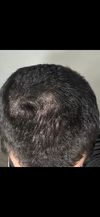
The user is allergic to minoxidil and plans to try Redensyl hair serum and derma rolling for hair regrowth. They cannot start finasteride until age 18.
A 27-year-old man shared his hormonal panel results after one year of taking finasteride 1mg/day for hair loss, showing his DHT levels nearly doubled. He reported stabilized hair loss with mild side effects that resolved, and he is considering a hair transplant but is concerned about the increased DHT levels and potential treatment options.
The user stopped using finasteride and RU58841 and is considering CB-03-01 for androgenic alopecia but is concerned about the cost and effectiveness, especially at a lower dose than in clinical trials. They are also using minoxidil, micro-needling, and nizoral shampoo but are unsure about the correct application method for CB-03-01.
The conversation discusses why CB-03-01, a potential hair loss treatment, isn't widely discussed despite evidence of its effectiveness and safety. Some users mention other treatments like melatonin, procianidin b2, and RU58841, debating their effectiveness and safety.
The conversation discusses hair loss treatments, specifically Minoxidil, finasteride, and RU58841. Concerns are raised about the lack of studies on RU58841 and its potential effects.
RU58841, a potential hair loss treatment, was not commercialized due to marketability issues and lack of long-term safety data. Concerns about its formulation and delivery methods further complicate its use.
The conversation discusses anticipation for CB-03-01, a potential new hair loss treatment that may be more effective and have a cleaner safety profile than finasteride. Users are hopeful but cautious, discussing current treatments like minoxidil, nizoral, and dermarolling, and the possibility of combining them with CB-03-01 for better results.
The user shared their experience with CB-03-01 (Breezula/Clascoterone) for hair loss, noting reduced shedding and improved hair appearance but experiencing significant sleep disturbances and low energy due to HPA axis suppression. They decided to stop using it due to these side effects and are waiting for GT20029 as an alternative.
A user switched from Anageninc to Aesthetic Cosmetics for RU58841 and experienced increased shedding, questioning the product's authenticity. They seek advice on reliable sources for RU58841 in Australia.
A 22-year-old male shared his one-year progress using dutasteride, minoxidil, and ketoconazole shampoo for hair regrowth, showing significant improvement. Users discussed the effectiveness of these treatments, with some confusion about ketamine, and shared their own experiences and questions about dosages and side effects.
Mallia Aesthetics has developed MAL-838, a hormone-free product derived from sCD83, which stimulates hair growth without disrupting the skin microbiome. sCD83 promotes hair growth by activating hair follicles and preventing cell death, offering a localized treatment without systemic side effects.
Despite using 5% minoxidil, 0.1% finasteride, and other treatments like microneedling, MK-677, and Cialis, hair loss continues with high testosterone and DHT levels. Considering oral dutasteride but concerned about further increasing testosterone levels.
A 17-year-old is frustrated with hair thinning and receding temples, seeking advice after a dermatologist dismissed concerns. Suggestions include starting Minoxidil for regrowth and considering Finasteride if androgenetic alopecia is suspected.
Fatty acid metabolic signaling can activate epithelial stem cells for hair regeneration. Oleic and palmitoleic acids showed the best results, but practical application on humans remains uncertain.
A user is seeking advice on treating a chin scar with Verteporfin, noting that higher doses were more effective. Another user responds that they do not use it, without providing further explanation.
The conversation discusses using 0.1% Alfatradiol compounded by a pharmacy for hair loss treatment. It also mentions Minoxidil, finasteride, and RU58841 as other treatments.
The conversation discusses using topical Calcipotriol and Valproic Acid for hair loss, focusing on their mechanisms involving the VDR receptor and Wnt/beta-catenin pathway. Specific treatments mentioned are Minoxidil, Finasteride, and RU58841.
The conversation discusses the potential of PP405 as a hair loss treatment, with some users expressing skepticism and others hopeful about its development. There is also mention of other treatments like Minoxidil, Finasteride, and Pyrilutamide, with users debating the effectiveness and safety of self-experimentation versus waiting for clinical trial results.
A 37-year-old man treated his hair loss with 0.5mg finasteride every other day and 5% minoxidil twice daily for 5 months, reducing finasteride from 1mg due to side effects. His hair improved significantly, with positive changes visible from all angles, and he experienced no more side effects after the dosage adjustment.
HMI-115 is a new drug developed by Bioinvent and licensed by Bayer, with mixed opinions on its potential effectiveness. Some users are skeptical and prefer proven treatments like Minoxidil, finasteride, and RU58841.
Two Chinese suppliers provided legitimate RU58841, confirmed through a free drug testing service. The vendors were Shaanxi Greenyo Biotech and Lyphar, found on Made-in-China.
The conversation is about testing the effectiveness of RU58841 for hair loss, with the user planning to increase their dose to 30 mg per day along with 20 mg of Minoxidil. The test results showed approximately 70 mg/ml, which the user considers a good result.
OP is considering using Stemoxydine or the Ordinary Multi Peptide Hair Serum as a carrier for topical finasteride, avoiding minoxidil due to palpitations. They plan to crush finasteride pills into a 30 ml solution.