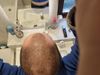
The user underwent a second hair transplant for the crown and mid-scalp, achieving good density. They are using minoxidil, finasteride, and biotin, and considering PRP treatments to enhance growth.
The conversation discusses using finasteride or dutasteride to reduce DHT, CosmeRNA to target androgen receptors, and Minoxidil as a vasodilator for hair growth. The regimen aims to maintain hair by addressing DHT-AR ratio and continuous Minoxidil use.
A user achieved significant hair regrowth from Norwood 3 to a dense Norwood 2 after five months using oral dutasteride, oral minoxidil, and a topical solution with minoxidil, retinoic acid, and hydrocortisone. The user reported no side effects and found the topical treatment especially effective for the hairline.
A user shared their successful hair regrowth journey using finasteride, minoxidil, microneedling, and castor oil, highlighting the importance of persistence despite initial shedding. They reported no side effects and encouraged consistency in treatment.
The user reports improvement in temple hair after three weeks of using finasteride, minoxidil, ketoconazole, microneedling, stemoxydine, and follicopeptide. They note visible progress by maintaining the same hair length for comparison.
A user developed AI software to simulate hair transplants on photos, helping people visualize potential results. The tool offers photo-realistic renderings but advises caution regarding exact outcomes due to various factors.
Microneedling combined with latanoprost may convert vellus hairs to transitional or terminal hairs. The user suggests using oral minoxidil to increase vellus hair, then applying a high concentration of latanoprost with microneedling for conversion.
A user shared their successful hair regrowth journey using oral minoxidil, dutasteride, and eucapil, with additional benefits from MTF hormone replacement therapy. They advised consulting specialists and considering individual responses to treatments.
Hair cloning is humorously discussed as always being 5-7 years away, with skepticism about its near-term availability. Gene editing to reactivate dormant follicles is suggested as a more likely solution within the next ten years.
The user is using a hair loss regimen involving 2ddr applied twice daily, tretinoin weekly, and occasionally micro-needling. They report feeling increased scalp thickness and seeing some hair growth progress.
Creatine may cause hair shedding and texture changes, with mixed user experiences. Combining creatine with finasteride doesn't always prevent these effects, possibly due to individual DHT sensitivity.
A 50-year-old man shared his 3-month hair regrowth progress using a regimen of Nutrafol, Minoxidil/Dutasteride pills and topical solution, dermastamping, and Nizoral shampoo. He noticed significant improvement and received positive comments, despite some increased body hair growth.
A trans man shared progress pictures showing significant hair regrowth after 9 months on oral Minoxidil and 1.5 years on finasteride. He encourages others to stick with their treatments despite initial setbacks.
The user experienced hairline improvement using microneedling once a month with a 12-pin set at 1.5-2.0mm and taking Tru Niagen, alongside a heavily modified diet. They attribute the slow hairline improvement to environmental factors, particularly diet, rather than solely genetic factors.
The user's hair appears to have improved, looking thicker and healthier, especially around the temples, after using topical minoxidil, finasteride, dutasteride, and tretinoin. Most participants agree the last picture shows significant improvement, though one disagrees.
Kintor's GT20029, a treatment for hair loss, has completed Phase 1 successfully, showing promise as an androgen receptor degrader that could potentially regrow hair. It is considered more effective than Pyrilutamide, with infrequent dosing and minimal systemic absorption.
The post discusses a user's hair loss treatment journey over a year, using finasteride, dutasteride (dut), and oral minoxidil (min). The user found finasteride ineffective, switched to dutasteride and oral minoxidil, and noticed improvements, but couldn't determine which of the latter two treatments was most effective.
The user experienced hair regrowth and darker hair using finasteride daily, minoxidil nightly, and occasional dermarolling. They noticed significant progress, especially in hair density, and are considering increasing minoxidil use despite itchiness from wearing a hat.
A user's progress with their hair loss treatment, which includes finasteride and nizoral, as well as the potential for using minoxidil; other users providing advice based on their own experiences; and others discussing how buzz cuts can make diffuse thinning look worse than it is.
The user experienced hair regrowth using daily oral finasteride and topical minoxidil applied about five times a week, with some existing hair becoming thicker and new growth appearing. They also used dermastamping once a month and are considering adding topical GHK-Cu to their regimen.
A user discusses a hair loss treatment combining minoxidil and tretinoin, noting it may enhance absorption. Some users express interest and share positive experiences, while others question its effectiveness without medical evidence.
The conversation jokes about a well-preserved mummy having more hair than living people, with comments on male pattern baldness and humorous speculation on the mummy's hair loss treatment, possibly using Minoxidil and Finasteride.
The conversation humorously discusses hair loss and its treatments, specifically mentioning Minoxidil, finasteride, and RU58841. It highlights a transformation from hairline recession to significant hair regrowth.
The user shares their hair growth progress using topical and sublingual minoxidil, dutasteride, hormone replacement therapy, and a laser comb. They report thicker hair and reduced hairline shedding, seeking advice for further thickening.
Chime Biologics and Hope Medicine are speeding up the launch of a first-in-class antibody drug, HMI-115, for endometriosis and androgenic alopecia. The treatment involves a series of subcutaneous injections, has shown promising results in phase 1, and continues to promote hair regrowth even after the treatment is stopped.
Ketoconazole shampoo helps with dandruff and may support hair health, but users report mixed results for hair regrowth. Some users find better results with separate prescriptions of minoxidil and finasteride rather than using Hims' combined chews.
The conversation discusses the potential effectiveness and future results of the hair loss treatment pp405, with questions about its impact on different hair loss stages and areas. There is anticipation for phase 3 trial results to provide more data, and hope that pp405 could enhance hair transplant outcomes.
The conversation is about the difficulty of applying both pyril and min/fin to treat hair loss twice daily and whether combining them yields positive results.
The user shared progress on hair regrowth using oral dutasteride, oral minoxidil, and verteporfin procedures. They reported some regrowth after 6-9 months of treatment.
Inconsistent minoxidil use led to hair loss, prompting a plan to resume consistent application with derma stamping, red light therapy, and DHT blockers like clascoterone or RU58841. The user avoids finasteride and dutasteride due to past side effects.