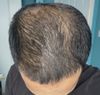
The conversation discusses alternatives to 5AR inhibitors for hair loss treatment, suggesting options like minoxidil, KX-826, pyrilutimide, microneedling, and topical bicalutamide. Concerns about side effects and the effectiveness of these treatments are also highlighted.
Clascoterone 5% shows potential for hair thickening and darkening, especially when combined with treatments like finasteride. It may be a good alternative for those who experience side effects from other treatments.
Be cautious when sourcing PP405 or its analogs from third-party suppliers due to potential safety risks and lack of regulatory approval. The conversation highlights concerns about counterfeit products and the absence of reliable testing, making it risky to use such treatments.
The conversation is about a user considering joining a clinical study for Clascoterone (Breezula) after experiencing no results with topical finasteride and minoxidil, and side effects from oral finasteride. The user is seeking advice on clinical study participation and experiences.
The user experienced heart palpitations after increasing their oral minoxidil dosage and starting a new topical minoxidil formulation. They wish to stop oral minoxidil for heart health and continue with topical minoxidil.
2-deoxy-D-ribose, a sugar molecule, is found to be 80%-90% as effective as Minoxidil in promoting hair growth, showing potential for alopecia treatment. Concerns include high cost, lack of human studies, and possible side effects like diarrhea and nausea.
CRISPR treatments for blood disorders have been approved, leading to discussions about its potential for treating hair loss (AGA). A study showed that editing a gene related to DHT sensitivity could lead to hair regrowth, suggesting CRISPR may eventually be used for AGA, but it's expected to be expensive and not soon available.
PP405 shows initial promise for treating androgenetic alopecia, with safety confirmed in early trials, but skepticism remains due to limited data. Further trials are needed to determine its true efficacy and potential market impact.
The user had a hair transplant 5 years ago and is currently using 1 mg finasteride and topical minoxidil but is not seeing an increase in hair volume. They are considering another transplant to improve hair volume.
The conversation is about when GT20029, a hair loss treatment, might be available on the grey market, with users discussing the challenges of compounding it and speculating it might be available after phase 2 results, similar to pyri. Specific treatments mentioned are pyri, RU58841, and GT20029.
A 41-year-old male is experiencing rapid hair loss at the crown and is considering starting finasteride and topical minoxidil. He is unsure whether to begin with 1mg or 0.5mg of finasteride and whether to delay using minoxidil.
OP used oral Dutasteride and Minoxidil but saw significant improvement only after adding PRP treatments. PRP sessions every 4 months maintained the results, though it is expensive.
Taking a slow and steady approach to treating hair loss, as well as the potential risks of combining too many treatments. The post suggests trialling individual treatments (such as Minoxidil, finasteride, or RU58841) for an extended period before adding more into your treatment protocol.
The user is considering PRP with exosomes for hair loss after oral minoxidil and dutasteride failed to provide desired results. Despite suggestions for a hair transplant, the user is hesitant due to cost and complexity, and is unsure about other options.
PP405 shows potential for hair growth by increasing terminal hair and converting vellus hairs, but results are modest and more waiting is needed. It complements existing treatments like minoxidil and finasteride, but won't replace them.
The conversation concludes that finasteride, a 5α-Reductase inhibitor used for hair loss, does not impair cognition either short-term or long-term. It suggests "brain fog" is not caused by the medication.
Verteporfin shows promise in donor hair regeneration after 84 days. Combining Finasteride, Minoxidil, and Pyrilutamide with unlimited hair transplants is seen as a potential near-cure for hair loss.
Topical Clascoterone showed a 539% improvement in hair count compared to placebo, but its effectiveness and safety are debated. Users compared it to minoxidil and finasteride, with mixed opinions on its potential release in 2026 or 2027.
The conversation is about choosing an additional topical treatment for hair loss, with options being fluridil, topical spiro, or alfatradiol, alongside existing treatments like dutasteride, oral minoxidil, latanoprost, and RU58841. Opinions vary on the effectiveness of adding these topicals, with some suggesting RU58841 is sufficient.
The conversation discusses using topical dutasteride from minoxidilmax for hair loss and the possibility of crowdfunding for DHT blood tests to check if the treatment goes systemic. The user plans to post before and after pictures.
The user experienced hair density loss after increasing finasteride dosage from 3x to 7x a week. It was suggested that this might be a temporary adjustment issue, and adding minoxidil could help.
The conversation is about finding an alternative hair growth stimulator for someone who cannot use Minoxidil due to heart issues. The person is currently using topical dutasteride, azelaic acid, and occasional microneedling, and is considering options like retinyl palmitate, latanoprost, certizine, or tadalafil.
The conversation discusses the use of topical finasteride and minoxidil for hair loss and inquires about the effectiveness of adding RU58841. Participants share experiences and opinions on the potential benefits of including RU58841 in their treatment regimen.
The conversation is about a person's one-year progress using finasteride and minoxidil for hair loss, with intermittent use of RU58841, showing improved hair quality, density, and thickness without side effects. Users complimented the improved appearance and suggested the longer hair also enhanced their look.
The conversation discusses the potential effectiveness of a Sult1a1 enzyme booster in enhancing the results of minoxidil for hair loss. Users express interest in the booster, hoping it will improve the effectiveness of oral minoxidil, especially for those who struggle with topical application.
The user has been using finasteride and minoxidil for hair loss but experienced worsening temple recession. They suspect they might be more sensitive to testosterone and are considering trying RU58841 or CB 03 01 as additional treatments.
The conversation discusses Dr. Blake Bloxham's experiment with Verteporfin for hair loss, with one person suggesting more doctors should try it as it seems beneficial. Another comment notes that results at 4-5 months were not very impressive.