Search
for
Sort by
Community Join
90-120 / 1000+ resultscommunity blood flow and scalp tension - put up or shut up
The conversation discusses skepticism about the effectiveness of scalp tension theory and scalp massagers for hair regrowth, contrasting it with treatments like finasteride and minoxidil, which have more user-reported results. Participants question the belief in scalp tension theory, suggesting it may be a marketing tactic, while others argue for a multifactorial approach to hair loss.
community The theory that explains everything. Community Crowdfund
3aHSD enzyme's role in hair loss and a crowdfund for research. Goal: explore new treatments, study RU58841, and develop natural topical product.
community Other factors involved then DHT/5aR
community 2nd HT FOR CROWN AND MID SCALP.
The user underwent a second hair transplant for the crown and mid-scalp, achieving good density. They are using minoxidil, finasteride, and biotin, and considering PRP treatments to enhance growth.
community Anyone heard of scube3? And other emerging treatments?
Emerging hair loss treatments like PP405, a topical MPC inhibitor, show promise in activating stem cells for hair growth. The conversation seeks information on the development stages and accessibility of these treatments.
community Dutasteride vs. Finasteride: Some interesting data about vertex hair regrowth
community Thin roots but thick ends hair – anyone else facing this?
A 23-year-old is experiencing hair that is thick at the ends but thin at the roots despite using minoxidil and finasteride for 10 months. They are concerned about whether this is normal or a sign of miniaturization and seek advice on reversing or improving the condition.
community Is it normal for scalp texture and appearance to change where hair is lost?
The conversation discusses changes in scalp texture and appearance in areas of hair loss, with concerns about the suitability of these areas for hair transplants. Users mention issues like fibrosis, inflammation, and thinner skin, advising caution and consultation with clinics before proceeding with transplants.
community Caffeine Reverses Androgenetic Alopecia in Cell-Cultured Follicles | Bernstein Medical
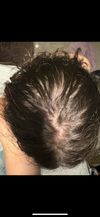
community Trying to identify area of treatment with topical fin
The user is considering using topical finasteride for thinning hair around the middle part, vertex, and crown, and is unsure if the whole scalp is thinning. Another user suggests oral finasteride is more effective than topical, and recommends consulting a dermatologist for proper treatment.
community An idea that I came up with recently💡
User suggests rotating scalp 180 degrees to address hair loss. Others discuss sanity, ethics, and similar procedures like scalp reduction and hair transplants.
community Is it normal?? As there are cracks in my scalp and I am seeing no hairs or very little hairs in between them. I had HT exactly 9 days before and I had some native hairs between the transplanted ones as well. 2548 graft count
community Rate my stack - suffering from male pattern baldness
community questions for the pyrilutamide users here
The conversation discusses the storage and use of pyrilutamide for hair loss, where one user advises against keeping it in the freezer as it may crystallize the active compounds.
community An Uncontrolled Case Series Using a Botanically Derived, β-Cyclodextrin Inclusion Complex in Two Androgenetic Alopecia-Affected Male Subjects
The conversation discusses a botanically derived treatment for androgenetic alopecia using ingredients like saw palmetto, green tea, and evening primrose, showing impressive results over 270 days. Concerns include the study's uncontrolled nature and potential product motivation, with suggestions to enhance absorption through derma rolling.
community Experiencing Rapid Norwood 3 to 7 Progression and Thinning Crown
The user is experiencing rapid hair loss, progressing from Norwood 3 to 7, with thinning at the crown and receding hairline. Suggested treatments include finasteride, minoxidil, ketoconazole shampoo, and CBD with MCT oil.
community Tressless regrowth results megapost
The conversation is about organizing hair regrowth results using a standard format in a single post for easier access. Treatments mentioned include oral minoxidil, oral finasteride, and dermarolling.
community The Korean began to suspect something. But they understood the mechanism to some extent. ( Cold shock therapy promotes hair growth in association with upregulation of cold-inducible RNA-binding protein and vascular endothelial growth factor)
Cold shock therapy may promote hair growth by stimulating follicular muscles and affecting stem cells. The exact mechanisms and full range of elements involved are not yet fully understood.
community When will Breezula be released and how does it compare to KX-826?
Breezula (clascoterone) is expected to be available by late 2026, showing good long-term results with minimal side effects. KX-826 (pyrilutamide) acts faster but is still in earlier development stages.
community PP405 Never Worked: the follicles were already activated at baseline
community The crazy thing with diffuse thinning is one day you think you have no hair loss, and another day you think you have no hair
The post and conversation discuss the unpredictable nature of diffuse thinning, a type of hair loss. Users share personal experiences, with some mentioning treatments like oral finasteride and toppik, and the need for patience with these treatments.
community Finasteride, Neurosteroids, and Neuroplasticity - have you noticed cognitive shifts or have you continued growing?
The conversation discusses concerns about potential cognitive and emotional effects of finasteride, with the original poster planning to monitor their cognitive performance while using the treatment. A user responds that most people do not experience cognitive shifts, though some report subtle changes.
community Hair transplants and PP405 - Irregular density concern
community How to mix raw Clascoterone (CB-03-01)?
community Using botox more effective than finasteride - and an argument against FUT
Botox injections may be more effective than finasteride for hair growth by reducing scalp tension. The discussion also suggests choosing FUE over FUT due to potential loss of scalp elasticity with FUT.
community Do hair follicles ever really "die"? Or does all your front, mid, and crown hair just become vellus?
Hair follicles don't truly die but become severely miniaturized. Treatments like finasteride, dutasteride, and minoxidil can help restore hair by providing nutrients and reducing harmful effects on hair roots.
community Just an interesting pic where you can see my original hairline. Looks like it’s eating at my sides too which seems weird. I think min made these hairs more prominent.
Hair loss discussion includes Minoxidil and regrowth. Regrowing hairs start light and curly, then become dark and thick; losing temporal peaks is normal.
community What’s your views on clascoterone 5% topical solution by cosmo
Clascoterone 5% topical solution shows promise for treating male-pattern hair loss by blocking DHT at the follicle without systemic absorption, potentially offering fewer side effects than oral treatments like finasteride. While results are promising, long-term safety and effectiveness need further study, and it may serve as a starting point for developing more effective treatments.
community What if a NW7 transplanted the rest of their hair into a "mohawk" pattern and did SMP on the side and back of their head?
A user is considering a hair transplant in a "mohawk" pattern with scalp micropigmentation (SMP) on the sides and back, questioning its feasibility and appearance. Others discuss donor region quality, potential scarring, and alternative treatments like dutasteride and RU58841.