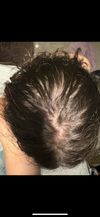
Topical Finasteride is most effective at 0.1-0.25%, and Minoxidil at 5%. Tretinoin is optional, and additional ingredients like biotin, caffeine, and saw palmetto are recommended.
The conversation is about experimenting with topical exosomes for hair loss treatment, alongside microneedling, Happy Head's gel-like topical, and Ordinary's hair serum. The user also mentions the availability of treatments like latanoprost and Redensyl.
The conversation is about a user making a homemade topical dutasteride solution to use alongside testosterone replacement therapy (TRT) and oral dutasteride. The user aims to reduce DHT locally at the testosterone injection site and on the scalp.
The user is considering using topical finasteride for thinning hair around the middle part, vertex, and crown, and is unsure if the whole scalp is thinning. Another user suggests oral finasteride is more effective than topical, and recommends consulting a dermatologist for proper treatment.
The conversation discusses switching from oral to topical finasteride due to side effects like nipple soreness. The user seeks advice on diluting and applying topical finasteride to minimize adverse effects.
The user is using a hair loss treatment regimen that includes applying various topical solutions and taking oral medication. They are mixing their topical treatments to save time but are concerned about the effectiveness of the treatments when combined and stored.
The conversation discusses the effectiveness of topical tretinoin as a monotherapy for hair loss, with users suggesting it may not be as effective as minoxidil or finasteride. The original poster is considering other options like a phenol peel and is concerned about the risks of derma rolling.
The conversation discusses using low-dose topical finasteride, specifically 0.005% and 0.01%, for hair regrowth, with some users considering increasing the concentration for better results. Users share experiences with different dosages and combinations, including minoxidil, and discuss the effectiveness and availability of these treatments.
Hair loss discussion includes topical Spironolactone's effectiveness and minimal side effects. Community members share personal experiences and opinions on its use.
Topical finasteride results in plasma levels 100 times lower than oral finasteride, potentially reducing systemic side effects. Users report similar efficacy with fewer side effects, suggesting a preference for topical application.
A user discusses their current hair loss treatment of topical minoxidil, tretinoin, and dermarolling, and considers adding topical spironolactone due to concerns about finasteride's mental side effects. Other users advise against topical spironolactone, citing ineffectiveness and unpleasant smell.
Oral Dutasteride and topical Finasteride may have similar effects on scalp DHT, but topical Dutasteride might be less effective due to poor absorption. Combining oral Dutasteride with topical Finasteride could potentially enhance results by blocking DHT in both the scalp and serum.
A 30-year-old male is considering using dutasteride and fluridil for hair loss maintenance and is curious about the effectiveness of topical spironolactone, as he cannot take finasteride. He is also planning a hair transplant.
The conversation is about someone considering adding topical Cetirizine 1% to their existing hair loss treatment regimen and seeking advice on where to buy it and others' experiences with it.
A user is seeking advice on making a topical bicalutamide solution as an alternative to RU58841 for hair loss, while already using dutasteride and minoxidil. They are considering crushing bicalutamide pills and adding them to their minoxidil.
A user is creating a custom topical hair regrowth serum using minoxidil, bimatoprost, tretinoin, castor oil, and hyaluronic acid. They are also using dutasteride, oral minoxidil, and castor oil in their current regimen.
The user is using finasteride, minoxidil, and ciclopirox shampoo for hair loss and is considering adding a topical anti-androgen like RU58841, Clacosterone, or KX286. They have scheduled a hair transplant and are concerned about the cost and effectiveness of future treatments.
A user is considering switching to a topical treatment containing finasteride, minoxidil, and tretinoin, instead of their current regimen of oral finasteride and oral minoxidil. They are unsure whether to try the new topical or continue with their current treatment.
Topical finasteride is considered a safer option for hair regrowth with fewer systemic side effects compared to oral finasteride. Some users report similar efficacy and side effects between topical and oral treatments, while others prefer topical due to reduced systemic exposure.
Applying hair loss treatments like minoxidil and finasteride, with concerns about side effects and application timing. Some users experience side effects, while others manage without issues, and there's interest in future treatments like pyrilutamide.
A user is using a topical spray containing Finasteride 1% and Minoxidil 5% along with other ingredients like glycerin and aqua, questioning if these are effective carrier agents. They apply it once daily and use a separate 5% Minoxidil solution at night.
A user discusses a topical prescription for hair regrowth containing Minoxidil, Finasteride, and Latanoprost, noting Latanoprost's side effect of promoting eyelash and eyebrow growth. Others share experiences and information about Latanoprost, highlighting its origins as a glaucoma drug and potential side effects.
Betnovate and mometasone furoate were tried for scalp issues, but Zoryve and Selsun shampoo were recommended for relief. Itraconazole was suggested for stronger treatment if topicals fail.
The conversation discusses using different concentrations of topical treatments for hair loss, specifically Minoxidil, Finasteride, Dutasteride, and Tretinoin. The user is considering higher concentrations after previous treatments were ineffective.
The conversation discusses whether topical caffeine is effective for hair loss, with some users questioning its role due to its vasoconstrictive and vasodilative properties, while another suggests that temporary vasoconstriction might be beneficial by promoting angiogenesis. Specific treatments mentioned include caffeine shampoo, which one user believes is ineffective.
The conversation is about adding crushed bicalutamide or spironolactone to a topical mix with finasteride and minoxidil to suppress testosterone in hair follicles, similar to what RU58841 does. The user cannot obtain RU58841 in their country and is seeking advice on this alternative approach for hair loss treatment.
The user has been using a combination of 0.3% topical finasteride, minoxidil, ketoconazole, and microneedling once a week for two months with positive results and no side effects. They apply the treatment daily using a spray and have short hair, which makes application easier.
The conversation discusses creating a personalized topical treatment for hair loss, with ingredients like finasteride, minoxidil, tretinoin, melatonin, caffeine, and others. Users share their ideal formulations, including combinations of minoxidil, finasteride, tretinoin, adenosine, and other compounds, while also discussing the importance of managing inflammation.
The conversation is about making a topical solution from clascoterone powder, with references to using a RU58841 mixing guide for guidance. Concerns about product authenticity and bulk purchase requirements are also discussed.