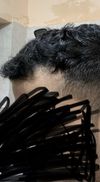
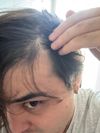
Epibiotech will offer off-the-shelf allogeneic hair multiplication treatment in South Korea, using dermal papilla cells from donors to grow hair in balding areas. This method is cheaper and less invasive than traditional hair transplants.
Hairline shows new growth, and hair quality and thickness have improved significantly after 10 months of oral Minoxidil and topical finasteride. The user also switched from a 0.5mm to a 1mm dermaroller.
A user's experience with Dutasteride causing rapid hair loss and temple recession over 3 weeks, with other users offering advice about the potential causes of this.
Finasteride's effectiveness and side effects may vary based on male phenotypes, with some users noting differences in response related to body and facial hair characteristics. Some users report success with lower doses, while others experience side effects, suggesting individual variability in response to the treatment.
The user has been using oral finasteride and topical minoxidil for 4 months and is questioning if there's regrowth. Responses suggest that diffuse thinning takes longer to show results, but there is some progress noted.
A user humorously shared their appearance three days after a hair transplant, sparking jokes and memes about their head shape. They remained positive, acknowledging the swelling and hoping for improvement.
A user experienced significant hair improvement using oral finasteride for six months, adding microneedling and switching to non-sulfate shampoo. They managed side effects by working out and noticed no negative impact on libido.
A user switched from topical to oral finasteride (0.5mg daily) and continued using topical minoxidil, seeing significant improvement in hair loss over four months. The user is pleased with the results, especially on the crown, and notes that hairline recession has stopped.
A 26-year-old has seen hair regrowth in 4.5 months using oral finasteride, topical minoxidil, and recently RU58841 on the temples. Suggestions include adding weekly microneedling to improve results.
The conversation discusses the potential for Verteporfin to reduce scarring, making hairline lowering surgeries more viable for men with mild hair loss. The user suggests that if scarring can be minimized, men might opt for hairline lowering instead of using grafts for other areas.
A 21-year-old is experiencing hairline recession and is using finasteride, saw palmetto, gelatin, topical minoxidil with retinoic acid, derma stamping, and scalp massage to address it. Suggestions include adding oral minoxidil, vitamin D3 with K2, and maintaining the current regimen for a year.
A 21-year-old is experiencing hair thinning and is using oral finasteride and topical minoxidil, considering adding oral minoxidil. They are unsure if the condition is androgenetic alopecia (AGA) or telogen effluvium (TE) and are advised to continue treatments and get a blood test.
Follicum discovered that their drug FOL-005 increased hair count by 12 hairs per cm2 in patients with less than 255 hairs per cm2 and is planning a phase 2b trial. They are currently fundraising for the trial, and the drug may also be effective for women.
A 22-year-old is experiencing hairline recession after switching from topical to oral finasteride, despite using minoxidil. They are considering returning to topical finasteride or trying dutasteride for better results.
The user experienced hair regrowth and thickening using 1mg oral finasteride, 3mg oral minoxidil, biotin, vitamin D, red light therapy, and microneedling. Some shedding occurred around 4-6 weeks into the treatment.
A 23-year-old is concerned about potential crown thinning and has been using minoxidil for 3 years and finasteride for 10 months, with overall hair improvement. They are unsure if their crown appearance is due to natural hair whorls or early thinning.
The user is 2 months post-hair transplant with 6,000 grafts using the DHI method and is using oral finasteride, minoxidil, and vitamins. They are seeking feedback on their progress.
User shared 6-month progress of hairline recovery using oral finasteride and topical minoxidil, asking for current Norwood scale rating. Responses praised impressive results, with estimates ranging from Norwood 1.5 to 3.
The brain resists updating its perception of gradual appearance changes, like hair loss, due to its preference for stability and reliance on an internal model. This delay in perception can make changes feel sudden once the brain finally updates its model.
The user is using 2.5mg Minoxidil, 0.5mg Finasteride, a dermastamp, and scalp massages for hair regrowth. There is some visible improvement, but patience is advised as significant results typically take around 6 months.
The conversation discusses whether someone with a naturally large forehead and widow's peak can get a hair transplant and start finasteride early. It also mentions a surgery to lower the hairline as an alternative.
Han Bio plans to start clinical trials for a new hair multiplication technology this year, which could significantly reduce the cost and time of hair transplantation. The technology uses a single hair strand to cultivate enough cells for 30,000 hair strands.
The conversation is about documenting hair loss over four years leading up to a hair transplant, with photos showing the progression. The next post will cover the experience and recovery from an FUE transplant.