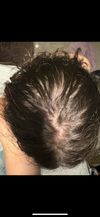
User discusses Eucapil for hair loss treatment and asks if it helps with itchy scalp. People share their experiences and results, including maintenance or slight improvement.
The user shared their 6-month hair loss progress, detailing a change in routine from using Minoxidil foam, topical Dutasteride, and topical Finasteride to using Minoxidil, oral Finasteride, derma rolling, and Keto shampoo. They seek suggestions for further improvements.
Discussion on hair loss treatments, focusing on Breezula, with mentions of Minoxidil, finasteride, RU58841, Pyrilutamide, GT20029, and PP405. Breezula's effectiveness is uncertain, with some trials showing minimal regrowth.
The user is experiencing reduced hair shedding and increased hair density after using finasteride, minoxidil, derma rolling, granactive retinoid, and Nizoral, while also taking testosterone and aromatase inhibitors. They question if they are a hyper responder to the treatments, despite mixed feedback from others about visible progress.
AMP-303 and AMP-601 are new hair loss treatments targeting dermal papilla cells, with AMP-303 showing early efficacy in transitioning vellus hairs to terminal hairs after one injection. Further clinical trials are planned, and these treatments are seen as promising due to their biologic approach and less frequent application compared to daily treatments.
Stem cell-related treatments and drugs like RCGD423 and WAY are being tested for hair growth. Clinics are conducting tests on patients who haven't had previous treatments.
A user is seeking advice on adding dutasteride to their finasteride regimen to stop DHT-related scalp itch. They have tried selenium sulfide and ketoconazole shampoos with temporary success.
Breezula (cb-03-01) and kx-826 are discussed as hair loss treatments. Kx-826 is available on Kintor's website, while Breezula is available on the grey market.
The user is pleased with increased hair density and thickness after six months of using topical minoxidil and finasteride. They plan to continue the treatment and consider adding dermarolling for potentially better results.
A user shared their hair regrowth progress using oral finasteride, biotin, topical minoxidil, and DS thickening shampoo over five months, reporting significant improvements in hair texture and growth. They experienced minor side effects like a slight headache from switching minoxidil forms but noted no issues with finasteride.
User discusses using trichosol as a vehicle for hair loss treatments like finasteride and minoxidil. They ask about others' experiences and the stability of the solutions.
The conversation discusses managing seborrheic dermatitis (sebderm) and male pattern baldness (MPB) with treatments like finasteride, coal tar shampoo, Nizoral, and oral minoxidil. Users suggest dietary changes, regular shampooing, and using antifungal products to control sebderm before considering minoxidil.
RootBioTec, a basil hairy root extract, claims to reduce hair loss by 31% in two months by inhibiting 5α reductase II and stimulating hair follicles. There is limited independent information available about its effectiveness.
The conversation discusses using peptides BPC-157 and TB-500, combined with microneedling, to potentially enhance hair regrowth. The user plans to try BPC-157 due to its lower cost and reports of hair growth, despite limited human trials and concerns about side effects from other treatments like minoxidil and finasteride.
The conversation discusses using Ketozolin shampoo in Germany as an addition to finasteride and minoxidil for hair loss treatment. Users recommend applying a small amount 2-3 times a week, leaving it on for 5-10 minutes.
The user has been using minoxidil daily, finasteride three times a week, and ketoconazole 1-3 times a week for a year to treat hair loss, resulting in noticeable hair regrowth at the hairline and temples, with minor side effects like itching and dandruff. They started with minoxidil a month before the other treatments and experienced an initial shedding phase for about six weeks.
A 20-year-old is using minoxidil, finasteride, tretinoin cream, and microneedling for hair loss but sees no improvement in the crown area and is considering a hair transplant. Users advise patience with finasteride and suggest trying a low-dose oral minoxidil if no progress is seen.
The conversation discusses positive initial trial results for GT20029, a topical compound for hair loss that degrades androgen receptors, potentially requiring only weekly application. Participants express hope for this treatment to be more effective and convenient than current options like Minoxidil, Finasteride, and RU58841.
The conversation is about using a 1mm derma roller for hair loss treatment, including cleaning the scalp with isopropyl alcohol and using castor oil mixed with coconut or olive oil afterward. The user seeks advice on the routine and mentions expected gains.
The conversation is about finding a suitable conditioner to use with Nizoral, a ketoconazole shampoo. One person is trying a caffeinated/coconut conditioner to strengthen hair but hasn't seen results yet.
User shared progress pictures showing significant hair regrowth using a compounded solution of Minoxidil 10%, Finasteride 0.1%, Biotin 0.2%, and Latanoprost 0.005%. They reported no side effects and are satisfied with the results.
Ketoconazole, once popular for hair health, is now less mentioned, with mixed reviews on its benefits for scalp health. Microneedling is discussed as a potential alternative to traditional treatments like finasteride and minoxidil, with varied opinions on its effectiveness.
The user is addressing hair loss with finasteride, dutasteride, oral and topical minoxidil, dermarolling, and shampoos. They are considering adding essential oils to improve circulation.
A South Korean company, Therazyne, has developed a promising hair loss treatment using a WNT chain surrogate that binds to Frizzled 7, with human follicle testing expected soon. Current treatments like minoxidil and finasteride are not seen as cures, and while optimism exists for future solutions like PP405, approval processes are lengthy.
Tea tree oil shampoo resolved redness, itching, and increased hair thickness for the user, suggesting demodex mites as a possible cause. Nizoral was ineffective, but tea tree oil showed significant improvement over several months.
OP is experiencing dandruff and is considering switching from climbazole to ketoconazole, with suggestions to use Nizoral and a routine involving ketoconazole, coconut oil, and lemon. OP is also using minoxidil and finasteride for hair loss, and there are discussions about various shampoos and treatments for dandruff.
Japanese scientists discovered ABM cells, enabling successful human hair follicle cloning, potentially curing hair loss. The treatment may be available in Japan by 2028, but it will be expensive and require travel.
The user shared progress on hair loss treatment between September and November using oral finasteride, topical minoxidil, dermarolling, a LaserComb, caffeine shampoo, Nizoral, scalp massages, and both oral and topical biotin. The conversation discusses the effectiveness of these treatments.