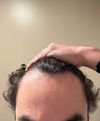
Minoxidil can prevent hair follicle miniaturization, not just stimulate hair growth. Finasteride and dutasteride don't work for everyone, suggesting DHT may not be the sole cause of hair loss; hair loss could be due to multiple factors, including autoimmune conditions.
Creatine monohydrate's potential link to hair loss, with mixed opinions on its effects. Treatments like minoxidil, finasteride, and RU58841 are discussed.
Dihydrotestosterone (DHT) impacts various skin conditions, including Androgenetic alopecia and seborrheic dermatitis, by causing overactivity in sebaceous glands. Topical medications Tacrolimus and Clobetasol can reduce these inflammatory conditions, and treatments like RU58841, Minoxidil, and Finasteride may also be beneficial.
A 20-year-old is experiencing hair thinning and is considering Clascoterone and Minoxidil as treatments, avoiding finasteride due to concerns about fertility and hormones. A suggestion was made to use Clascoterone for local DHT targeting and combine it with Minoxidil for maintenance and regrowth while avoiding systemic side effects.
Kintor 0.9% is not effective for hair regrowth or thickening and may cause testicle sensitivity. The conversation criticizes the hype around Kintor and discusses the ineffectiveness of pyrilutamide compared to other treatments like RU58841, finasteride, and minoxidil.
User discusses group buy for finerenone, a third-gen mineralocorticoid antagonist for hair loss treatment. Finerenone inhibits TGFb, NOX, and ROS, and improves renal and cardiac function; topical dose should be no more than 10mg per day.
The user is exploring KX-826 as a potential hair loss treatment due to intolerance to FDA-approved drugs like Minoxidil and finasteride. They seek fundamental help and information about KX-826.
Ketoconazole shampoo is primarily used to reduce scalp fungus and inflammation, not to block DHT or androgen receptors. It may help with seborrheic dermatitis and improve scalp health, but its effects on hair loss are minimal compared to treatments like finasteride.
Setipiprant and Fevipiprant are questioned for their effectiveness in hair maintenance, with skepticism due to lack of convincing results beyond vellus hair growth. The user is satisfied with Minoxidil and Finasteride but is curious about the potential of DP2 inhibitors.
A 27-year-old male with diffuse hair loss, including the donor area, did not respond to finasteride, dutasteride, or minoxidil. He suspects his hair loss may be linked to a mild connective tissue disorder, possibly affecting the structural support of hair follicles, rather than being purely hormonal.
DutchFella1993 has been using a lotion with finasteride and minoxidil for hair regrowth with some success and is considering using ketoconazole shampoo daily to reduce scalp itchiness. There's concern about the harshness of daily shampooing and twice-daily lotion application, and one reply suggests that daily use of ketoconazole may damage hair and questions its effectiveness, while also noting that once-daily minoxidil application is sufficient.
A user created a tracker for hair loss treatments in clinical development, including compounds like Dermaliq, RU58841, and Pyrilutamide. The tracker updates with new information and allows filtering by conditions like androgenetic alopecia (AGA) and alopecia areata (AA).
RU58841 is being considered for hair maintenance by someone who can't tolerate finasteride. Alternatives like topical finasteride, dutasteride, and KX826 are also suggested.
Kintor edited their Amazon page, removing claims that KX-826 provides "real" visible results from clinical experiments. The discussion includes treatments like Minoxidil, finasteride, and RU58841.
A user shared progress pictures showing improvement in PCOS-related hair loss after six months of using topical minoxidil, dermarolling 0.5mm weekly, and taking biotin gummies. They expressed happiness about the appearance of new baby hairs.
The conversation is about a user expressing concerns over the safety of a new drug called Pyrilutamide (also known as KX-826) for hair loss. The user will only trust the drug if it's permitted by EU regulations and sold by a reputable company.
Korea launched its first OTC oral hair loss drug, dexpanthenol B5. Users discuss its anti-oxidative and anti-inflammatory effects but note a lack of efficacy studies.
The user applied Kindor's KU, followed by a solution of Finasteride, Minoxidil, and Tretinoin for alopecia. They experienced no side effects from Kindor's KU.
KX-826 failed Phase III trials due to high placebo effects, patient compliance issues, COVID-19 side effects, and detection method deviations. KX-826 is now marketed as a cosmetic and approved for combination with Minoxidil.
PP405 shows promise for reactivating hair follicles, with potential maintenance using 5AR inhibitors. Current treatments like Minoxidil and finasteride are effective but have limitations, and there is hope for more effective solutions in the future.
The conversation discusses the effectiveness of adding RCP (redensyl, capixyl, procapil) to a hair loss treatment regimen that includes minoxidil and finasteride. Users share experiences, suggesting RCP may not be as effective as minoxidil, but could be useful for creating topical solutions.
Clascoterone 5% and PP405 are being discussed as potential future treatments for hair loss, with clascoterone nearing phase three completion and PP405 possibly taking a cosmetic route to market. Current treatments like minoxidil, finasteride, and RU58841 are mentioned as effective in slowing hair loss, but a complete cure remains elusive.
PP405 is a potential hair loss treatment that inhibits mitochondrial pyruvate carriers, increasing lactate dehydrogenase activity and stimulating hair follicle stem cells. In a phase 1 trial, 31% of participants showed over 20% hair density increase with PP405 treatment.
TDM-105795 showed promising hair growth results, with higher efficacy than placebo and minimal side effects. It activates dormant hair follicle stem cells and may maintain gains without immediate loss, unlike minoxidil.
A user is participating in a phase 3 trial for Clascoterone, a topical acne medication that may stimulate hair growth, and will share results after 6 months. They will have a section of their hair shaved and marked with a tattoo for the study.
MCL-1 is important for hair follicle stem cell survival, but its impact on human hair regrowth is unclear. Minoxidil and finasteride are the main treatments, with doubts about new discoveries leading to effective human solutions soon.
RU58841 was the only treatment that slowed hair loss and reduced irritation for a DUPA sufferer after trying finasteride, minoxidil, and dutasteride with no success. The user continues using 6mg oral minoxidil, 0.5mg dutasteride, and an 8% RU58841 solution.
The conversation discusses using finasteride or dutasteride to reduce DHT, CosmeRNA to target androgen receptors, and Minoxidil as a vasodilator for hair growth. The regimen aims to maintain hair by addressing DHT-AR ratio and continuous Minoxidil use.