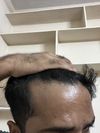
A new topical medication, Clascoterone, shows promise for hair loss, improving hair count significantly. Trials for Breezula are ending, but sign-ups for PP405 trials are available for 2026.
Kintor is accused of using fake pictures to promote their product, Pyrilutamide (KX826), which failed Phase 3 trials. Users express disappointment and note similar false advertising has occurred with finasteride and minoxidil.
An experiment to determine the effectiveness of Pyrilutamide in reducing hair loss, using a regimen of Minoxidil and Finasteride, with promising results. The conversation also suggests comparing this to RU58841 as an alternative.
Winlevi (clascoterone 1%) is being discussed as a potential hair loss treatment. Users are considering its use despite concerns about its delivery method.
The acne medication Winlevi, which contains Clascoterone, is available in the U.S. and may slow down hair loss until a higher concentration treatment, Breezula, is released.
PP405 is a potential hair loss treatment showing promise, especially for men with severe balding. Some are hopeful it will be a game-changer for those who cannot tolerate finasteride or minoxidil, despite skepticism about the outcomes.
Procapil is marketed as a natural hair loss treatment but lacks strong evidence and is industry-biased. Minoxidil and Finasteride are the only FDA-approved treatments for androgenetic alopecia.
Users discuss the release of Pyrilutamide 1% outside China and its potential effectiveness compared to 0.5%. They also mention using Minoxidil, Finasteride, and RU58841 for hair loss treatment.
The conversation discusses the safety study of PP405, emphasizing that early trials focus on safety rather than efficacy, and that any efficacy data from such a short study should be viewed skeptically. It also highlights that the information released is primarily for securing funding, and that meaningful efficacy results are expected in later phases.
Ordering Pyrilutamide from Minoxidilmax to use as an experimental topical treatment for hair loss, with discussion of the carrier used in trials and encouragement from other users.
The conversation discusses using NAC and quercetin as supplements for hair loss, with some users also mentioning finasteride. NAC is highlighted for its potential benefits, but concerns about its safety and absorption are also raised.
The user has been using pyrilutamide, topical finasteride, and 15% minoxidil for hair growth for almost 4 years. Despite mixed responses from others, the user reports seeing progress, especially with the addition of pyrilutamide, and plans to continue the regimen.
Breezula (clascoterone) initially performed better than finasteride for hair loss but then effectiveness decreased almost back to baseline after 6 months, raising questions about its strength.
Everychem's solution, similar to PP405, has mixed results for hair regrowth, with some users reporting improvements and others seeing no change or worsening hair loss. Users are sharing experiences and updates to determine its effectiveness.
The post and conversation are about the high cost and skepticism surrounding pyrilutamide as a hair loss treatment, with comparisons to minoxidil, finasteride, and RU58841. The original poster defends pyrilutamide's effectiveness and criticizes others for dismissing it without proper understanding.
The conversation is about finding a safe carrier for topical antiandrogens like finasteride, kx-826, RU58841, and dutasteride to minimize systemic absorption and side effects. The user experiences side effects from these treatments and is seeking advice on carriers that reduce these effects.
KY-19382, an indirubin derivative, is discussed for its potential to stimulate hair growth and create new hair follicles. The conversation seeks experiences with synthesizing, topically applying, or orally administering KY-19382.
Verteporfin shows promise in donor hair regeneration after 84 days. Combining Finasteride, Minoxidil, and Pyrilutamide with unlimited hair transplants is seen as a potential near-cure for hair loss.
Epibiotech will offer off-the-shelf allogeneic hair multiplication treatment in South Korea, using dermal papilla cells from donors to grow hair in balding areas. This method is cheaper and less invasive than traditional hair transplants.
The conversation discusses hair loss treatments, specifically the progress made with Pyrilutamide over 15 months. One person suggests using oral Minoxidil or Dutasteride, but another mentions experiencing negative side effects from oral Finasteride.
The user is using oral finasteride, minoxidil, and KX-826 for hair regrowth, noticing small improvements. They plan to add ketoconazole shampoo and consider a hair transplant with verteporfin after a year of treatment.
A 26-year-old male shared progress pictures after 4 months of treating hair loss with finasteride (1.25 mg on Mondays, Wednesdays, and Fridays), topical minoxidil twice daily, ketoconazole shampoo twice weekly, and weekly microneedling at 1.5 mm. He is seeing hair growth improvement, especially in the front, and is considering hair grafts for the crown area if necessary for more density.
PP405 shows promise for hair regrowth, with new hairs observed in 66% of patients in just 27 days. The discussion also mentions Minoxidil, finasteride, and RU58841 as potential treatments.
Actifollic selling Pyrilutamide as a treatment for hair loss, with people debating its efficacy compared to Minoxidil and Finasteride in combination with RU58841.
The conversation is about the long-term safety trial results for pyrilutamide, which are expected soon. Treatments mentioned include Minoxidil, finasteride, and RU58841.
The user is experiencing intense hair shedding all over the scalp after applying pyrilutamide to the hairline and taking oral castor oil. They are also using topical finasteride and latanoprost, but are unsure which treatment is causing the shedding.
PP405 is a potential hair loss treatment showing promising early results, with hopes for market release by 2028, but skepticism remains due to inconclusive data and past disappointments with similar products. Current treatments like Minoxidil and Finasteride have side effects, leading some to anticipate PP405 as a safer alternative, though its effectiveness compared to placebo is debated.
The user is applying topical finasteride with stemoxydine for hair loss and has noticed hair thickening but no regrowth after two months. They also report high SHBG and prolactin levels and a lack of morning erections, even on low doses of medication.
The conversation discusses updates on hair loss treatments, specifically GT20029, PP405, and a rumored injectable peptide from UT. GT20029 is seen as a promising treatment expected within 5-7 years.