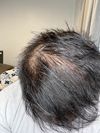
User experienced scarring from microneedling at fast speed and paused treatment for 3-4 weeks to recover. Advice given includes waiting a full month for recovery to avoid scars.
Fatty acid metabolic signaling can activate epithelial stem cells for hair regeneration. Oleic and palmitoleic acids showed the best results, but practical application on humans remains uncertain.
The conversation discusses using high molecular weight hyaluronic acid after microneedling to form a protective barrier, though it's considered expensive and offers marginal improvement. Users share experiences with different microneedling tools like derma rollers, dermastamps, and Dr. Pen, with some opting not to use any products on the scalp.
OP injured their temple using derma rolling and tretinoin, causing peeling and potential hair follicle damage. Users suggest the injury might be permanent, possibly resulting in scar tissue where hair won't grow.
The efficacy of degrading the androgen receptor through dermal application in DP cells, a delivery system for topical drugs that involves dissolving microneedles, and rosemary oil as an alternative anti-androgen.
The conversation discusses a patent filed by Shiseido for cloning Dermal Papilla (DP) cells to treat hair loss. The method involves using viral vectors to maintain the cells' growth-inducing properties, differing from Replicel's approach with Dermal Sheath Cup (DSC) cells.
This post and conversation are about the molecular mechanisms triggered by microneedling, specifically its effects on inflammation, tissue remodeling, epithelial proliferation, differentiation, and collagen synthesis. The discussion highlights the potential benefits of microneedling for hair loss treatment.
A 27-year-old male with diffuse hair loss, including the donor area, did not respond to finasteride, dutasteride, or minoxidil. He suspects his hair loss may be linked to a mild connective tissue disorder, possibly affecting the structural support of hair follicles, rather than being purely hormonal.
The user switched from finasteride to DIY dutasteride mesotherapy and topical minoxidil due to side effects. They report improved well-being and no hair loss worsening after stopping finasteride.
The conversation discusses using topical dutasteride with a dermapen for hair loss treatment. The user is deciding between liposomal and mesosomal formulations for this purpose.
Adipose-derived stem cell secretome showed significant improvement in hair density and growth, especially when combined with minoxidil, suggesting a synergistic effect. The study had limitations, including a small sample size and potential bias.
User noticed beard and sideburn hair loss, and thinning eyebrows, diagnosed with alopecia barbae and male pattern baldness, and prescribed Desonide cream. User seeks feedback on Desonide cream.
The user has been using dutasteride, lymecycline, betamethasone, and minoxidil for hair loss but struggles with eczema and dry skin. They feel hopeless as no treatments or moisturizers have helped, and they are concerned about their appearance due to their soft facial features.
Excess Vitamin A and topical retinoids can cause diffuse hair shedding. The user suspects their chronic telogen effluvium may be linked to using adapalene, a topical retinoid.
The conversation discusses preventing infection from derma stamping for hair loss treatment, with suggestions to reduce needle depth and consider alternatives like tretinoin. The user experienced irritation possibly from zinc chloride and stopped using the shampoo and derma stamping.
A user experienced significant hair loss after starting microneedling, despite using dutasteride and topical minoxidil. They are advised to consult a doctor as the shedding pattern is unusual and may indicate alopecia areata or other scalp conditions.
Dihydrotestosterone (DHT) impacts various skin conditions, including Androgenetic alopecia and seborrheic dermatitis, by causing overactivity in sebaceous glands. Topical medications Tacrolimus and Clobetasol can reduce these inflammatory conditions, and treatments like RU58841, Minoxidil, and Finasteride may also be beneficial.
The user uses a 1.5mm derma stamp weekly for hair loss and applies minoxidil afterward, feeling a slight burn but no bleeding. They question if bleeding, seen in others using a derma pen, indicates proper technique.
Dermatologists often advise against at-home microneedling due to risks of scarring, infection, and improper technique. Professional guidance is recommended for safe and effective use, with some users reporting positive results when done correctly.
The user experienced significant hair shedding after using a dermapen at 1.5mm weekly, which they later realized was too much. They are now using a dermapen at 0.75mm weekly and are also using topical minoxidil twice daily and finasteride 1.25mg daily.
Switching from oral to topical dutasteride can cause shedding due to changes in DHT levels, and it's recommended to overlap both treatments to minimize this effect. Topical dutasteride may cause scalp irritation, and the user is considering dutasteride mesotherapy as an alternative.
The conversation is about using micro needling and PTD-DBM for hair loss treatment. The user applies PTD-DBM drops on weekdays and performs micro needling weekly.
Adipose-derived stem cells with ATP improved hair regrowth in male and female mice with androgenetic alopecia. The most effective treatments were low dose stem cells with ATP for males and medium dose stem cells with non-liposomal ATP for females.
A user experienced a dry, scaly scalp two weeks after microneedling with a dermapen at 1mm and applying Rogaine foam. They tried moisturizers and coconut oil without success and are seeking advice.
A user experienced accelerated hairline recession after adding dutasteride to their regimen of topical finasteride and minoxidil, despite reduced hair shedding. They were informed that ELISA testing for DHT levels can be highly inaccurate.
The user has been using minoxidil and finasteride for hair loss without positive results and switched to dutasteride 1.5 months ago. They suspect seborrheic dermatitis might be affecting the effectiveness of these treatments.
The user underwent a biopsy two years ago and was diagnosed with keratosis pilaris, leading to hair issues. They tried treatments including Minoxidil, betamethasone, lymecycline, topical Accutane, and dutasteride, as well as diet changes, without improvement in hair thickness or skin dryness.
The user experienced side effects from oral finasteride and switched to a DIY topical solution, then to Essegen F. They noticed increased hair shedding with the topical finasteride and are concerned about its normalcy and duration.
The post discusses using at-home Dutasteride mesotherapy for hair loss, combined with topical minoxidil, microneedling, and a red laser cap. The user reports initial shedding, thicker hair, and a temporary dip in libido as side effects.