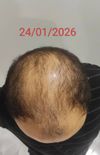
The user has been using finasteride, minoxidil, and a dermaroller for 80 days to treat hair loss. Early results are noted, but significant improvement is expected in 3–6 months.
Finasteride users discuss the impact of creatine on hair loss, with mixed personal experiences and no definitive evidence linking creatine to increased hair loss. Some report shedding, while others see no change, and a new study suggests creatine does not increase DHT or cause hair loss.
The conversation discusses hair regrowth treatments using finasteride, minoxidil pills, and topical minoxidil, with a focus on the use of a 1.5mm derma roller. Users advise caution with derma rolling, suggesting smaller needle sizes and longer intervals between sessions to avoid skin damage and systemic absorption of minoxidil.
Be cautious when sourcing PP405 or its analogs from third-party suppliers due to potential safety risks and lack of regulatory approval. The conversation highlights concerns about counterfeit products and the absence of reliable testing, making it risky to use such treatments.
PP405 shows promise in stimulating new terminal hair growth by activating dormant follicles, with no systemic adverse effects observed in a short-term trial. However, long-term efficacy remains unproven, and further trials are needed to confirm its potential as a hair loss treatment.
The user shared their 9-month hair regrowth progress using topical Minoxidil 5%, finasteride 0.05%, retinoic acid 0.01%, dermastamping, ketoconazole shampoo, and supplements like biotin. They experienced some hair density improvement but minimal change in the hairline, with initial side effects from finasteride that resolved after dosage adjustment.
The conversation discusses the safety and use of ketoconazole shampoo for hair loss, with mentions of zinc pyrithione and selenium sulfide. Users debate the safety of these ingredients, particularly zinc pyrithione, and share opinions on regulatory differences between Europe and the US.
Reducing sebum can indirectly lower DHT levels, with treatments like accutane, tretinoin, and green tea extract acting as DHT blockers. Accutane can lower DHT levels by reducing 5α-reductase activity, but its impact on hair varies.
Scalp massaging for hair loss hasn't shown significant changes yet, but the scalp is more flexible. Combining treatments like minoxidil, tretinoin, dutasteride, inversion, microneedling, and a good diet might enhance results.
Hair loss is linked to a higher rate of body dysmorphic disorder (BDD), OCD, and depression. Finasteride and dutasteride are not linked to increased suicidal risk, though some users report mental health side effects.
Topical finasteride with minoxidil effectively stabilized and thickened hair but caused side effects like brain fog, reduced libido, and emotional flattening, leading to discontinuation. The user switched to a new regimen including minoxidil, KX-826, and other treatments, noting improvements in libido and vivid dreams after stopping finasteride.
A 34-year-old from Patna shared a 5-month update on his hair transplant, which involved 4,200 grafts using the FUE technique to cover the front and mid-scalp. He experienced initial shock loss but now sees natural-looking growth and improved density.
The conversation discusses alternative and unorthodox hair loss treatments, including RU58841, nandrolone, and dianabol, as well as theoretical approaches involving high doses of estrogen and selective estrogen receptor modulators. These methods are considered extreme and potentially harmful but are explored for those unable to tolerate traditional 5-alpha reductase inhibitors.
The user successfully improved their hair from Norwood 3 to 0.5 using finasteride, topical minoxidil, microneedling, and a hair peptide, and plans to maintain it with dutasteride. They are leaving the forum due to emotional distress caused by the community.
A person is worried about balding affecting their relationship and is using minoxidil, finasteride, and dutasteride. They are advised to be honest with their partner and focus on self-acceptance, as many people don't care about hair loss.
The user experienced hair loss due to defective dutasteride and is now using a regimen including dutasteride, oral and topical minoxidil, RU58841, tretinoin, and microneedling to recover hair density. They are optimistic about regaining their hair despite recent setbacks.
Low-level laser therapy (LLLT) is discussed as a supplementary treatment for hair loss, with users recommending brands like LaserCap, Ideatherapy, Capillus Pro, and iRestore Pro. Users suggest combining LLLT with treatments like minoxidil and finasteride for better results.
Hair follicle stem cells remain in bald individuals, but progenitor cells do not, raising questions about hair regrowth claims by Pelage. PP405 is discussed as a potential treatment, with skepticism about its effectiveness compared to existing treatments like Minoxidil and Finasteride.
RU58841 helped regrow hairline without side effects for a bodybuilder using PEDs. The treatment included RU58841, finasteride, minoxidil, GKH-Cu, microneedling, and HGH.
The conversation humorously discusses using "pure willpower" as a method to combat hair loss, alongside treatments like dutasteride, finasteride, and RU58841. The original poster claims that this unconventional approach, involving shouting affirmations and avoiding distractions, has led to noticeable hair regrowth.
The user experienced significant hair regrowth after taking oral finasteride and minoxidil for four months. They reported no major side effects and are pleased with the progress.
New hair loss treatments, including Breezula, VDPHL01, and PP405, are nearing Phase 3 trials, offering hope for effective solutions. Current treatments like finasteride and minoxidil remain effective, but early intervention is crucial.
The user shared positive results after one year of using topical minoxidil and finasteride for hair loss, reporting no side effects and fuller hair. They recommend trying topical treatments over oral due to fewer side effects.
Ketoconazole 2% shampoo effectively regrew hair by treating scalp dermatitis and inflammation. The user also used jojoba and oat oil, Aveeno moisturizer, and hyaluronic acid for scalp care.
Clascoterone 5% topical solution shows promise for treating male-pattern hair loss by blocking DHT at the follicle without systemic absorption, potentially offering fewer side effects than oral treatments like finasteride. While results are promising, long-term safety and effectiveness need further study, and it may serve as a starting point for developing more effective treatments.
Hair loss is linked to cellular physiology and the IGF-1 to TGF-B1 ratio, not just androgen sensitivity. The theory lacks evidence, while finasteride and minoxidil are effective treatments.
A woman using minoxidil for hair loss is trying hair fibers but finds they look like dandruff. Suggestions include using pomade, Derm Match, matte eye shadow, mascara, and spray applicators for a more natural look.
A dermatologist advised stopping minoxidil due to heavy shedding, suggesting alternative treatments like Betaval Lotion and supplements, but many users disagreed, recommending continuing minoxidil and adding finasteride for better results. The conversation highlights skepticism about the dermatologist's motives and emphasizes the importance of understanding the type of hair loss before choosing treatments.
PP405 and ABS-201 are promising treatments for male pattern baldness. PP405 shows rapid hair growth in human trials, while ABS-201 shows significant regrowth in animal studies but is still in early human trials.