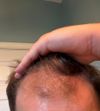
The user experienced significant hair shedding after one month of using finasteride 1 mg every other day and minoxidil 2.5 mg daily. They also use ketoconazole shampoo 2% every other day.
A 37-year-old man treated his hair loss with 0.5mg finasteride every other day and 5% minoxidil twice daily for 5 months, reducing finasteride from 1mg due to side effects. His hair improved significantly, with positive changes visible from all angles, and he experienced no more side effects after the dosage adjustment.
SCUBE3, a protein linked to hair growth in moles, was discovered over 25 years ago and is being developed by Amplifica for potential hair loss treatment. Concerns exist about SCUBE3's association with cancer, as it is a protein that promotes cell growth, which could potentially trigger cancer development if used for hair growth therapy.
A boyfriend's hair improved significantly over 10 months using minoxidil, steroid cream, antihistamine cream, and wild growth oil, with a strict cleaning regimen. His partner's dedicated care contributed to the transformation.
User shared progress pictures after 9 months of using minoxidil, finasteride, spironolactone, and estradiol for hair loss. Significant regrowth was noted, especially after starting estradiol.
User shares 3-month hair loss treatment progress using 1mg oral Fin, 2.5mg oral Min, Nizoral 3x week, and 1.5mm derma 1x week. Others comment on improvements and ask about oral Min source.
The conversation discusses a topical formula for hair loss including Finasteride (0.025%), Minoxidil (0.5%), Tretinoin (0.01%), Caffeine (0.005%), Melatonin (0.003%), Tea Tree Oil (0.05%), Aloe (0.05%), Biotin (0.05%), and Fagron TrichoXidil (2.5%). The user considers removing Minoxidil and Tretinoin to test TrichoXidil's effectiveness.
A user is seeking feedback on a homemade topical finasteride formula for hair loss, consisting of 7.5 mg of finasteride, propylene glycol, ethanol, and distilled water. They aim to achieve a 0.0125% solution by applying 2 ml daily.
A 19-year-old transgender individual is experiencing worsening temple recession despite taking female hormones and 1.25mg finasteride. They are seeking advice on additional treatments to address hair loss.
User tried various hair loss treatments with limited success. RU58841 was effective but caused side effects, now trying Eucapil and continuing Finasteride.
The conversation humorously discusses hair loss treatments, mentioning Minoxidil, finasteride, and RU58841. It jokingly credits a person for the potential success of a treatment called GT20029.
Mixing tretinoin with minoxidil for hair loss treatment. Some users prefer separate application or professional compounding due to potential solubility issues.
User questions credibility of a hair loss "cure" found by a non-expert and warns against wasting money on unproven supplements. Others discuss trying natural extracts and the importance of researching the enzyme 3ADH for potential hair growth benefits.
KX826 is considered a legitimate option for those who cannot use finasteride or dutasteride, but many users report it as ineffective compared to RU58841. RU58841 is favored by some due to anecdotal evidence of effectiveness, despite the lack of published clinical data.
The user has been taking oral minoxidil and finasteride for 10 months with no hair growth but no further hair loss. They are considering adding rosemary oil and possibly returning to a topical solution.
17-alpha-estradiol may work for hair loss by inhibiting 5-alpha reductase, similar to finasteride. It might lower testosterone in the scalp, reducing DHT conversion.
Hair loss treatments like finasteride, minoxidil, and ketoconazole shampoo are discussed humorously, with skepticism about future cures. Users express frustration over the lack of a permanent solution and joke about investing in stocks or using time travel to solve baldness.
The user is using Minoxidil, finasteride, Nizoral, and dermarolling for hair loss but is not seeing results. They are considering trying a product called "capilia longa" for beard growth and are questioning its effectiveness.
The conversation is about the effectiveness and production of GT20029, a drug being developed as a topical androgen receptor degrader for hair loss, and whether it can fully degrade androgen receptors or only partially. It also discusses the drug's potential unique working mechanism and synthesis by a company called Anagen.
The user has been taking 0.5 finasteride for 10 months and wants to repeat blood tests, including estradiol. However, their doctor is reluctant to test estradiol, arguing it's typically low in men, and the user is considering seeking a second opinion.
KX-826 Phase II results show that a 0.5% concentration performs better than 1% for treating male pattern baldness. Concerns about receptor upregulation from long-term DHT antagonism were mentioned.
The conversation discusses concerns that Anagenic's version of GT20029 might not be as effective or safe as Kintor's, with comparisons to issues faced by pyrilutamide. The chemical structure of the drug has been published.
A non-binary transfeminine person experienced significant hair regrowth after starting finasteride, minoxidil, microneedling, and hormone replacement therapy with estradiol. They encourage trans individuals concerned about hair loss to consider estrogen as it has greatly improved their hair condition.
PP405 is a potential hair loss treatment that may work by blocking signals that cause hair cells to stop growing, requiring daily application for effectiveness. It could serve as an alternative to minoxidil and finasteride, but it is not yet available on the market and may take several years to be released.
The user is seeking help with using Ell-Cranell for hair loss treatment. They are unsure about the correct application method and dosage. They also inquire about combining microneedling with topical alfatradiol and question a study that referred to alfatradiol as a hair growth inhibitor in male mice.
A user is considering a hair loss treatment lotion containing minoxidil, adenosine, caffeine, melatonin, and azelaic acid, questioning the interaction between caffeine and adenosine receptors. Another user suggests adding a topical anti-DHT ingredient like spironolactone, noting it should not be taken orally by men.
The user shared progress pictures after 4 months of using 1.25 mg oral Finasteride every other day. Responses indicate hair regrowth and a filling hairline, with one user asking about side effects or shedding.