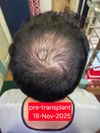
The user has been treating hair loss for 7 months using a combination of pyrilutamide, a topical mix of finasteride and minoxidil, microneedling, a topical mix of GHK-Cu and minoxidil, ketoconazole shampoo, fish collagen peptides, zinc, and vitamin D3. Another user suggests that continuous small improvements could lead to significant hair regrowth over time.
Exosome therapy for hair loss is questioned for its effectiveness and authenticity. Users express skepticism, citing manipulated photos and high costs.
The user shared progress on hair regrowth after 7 months using Minoxidil 5% twice daily, Finasteride 1mg once daily, vitamin D3, and Neurobion injections. They encouraged others to persist with their treatments, noting visible improvements and expecting further gains.
ET-02, a new hair loss treatment, shows promising results with a 6-fold increase in hair count, potentially outperforming minoxidil by activating stem cells in hair follicles. Further trials are ongoing to confirm its efficacy and safety, with potential market release in the future.
The user has been using topical minoxidil for over a year and added kx826/pyrilutamide to improve hair growth, avoiding finasteride due to side effects like lowered libido and panic attacks. They report positive results with reduced shedding and healthier hair, particularly in areas previously unresponsive to minoxidil.
A South Korean company, Therazyne, has developed a promising hair loss treatment using a WNT chain surrogate that binds to Frizzled 7, with human follicle testing expected soon. Current treatments like minoxidil and finasteride are not seen as cures, and while optimism exists for future solutions like PP405, approval processes are lengthy.
A user applied the 8T3 product for hair loss, targeting LPP and AGA, and plans to update on its effectiveness. The product uses a saline buffered phosphate vehicle, suitable for those intolerant to ethanolic vehicles.
The conversation discusses hair loss treatments, specifically mentioning Minoxidil, finasteride, and RU58841. It also references Epibiotech's hair multiplication and cell therapy as potential solutions.
Kintor Pharma completed a successful Phase II clinical trial for KX-826, a treatment for androgenetic alopecia. KX-826 is similar to finasteride with minor side effects and is more backed than Cosmerna.
A Swiss product called Redensyl, which is supposed to target hair follicle stem cells and has recently been marketed in Europe. The post inquires if anyone has had any experience with the product.
AH-001 is a new topical treatment designed to degrade androgen receptors, targeting the root cause of androgenetic alopecia without the side effects of oral treatments like finasteride. It has shown a strong safety profile and good local tolerability in early trials.
A 23-year-old male has been experiencing hair loss since 2022 and has used minoxidil and dutasteride with reduced shedding but no hair regrowth. He is considering PRP with mesotherapy and red light therapy, GFC, or exosomes, with a preference for exosomes due to efficiency and a reputable clinic.
The user is pleased with their hair transplant results after nearly 7 months, noting thicker, longer, and stronger hair with good coverage and full donor recovery. They are using oral minoxidil and finasteride.
The conversation discusses hair loss treatments, specifically Regenera stem cells and exosomes from 'Cellgenic' umbilical cord donors. The user has been using topical minoxidil 5% and 0.001% estradiol for a year without seeing effects, and another user mentions the importance of microneedling.
The user is one month into their FUE treatment and has just undergone PRP treatment at American Mane in Miami. They plan to start using minoxidil and LLT, take xpecia with saw palmetto, and try Exosome from ExoScrt and PRP for better hair growth results.
A 28-year-old male shares his 7-month progress after a crown hair transplant, using topical minoxidil foam, finasteride, and microneedling. He seeks feedback on whether his crown's progress is typical and if further thickening is expected between months 7 and 12.
A 21-year-old shared a 7-month update on using 1mg finasteride and minoxidil for hair loss, reporting positive results with no side effects except watery semen. The user initially stopped minoxidil due to inconvenience but resumed it after shedding, and is satisfied with the progress despite some thinning at the crown.
A 27-year-old shares his 7-year journey using finasteride and 4 years with minoxidil to combat hair loss, experiencing cycles of shedding and regrowth. Despite emotional challenges, he finds the treatments worthwhile, though he still faces insecurities and uncertainties about shedding phases.
Exploring different treatments for hair loss, such as cosmeRNA and HMI-115 which are small interference messenger RNA that inhibits the DHT receptor and an antibody that binds to the prolactin (PRL) receptor respectively; and researching mechanism and environment of hyperresponders.
User shared 7-month hair loss progress using finasteride, minoxidil, ketoconazole shampoo, and dermastamp. Hairline is stronger but still receding, hoping for more improvement.
A 30-year-old male successfully improved hair density over 7 years using finasteride, minoxidil, microneedling, and recently added dutasteride. He experienced no side effects and noticed significant regrowth, especially after adding minoxidil and microneedling.
A person experienced hair loss due to stress, hormonal changes, and possibly genetics, and tried treatments like minoxidil, finasteride, and dutasteride. They are now considering exosome therapy but are unsure about its effectiveness and which dermatologist to trust.
Stemson Therapeutics will start human trials for hair cloning in late 2025-2026. Product development is complete, and they are preparing for production and clinical trials.
KX-826 (Pyrilutamide) being tested in the US for hair loss treatment and that they have found enough people to participate in phase II clinical trials. Other treatments discussed are Minoxidil, finasteride, and RU58841.
The conversation discusses hair loss and queries the effectiveness of treatments like PRP, Exosome therapy, peptides, and Stem Cell therapy. Specific treatments like Minoxidil, finasteride, and RU58841 are also mentioned.
PP405 and hair cloning are discussed as potential treatments for reversing hair loss from Norwood 7 to Norwood 1. Hair cloning is seen as a more permanent solution, while PP405's effectiveness and long-term effects remain uncertain.
Exosome treatment for hair loss is being considered, but its effectiveness is questioned. The user is already using finasteride and minoxidil and is contemplating a hair transplant.
The conversation discusses disappointment with the hair loss treatment KX-826 but notes that the company Kintor is still focused on developing and commercializing it, as stated in their 2023 annual report. The user questions the effectiveness of KX-826 in comparison to minoxidil's role in improving hair thickness and appearance.