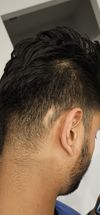
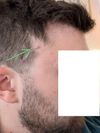
The user reintroduced RU58841 and noticed increased shedding and visible thinning. They have also been using dutasteride and oral minoxidil for 2 years.
The conversation discusses hair thinning and treatments like Minoxidil, finasteride, and RU58841. The user is concerned about distinguishing between natural hair parting and actual thinning.
Applying hair loss treatments like minoxidil and finasteride, with concerns about side effects and application timing. Some users experience side effects, while others manage without issues, and there's interest in future treatments like pyrilutamide.
A user shared progress pictures showing improvement from NW6 diffuse to NW1 after 5 months of finasteride and 2 months of dutasteride. Another user asked if these treatments affected beard or body hair thickness.
A user shared their experience with Finasteride for hair loss, noting improvement but still some thinning. They plan to get a hair transplant to address remaining thin spots and strengthen their hairline.
The user is using topical dutasteride, finasteride, minoxidil, and tretinoin but seeing no results or side effects. They also microneedle every two weeks but experience little bleeding, questioning if a thick scalp is preventing treatment effectiveness.
The user is considering a hair transplant for frontal temple density but is concerned about shock loss. They have been using finasteride for about two years and are advised to consider minoxidil and microneedling for better results.
GT20029 showed significant hair growth and safety in phase II trials, with no adverse sexual events. Users are hopeful but concerned about future costs and systemic effects.
Pelage Pharmaceuticals raised $120M for their hair loss treatment, PP405, showing strong investor confidence despite limited data. There is skepticism about its efficacy and long-term effects compared to treatments like GT20029.
Hair loss discussion focused on 2% Fluridil's peak efficacy at 3 months and 7% Fluridil group buy results, including shedding decrease, side effects, and regrowth.
The user is using Minoxidil 5% foam in the morning and a Minoxidil 5% + Finasteride 1% solution in the evening for hair loss. They are seeking advice on additional topical treatments to use midday, such as caffeine serums, peptides, Redensyl, or natural anti-inflammatories.
The conversation is about a user's hair loss treatment regimen, which includes Dutasteride, oral Minoxidil, topical Dutasteride, Minoxidil sulfate, antioxidants, and various supplements. The user is also using a derma stamp and has paused Tretinoin due to a TCA peel recovery.
The conversation discusses Breezula, a hair loss treatment, and its Phase 3 clinical trial recruitment at 50 locations. Specific treatments mentioned include Minoxidil, Finasteride, and RU58841.
PP405 shows promise in activating dormant hair follicles and increasing hair counts but lacks detailed efficacy data compared to minoxidil and finasteride. Opinions are mixed, with some optimism and skepticism about its effectiveness.
The use of tropoelastin injections and verteporfin for hair transplant recipients to help regrow donor area hairs, as well as research done on tropoelastin injections restoring elastin in scarred heart tissue and skin. There are discussions about why it is taking so long to get cosmetic mass produced tropoelastin injectables on the market.
A user has been losing hair for two and a half years after a tropical trip and illness. A dermatologist prescribed betamethasone valerate 0.1% lotion, but the user is unsure if it's safe or effective for general hair loss.
A user plans to order Pyrilutamide for hair loss after losing ground on finasteride. Another user advises against buying from Hairliciously, suggesting Amazon instead.
The user is using topical finasteride, Bioscalin, Omega 3, and hair filler therapy for hair loss. There is some progress noted, but varying photo angles and lighting make it hard to assess fully.
Phase II for TDM-105795 for Androgenic Alopecia is set to begin in April 2023. The study aims to evaluate the efficacy and safety of TDM-105795 in male subjects.
The post and conversation discuss the unpredictable nature of diffuse thinning, a type of hair loss. Users share personal experiences, with some mentioning treatments like oral finasteride and toppik, and the need for patience with these treatments.
Pelage, backed by Google Ventures, is seen as a promising company potentially finding a cure for hair loss using stem cell activation. There is skepticism and optimism among users, with some awaiting results from ongoing trials.
Minoxidil is applied beyond the crown, including the hairline and other areas, despite labels suggesting crown use only. Users report success with broader application, and some prefer oral minoxidil for convenience.
Treatments used to prevent and treat male pattern baldness, the difficulty in finding a permanent cure for hair loss, and the potential financial motivations of companies not wanting to find a cure.
The user is currently using alfatradiol and fluridil for hair loss and is considering adding low-dose topical finasteride but is concerned about potential side effects due to past mental health issues. They are seeking others' experiences with these treatments and their effectiveness.
Pyrilutamide is a selective AR antagonist with a high binding affinity, making it effective in competing with DHT for androgen receptors. The 1% concentration is more effective than the 0.5%, but the latter may suffice for mild hair loss; the drug is considered a good option for those avoiding 5AR blockers due to side effects.
The conversation discusses a small patch of missing hair and whether treatments like Minoxidil, finasteride, or RU58841 could help. The user is seeking advice on addressing this specific hair issue.
The conversation is about creating a topical hair loss treatment with B6, zinc, and azelaic acid, which is claimed to inhibit 90% of scalp DHT. One user is skeptical about the effectiveness of this treatment and its comparison to other treatments without side effects.
The conversation humorously discusses hair loss treatments, specifically mentioning Minoxidil, finasteride, and RU58841. It highlights a funny brand name found on Amazon related to derma stamps.