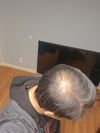
The user has been taking oral finasteride 1.25mg daily for 9 months but is still experiencing hair recession. They plan to try topical minoxidil and consider oral minoxidil and dutasteride if needed.
The user tried LLLT laser treatment for hair loss, noticing less hair shedding and thicker hair after six months, emphasizing consistency and gentle scalp care. Other users questioned the authenticity of the post and inquired about the frequency and type of device used.
The user has been using topical minoxidil and microneedling for 4 months and added finasteride 1mg daily for 1 month, but progress has stopped. Others suggest continuing treatment as hair growth cycles are slow and results may take up to a year.
A 47-year-old used finasteride and minoxidil for a year without results and is concerned about whether it's too late to regrow hair. Another user suggests continuing the treatments and adding microneedling for potentially better results, emphasizing patience.
A user is considering starting finasteride to prevent further hair loss and is unsure whether to add minoxidil immediately or later. They plan to try finasteride alone first to assess its effectiveness and consider adding minoxidil later if needed for regrowth.
Stopping dutasteride for a year caused significant hair loss, and resuming it with oral minoxidil led to only partial recovery. Users discuss treatments like finasteride, microneedling, and RU58841, noting mixed results and side effects.
Hair loss is influenced by scalp tension, stress, and environmental factors, not just hormones. Treatments like tretinoin, microneedling, scalp massage, and Botox can reduce tension and improve hair health.
Microneedling may still be beneficial for those on oral minoxidil due to its effects on tissue repair and blood flow, not just absorption. Some users report mixed results, and the effectiveness of combining microneedling with oral treatments remains debated.
The conversation is about a user's one-year hair loss treatment using dutasteride, oral and topical minoxidil, ketoconazole, tretinoin, and PRP. Users discuss treatment effectiveness, potential issues with diffuse thinning, and sourcing affordable treatments.
Microneedling is still considered effective for hair growth, especially when combined with minoxidil, though it is time-consuming. Some users report significant success with consistent use, while others find it less popular due to the effort required compared to topical treatments alone.
Some people may not respond to topical minoxidil due to low SULT1A1 enzyme activity, but oral minoxidil can be effective. Tretinoin may enhance minoxidil's effectiveness, and some users prefer oral minoxidil despite side effects.
A user experienced burning, itching, and soreness on their scalp after a perm in 2021, despite using oral finasteride, oral minoxidil, and ketoconazole shampoo. They are seeking advice on whether to pursue further medical tests or consult a neurologist for nerve pain.
The conversation discusses hair care tips and product recommendations for hair growth, including red light therapy, The Ordinary hair density serum, Nizoral shampoo, and Minoxidil. It also covers nutrition, stress management, and the importance of blood work for addressing hair loss.
The user experienced hair loss and initially saw improvement with Finasteride but is now considering switching to Dutasteride due to lack of recent results. They plan to add topical Minoxidil and are awaiting biopsy results to determine the cause of hair loss.
A 21-year-old male has been using dutasteride, minoxidil, ketoconazole shampoo, and microneedling for hair loss, with plans to increase minoxidil dosage. He is experiencing no side effects and is planning a trichoscopy to assess hair regrowth.
Dutasteride can slow hair loss and potentially stabilize it, but results vary by individual. Minoxidil and dutasteride may lose effectiveness over time, and hair loss might continue despite treatment.
Dr. Muñoz's discovery suggests that targeting potassium channels in fibroblasts could reactivate hair growth, offering new treatment possibilities for alopecia. Potential strategies include using minoxidil, diazoxide, and other potassium channel openers, as well as bioelectric devices and direct growth factor applications.
Stopping hair loss treatments like finasteride and minoxidil can result in losing regrown hair, highlighting the importance of consistent use. Restarting these treatments may cause temporary shedding, but hair can regrow with continued use.
Finasteride, dutasteride, saw palmetto, caffeine, spironolactone, acetyltetrapeptides, tea tree oil, hydrocortisone, zinc pyrithione, latanoprost, melatonin, marine protein supplements, PRP, microneedling, and valproate are discussed as treatments for hair loss. DHT reduction and inflammation control are key strategies.
A 21-year-old male is concerned about hair loss, particularly his hairline, and is considering using minoxidil and finasteride but is unsure about the safety of finasteride. He is seeking opinions on these treatments to maintain his hair through his 20s.
The conversation discusses whether finasteride and minoxidil can help regrow hair at the corners, with one user suggesting that recovery is possible even from worse conditions.
The conversation is about a user experiencing hair shedding after starting a treatment with oral minoxidil, topical minoxidil, and finasteride. Other users reassure that shedding is normal and part of the process, suggesting it will lead to stronger hair growth.
The user is considering switching from Finasteride to Dutasteride for better hair regrowth, despite concerns about potential shedding and side effects. Opinions vary, with some suggesting the switch for stronger results and others advising caution due to possible side effects and the importance of consulting a doctor.
Finasteride is effective for DHT/AR-driven hair loss but not for chromosome 20-driven cases, where treatments like minoxidil, prostaglandin analogs, and low-level laser therapy may be more beneficial. Genetic testing can help determine the underlying cause of hair loss to tailor treatment effectively.
The conversation humorously suggests that the hair loss industry, referred to as "Big Bald," deliberately delays a cure to profit from ongoing treatments like minoxidil, finasteride, and dutasteride. Participants debate whether a cure would be more profitable than current treatments, with some suggesting that the industry prefers continuous treatments for sustained profit.
The conversation discusses hair loss treatments, specifically the use of dutasteride, finasteride, and the potential of mesotherapy. The user experiences hair loss despite low DHT levels and considers localized dutasteride treatment, while others suggest consulting a dermatologist and exploring other causes like malabsorption.
A 21-year-old male recently had a hair transplant and is considering starting finasteride to prevent further hair loss. Finasteride can be started immediately to maintain existing hair, with potential side effects like decreased libido, and results may take several months.
Microneedling before applying topical finasteride or dutasteride may enhance their effectiveness by increasing local absorption in the scalp, despite concerns about systemic absorption. Users discuss combining this method with oral treatments and minoxidil, noting potential benefits and side effects.
Oral Dutasteride and topical Finasteride may have similar effects on scalp DHT, but topical Dutasteride might be less effective due to poor absorption. Combining oral Dutasteride with topical Finasteride could potentially enhance results by blocking DHT in both the scalp and serum.
PP405 and hair cloning are discussed as potential treatments for reversing hair loss from Norwood 7 to Norwood 1. Hair cloning is seen as a more permanent solution, while PP405's effectiveness and long-term effects remain uncertain.