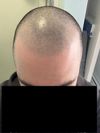
OP underwent a hair transplant (HT) and has been using finasteride for one year. Despite having thin hair, OP is happy with the results and feels more confident.
Hair loss without a white bulb may indicate mechanical damage, anagen effluvium, alopecia areata, or traction alopecia. Seeking a specialist is recommended, but access can be difficult in smaller areas.
A 7-month update from Markoj44 regarding their hair transplant results, which includes the use of topical finasteride and minoxidil in combination with Viviscal, biotin, Nizoral shampoo, and donor area photos. People responded positively to the post.
The user has been using minoxidil and finasteride for 7.5 months to address hair thinning, particularly at the crown and temples, and is considering additional treatments like tretinoin and dermastamping despite having chronic scalp folliculitis. They are experiencing progress but are concerned about side effects and the effectiveness of treatments on temple regrowth.
The user has tried various hair loss treatments including topical minoxidil, oral finasteride, oral dutasteride, oral minoxidil, and exosome therapy, but none have been effective. They suspect trichodynia might be preventing these treatments from working.
Hair loss treatment progress with Dut, Min, Keto, needling, and RU/Min/Fin/Dut topical. User noticed improvement, believes RU and needling most effective.
The user experienced significant hair loss after extended fasting, initially thought to be Telogen Effluvium, but later suspected male pattern baldness. They tried finasteride briefly but stopped due to concerns about side effects, and are unsure if the hair loss is due to Telogen Effluvium or another cause.
A hair transplant of 3361 grafts, 11.5 months after the procedure, that resulted in a very natural looking NW1 hairline; the person who underwent this procedure has not experienced any hair loss and is expecting to have no future hairloss either.
A bodybuilder's hair transplant appears unnatural with a straight hairline and low density, possibly worsened by not using finasteride. The Turkish clinic is criticized for poor design, and the transplant may have been free for promotion.
User experienced hair loss after weight lifting, had a successful hair transplant, but later faced significant thinning. Current treatment includes finasteride, minoxidil, dermal rolling, and supplements.
The user experienced significant hair regrowth using finasteride, minoxidil, and a 4,000-graft hair transplant performed by Dr. Nader in Reynosa, Mexico. The results were natural-looking, and the user plans a second transplant for additional density if needed.
A 21-year-old is considering a hair transplant in Turkey due to aggressive hair loss and scalp psoriasis, but is advised to try finasteride and minoxidil for at least a year to stabilize hair loss before proceeding. The user is concerned about side effects but plans to consult a dermatologist and possibly start finasteride.
The conversation is about hair loss treatment progress using finasteride and GHK-CU over six months. Users discuss application methods and share experiences with GHK-CU and AHK.
A 35-year-old had a hair transplant with 3,153 grafts at HLC Ankara, experiencing some pain and numbness but pleased with the density and results. The procedure cost $10,000, and the user has been using finasteride for over 13 years.
The user has been microneedling weekly for almost 8 months without seeing progress and is experiencing shedding. They are also using finasteride daily and Kirkland minoxidil twice a day, and had a hair transplant after starting finasteride.
The user experienced regrowth and stabilization in hair density using finasteride, minoxidil, a derma roller, and an LLLT helmet, but noticed a recent decline in hair quality. They only take finasteride orally and are unsure about the effectiveness of the LLLT device.
A 21-year-old is experiencing aggressive hair loss despite using minoxidil, dutasteride, and GFC, and is seeking advice on whether to switch treatments or consider a hair transplant. Suggestions include continuing current treatments, checking for underlying health issues, and considering alternatives like RU58841 or microneedling.
A 28-year-old used oral finasteride and minoxidil, and underwent two hair transplants in Turkey, with a total of 3150 grafts, resulting in a natural-looking hairline. The first procedure cost £3300, and the second was a free touch-up, with additional costs for flights and accommodation.
The conversation discusses potential future hair loss treatments, including SCUBE3, hair follicle cloning, and GT20029, with mentions of past disappointments like CosmeRNA and hopes for treatments like Verteporfin for infinite donor hair.
Combining microneedling with Low Level Laser Therapy (LLLT) for hair growth, with discussions on device legitimacy and effectiveness. Alternatives like PEMF and the use of oral and topical treatments such as dutasteride, minoxidil, and finasteride are also considered.
David Barreto shared that a London-based research group is conducting a 12-month trial for a new nutraceutical treatment for pattern hair loss, designed with Dr. Carlos Puig. The trial aims to provide robust data, with results expected in 1-2 years, potentially representing a significant advancement since finasteride’s introduction in 1997.
A person had a hair transplant at Diamond Hair Clinic with Dr. Mehmet Demircioglu using the Sapphire FUE method with 4500 grafts. They are using Duasteride, oral and topical Minoxidil, and vitamins for recovery and hair growth.
BackToTheFutehair's 3.5 month progress update on their hair loss treatment regimen of finasteride, minoxidil, and microneedling which has led to a significant improvement in thickness and life to the hair. Others have provided encouragement and advice for future treatments.
A 24-year-old male using topical finasteride for hair loss is experiencing thinning despite treatment and has high estrogen levels. He is seeking advice on whether high estrogen could be causing hair loss and how others with high estrogen levels have addressed it.
The user is undergoing Mesotherapy and Low-Level Laser Therapy for hair loss, with plans for multiple sessions. They are also using oral finasteride, topical minoxidil, dutasteride, and hair fibers.
Adding exosomes to a treatment of dutasteride and minoxidil for hair loss increased hair count by 55% at 6 months and 46% at 1 year compared to the control group. The control group did not receive exosomes or PRP.
A user is considering exosome therapy from Springs Rejuvenation for hair loss after unsuccessful attempts with PRP, adipose injections, and a laser cap. They are intrigued by the therapy's potential and the clinic's guarantee of 30% improved coverage, despite concerns about FDA approval and high-pressure sales tactics.
A 36-year-old had a hair transplant with 6,500 grafts 7 months ago, took 1.25mg of finasteride every other day for 5 months, and recently switched to 1mg daily along with 5% minoxidil spray. They are considering a touch-up transplant and are seeking advice on their progress and future expectations.
The user used 0.5 mL of 0.5 mg of Pyrilutamide for 60 days for hair loss, but didn't notice any hair growth. They shared their hormone panel results and are seeking advice on next steps.
The user is experiencing severe hair loss after surgery and stress, with thinning all over the head, including the sides and neck. They are unsure if it's due to DUPA or alopecia areata incognita, and doctors have not observed miniaturization.