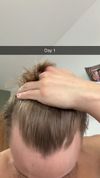
A 22-year-old male is on day 77 of using 1 mg finasteride for hair loss. He reports decreased oiliness and shedding but is unsure about overall progress.
User shared progress pictures 4 months after a hair transplant in Turkey, detailing the use of dermarolling, vitamins, and starting finasteride while avoiding minoxidil. They are happy with the results so far and hope for further improvement.
The user reported solid results after 5 months of using 1.25mg finasteride daily, with minimal sexual side effects and some hair regrowth at the hairline. They discontinued minoxidil due to its greasy effect on their hair.
A user is excited to start using Pyriltamide for hair loss after experiencing side effects from topical finasteride. Other users discuss the potential and skepticism of Pyriltamide compared to older treatments like finasteride and RU58841.
The user is using a hair loss treatment regimen that includes RU58841, minoxidil mixed with finasteride, adenosine, dermarolling with lidocaine cream, and biotin. They are questioning if they are dermarolling too aggressively and are willing to accept baldness if no improvement is seen in 6 months.
The conversation is about dealing with hair shedding due to seborrheic dermatitis and recent illness. Recommendations include treating seborrheic dermatitis with ketoconazole, correcting vitamin D deficiency, and improving sleep.
A user is considering using finasteride for a receding hairline at age 22, preferring not to use minoxidil. Another user suggests finasteride can help maintain and thicken existing hair but is less effective for regrowth without minoxidil.
The conversation discusses hair loss treatments, with a focus on the use of finasteride, minoxidil, laser treatment helmets, and Redensyl. Opinions vary on the effectiveness and side effects of finasteride, with some users advocating for its use despite potential risks, while others express concerns about its impact on sexual function.
Dutasteride is more effective than finasteride for hair loss, especially at the crown and midscalp, but both have similar side-effect profiles with low incidence of sexual adverse events. Improvement is measured visually, and significant results may take over 12 months to appear.
The conversation is about a person's slow progress in treating hair loss using finasteride, microneedling, testosterone replacement therapy, dutasteride, RU58841, and minoxidil. They experienced a significant hair shed after adding dutasteride.
A user shared their two-year progress using finasteride 1mg daily for hair recovery, noting significant improvement with minimal side effects like a slight decrease in libido. They initially tried microneedling weekly for six months but discontinued it, and they are now experimenting with reducing the finasteride dose to 0.5mg daily.
Increasing the finasteride dosage from 1mg every other day to 1mg daily can cause increased shedding, which is normal as hair follicles adjust. Shedding may stabilize in a few weeks to months, and sticking with the new dosage could lead to better long-term results.
The user experienced increased hair shedding after switching from finasteride to dutasteride, despite lifestyle improvements and additional treatments like oral minoxidil and PRP. They are concerned about persistent shedding, changes in hormone levels, and potential chronic telogen effluvium, and are considering a scalp biopsy for further investigation.
The conversation is about someone looking for a single product that combines finasteride, minoxidil, and tretinoin for hair loss treatment. They are asking if it exists, where to find it, and if it's available without a prescription.
A user shared progress pictures after 6 months of using oral finasteride, minoxidil, ketoconazole, and occasional derma rolling for hair loss. Another user complimented the hair improvement but suggested a different hairstyle.
The conversation is about a user sharing their 3-month progress with finasteride, minoxidil, and weekly derma rolling for hair loss. Some suggest buzzing the hair off to better apply treatments and consider a hair transplant in the future.
The user experienced a sudden and severe hair loss after 1.5 years of successful treatment with finasteride and minoxidil. They plan to check their thyroid and vitamin D levels as potential causes.
The conversation discusses two methods for making topical finasteride: using ethanol and propylene glycol or mixing it with topical minoxidil. The focus is on solubility and absorption, with a suggestion to crush pills finely and possibly mix with minoxidil at a slightly elevated temperature.
Neofollics lotion is discussed as a hair loss treatment, but users report it is ineffective and not supported by strong evidence. Users suggest sticking to FDA-approved treatments like Minoxidil and Finasteride.
A 42-year-old user shares progress on hair loss treatment using finasteride, topical minoxidil, and dermarolling. They seek advice on obtaining Minoxidil pills in Europe.
A user shared their positive experience using a cheap dermastamp from Aliexpress for microneedling, finding it effective and mostly painless. Other users discussed their experiences with similar products, cleaning methods, and needle lengths, with some noting differences in product quality between sellers.
The post is about using different solutions for RU58841, a treatment for hair loss. The user is asking for opinions on the effectiveness of different vehicles and dosages.
LagRag revived their hair using finasteride, minoxidil, derma rolling, dermapen, and biotin shampoo. Users discussed the effectiveness and requested photos with different hair positions.
The user experienced hair regrowth and stabilization at Norwood 2 using natural remedies like pumpkin seed oil, rosemary oil, vitamins, and scalp massages, avoiding minoxidil and finasteride due to side effects. Another user suggested starting topical finasteride earlier to prevent further hair loss.
Efforts to find a Canadian dermatologist in the US to prescribe H&W's topical finasteride for hair loss. The user is willing to fund a crowd-share effort to identify prospects.
A user found a successful hair loss treatment using a combination of finasteride, dutasteride, minoxidil, and RU58841. They plan to switch to a purely topical regimen with finasteride, RU58841, and minoxidil.
Fluridil was discussed as a hair loss treatment, with some users experiencing side effects like lethargy and chest tightness. Users also mentioned other treatments like RU58841 and finasteride, with mixed opinions on their effectiveness.
The user has been using finasteride for 4 years and minoxidil for 1 year, with a recent break from minoxidil due to shedding concerns. They resumed minoxidil and started dutasteride 3 times a week, but are experiencing increased hair shedding.
Temporal peaks are crucial for a natural-looking hair transplant, but they are challenging to achieve due to the need for precise angles and appropriate hair thickness. Many users emphasize the importance of finding a skilled surgeon and using finasteride to maintain hairline stability.