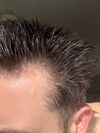
A user is frustrated about early balding despite older male relatives retaining hair into old age. Another user plans to start finasteride soon to address their hair thinning.
KX-826 is undergoing Phase III trials in China as a potential treatment for male pattern baldness, with some users considering it as an alternative or addition to finasteride and dutasteride. Opinions on its effectiveness vary, with some users reporting positive results and others finding it expensive and ineffective.
PP405 and hair cloning are discussed as potential treatments for reversing hair loss from Norwood 7 to Norwood 1. Hair cloning is seen as a more permanent solution, while PP405's effectiveness and long-term effects remain uncertain.
Hair loss treatments, specifically about the effectiveness of RU58841 compared to Pyrilutamide. Molecular weights and side effects were discussed in terms of efficacy and cost-effectiveness.
A user shared their baseline bloodwork results before starting Finasteride 1mg every other day, seeking comparison with others who have done similar tests. They are interested in any changes observed after beginning the treatment.
The conversation discusses the potential availability of a new hair loss treatment, GT20029, on the grey market, with users suggesting it could be within a year but advising against using grey market products due to safety concerns and complexity of the drug.
RU58841 is discussed as a potential hair loss treatment, with comparisons to finasteride. There is interest in leaked trial data, but no official clinical validation or approval for RU58841.
A female with male-pattern hair loss (AGA) is seeking help after unsuccessful treatments with spironolactone and supplements, and is considering oral minoxidil and finasteride despite concerns about medication side effects. She has ruled out hormonal birth control and PRP/PRFM, and is looking into further medical advice due to abnormal lab results.
The conversation discusses potential advancements in two hair loss drugs, KX-826 and GT20029, and the interest in whether transitioning from oral finasteride to these drugs would maintain hair growth. One reply expresses skepticism about the compounds' representation.
GT20029 and KX826 are promising hair loss treatments, with GT20029 increasing hair count and KX826 showing significant results. KX826 may be a good alternative for those who can't use finasteride or dutasteride, though results vary.
The conversation is about the progress and development of a hair loss treatment called GT20029. People are discussing updates on its status and speculating on how long it will take to become available.
The post discusses the potential of GT20029 in treating hair loss, questioning if it will replace finasteride or be used alongside existing treatments. A reply indicates that its role is still uncertain.
The conversation is about the availability of the research chemical GT20029 for hair loss treatment and when companies like Anageninc will have it. Specific treatments mentioned include Minoxidil, Finasteride, and RU58841.
The conversation discusses potential new treatments for androgenetic alopecia (AGA), including verteporfin, pyrilutamide, and hair cloning. There is optimism about scientific advancements providing alternatives to minoxidil and finasteride.
A Phase 1 update for the HMI 115 clinical trial, which involves 16 participants and is expected to end in July 2023; as well as changes to the recruitment process, including treatment protocols with Minoxidil, Finasteride, and RU58841.
GHK-RU58841 is used for hair loss, with positive results when combined with finasteride, stemoxydine, redensyl, and alfatradiol. Users report effectiveness after adding finasteride.
Hair loss is linked to cellular physiology and the IGF-1 to TGF-B1 ratio, not just androgen sensitivity. The theory lacks evidence, while finasteride and minoxidil are effective treatments.
Recruitment for a verteporfin trial and a separate hair cloning trial using verteporfin and other methods is underway, with locations in Jordan, NYC, Beverly Hills, and Memphis. Dr. Bloxham is conducting the hair cloning trial, and interested participants are encouraged to contact him directly.
The conversation is about using Biolabshop's RU58841 product, which includes GHK-Cu and melatonin, to improve hair quality and combat hair loss. The user has previously used finasteride, minoxidil, and Anageninc’s RU58841 with success and seeks feedback on the new product, especially from those on anabolic steroids or hormone treatments.
The conversation discusses the anticipation and skepticism around the release of GT20029 for hair loss treatment. The original poster has been using Finasteride and Minoxidil but is hopeful for GT20029, while others express doubts about its timely release and suggest alternatives like KX826 and hair transplants.
A woman with AGA is using spironolactone, dutasteride, finasteride, oral minoxidil, bicalutamide, and anti-androgenic birth control but still experiences worsening hair loss. Steroid shots temporarily stop her hair shedding, leading her to question her biopsy results.
The user is considering blood tests to understand their receding hairline and is exploring brewer's yeast for its biotin content. They have been using topical Minoxidil, biotin, collagen, and microneedling, but are avoiding oral Finasteride and Dutasteride.
The user is experiencing irritation from using PG with RU58841 and is seeking alternative solutions like K&B in the UK. They report redness, itchiness, and flaky skin from the current treatment.
GT20029 and CosmeRNA are both potential hair loss treatments; GT20029 breaks down the androgen receptor, while CosmeRNA prevents its production. Continuous use is needed, but less frequently than current treatments like Minoxidil and Finasteride.
The conversation discusses the safety and trustworthiness of ordering RU58841 from Lyphar Biotech in China, with a focus on pricing and reliability. The user is seeking advice on whether to proceed with the purchase or consider alternative sources.
A 33-year-old male is experiencing thinning at the temples and hairline, with increased shedding over the past year. The user suspects androgenetic alopecia (AGA) despite AI suggesting a maturing hairline.