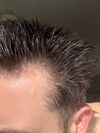
A user is using 1ml/day of Dualgen-15 (15% Minoxidil, caffeine, retinol, azaleic acid, Adenosine, biotin, niacin) on their temples and asks if Minoxidil alone can completely regrow their temples.
Stem cell therapy shows promise in treating hair loss by mimicking DHT-resistant cells from the back of the head. Traditional treatments like finasteride are also discussed, but stem cells could potentially offer a more permanent solution.
A user applied the 8T3 product for hair loss, targeting LPP and AGA, and plans to update on its effectiveness. The product uses a saline buffered phosphate vehicle, suitable for those intolerant to ethanolic vehicles.
A gel of keratin microspheres promotes hair follicle growth, showing similar effectiveness to minoxidil in mice. The treatment activates hair growth pathways and reduces inflammation, with potential applications in drug delivery for hair-related disorders.
A dermatologist recommended PRP (Platelet Rich Plasma) and GFC (Growth Factor Concentrate) for pattern baldness, but online sources suggest they may not be effective. The user is seeking opinions on these treatments.
A 33-year-old male is experiencing thinning at the temples and hairline, with increased shedding over the past year. The user suspects androgenetic alopecia (AGA) despite AI suggesting a maturing hairline.
The user experienced new hair growth after switching from oral finasteride to topical RU58841 with minoxidil and undergoing stem cell therapy. They noticed new hairs at the hairline and temples, but are unsure which treatment is responsible.
Chinese researchers have successfully created hair follicles in vitro, potentially offering unlimited hair for transplantation and a cure for hair loss. They plan to test these follicles in vivo on human scalps.
Hair cell therapy and follicle cloning are still in experimental stages, with treatments like hair multiplication and regenerative hair therapy being marketed but not yet proven to create unlimited new follicles. There is skepticism about the effectiveness and legitimacy of these treatments, with some considering them scams.
Breezula's phase 3 results are expected soon, with discussions on the effectiveness of androgen receptor antagonists like spironolactone and the potential of GT20029. Users express skepticism about new treatments and discuss the complexities of male pattern baldness, often relying on finasteride despite its side effects.
The conversation is about a female experiencing hair loss and seeking advice on why it's difficult to regrow hair. Specific treatments like Minoxidil, finasteride, or RU58841 are not mentioned.
Follicum discovered that their drug FOL-005 increased hair count by 12 hairs per cm2 in patients with less than 255 hairs per cm2 and is planning a phase 2b trial. They are currently fundraising for the trial, and the drug may also be effective for women.
Hair loss and its potential treatments, such as minoxidil, finasteride, RU58841, dermarolling, and supplements. It discusses whether miniaturized follicles can be revived to grow again or must shed for new growth to appear.
Hair loss treatment should target dermal white adipose tissue (DWAT) to restore hair follicles. Potential remedies include tocopherol (vitamin E), botox, rosiglitazone, niacin, kojyl cinnamate esters, and ADP355.
PP405 shows promise for hair regrowth by manipulating stem cell characteristics and lactate dehydrogenase, with Phase 2a trials pending. Google Ventures' $15M investment suggests confidence, but results and market availability remain uncertain.
Epibiotech will offer off-the-shelf allogeneic hair multiplication treatment in South Korea, using dermal papilla cells from donors to grow hair in balding areas. This method is cheaper and less invasive than traditional hair transplants.
MCL-1 is important for hair follicle stem cell survival, but its impact on human hair regrowth is unclear. Minoxidil and finasteride are the main treatments, with doubts about new discoveries leading to effective human solutions soon.
A healthy scalp barrier is crucial for hair growth, and ceramides may play a key role in maintaining it. The conversation suggests that focusing on scalp health, alongside treatments like Minoxidil, Finasteride, and RU58841, could improve hair follicle health.
The conversation is about whether treatments like finasteride, dutasteride, and minoxidil can make single hair follicles produce multiple hairs again. The user is curious if these medications can thicken hair and prolong the growth phase.
The user discusses a galenic hair lotion containing progesterone, estradiol, cyproterone, hydrocortisone butyrate, and cetirizine pheniramine, which has effectively stopped their hair loss over two years. They are curious about the compatibility of finasteride with the lotion's components and note that their trichologist has successfully used minoxidil and finasteride in similar treatments for others.
Treating hair loss with various remedies, such as Cetirizine and the Big3 complex (minoxidil, finasteride, and RU58841), which have properties like adipogenic, anti-fibrotic and anti-inflammatory. References to research studies are also included.
The conversation is about the potential of SCUBE3 to regrow a juvenile hairline. Specific treatments mentioned include Minoxidil, Finasteride, and RU58841.
Probiotics like L. reuteri ATCC PTA 6475 and B. longum BB536 may improve hair growth and density by reducing inflammation and reversing DHT damage. The user is trialing these probiotics personally, ordering them from the U.S. to Canada, and plans to continue if no adverse effects occur.
A human trial involving verteporfin for hair regeneration, with the results showing some regrowth of 1-2 hairs in an area where a follicular unit was extracted. The conversation also suggested that future studies should involve higher doses and more frequent injections.
Hair loss treatments like finasteride, minoxidil, and hair transplants have side effects and limitations. There is hope for future advancements in stem cell therapy and hair follicle regeneration, though skepticism about their effectiveness and timeline persists.
Microneedling may help regrow hair in dormant bald regions by stimulating stem cell transfer. Users discuss its effectiveness and how collagen might aid in the process.
PP405 shows promise for hair regrowth, with new hairs observed in 66% of patients in just 27 days. The discussion also mentions Minoxidil, finasteride, and RU58841 as potential treatments.
Dr. Kang-Yell Choi's company, CK Regeon, is developing a drug called KY19382 for hair regeneration, which involves creating fine wounds to activate stem cells. The drug is in the formulation development stage, targeting markets like the US and Korea.
A user shared their positive experience with Trichogenics for hair restoration, highlighting their unique zigzag hairline technique and personalized attention. They had 1700 follicles transplanted and praised the natural results.