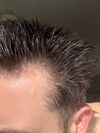
A user is participating in a phase 3 trial for Clascoterone, a topical acne medication that may stimulate hair growth, and will share results after 6 months. They will have a section of their hair shaved and marked with a tattoo for the study.
Pelage is developing a topical hair follicle stem cell therapy, PP405, for non-scarring alopecias like androgenetic alopecia, with Phase III trials planned and a potential market launch by 2027. The treatment may not require continuous use after initial regrowth.
Creatine may affect hair loss by reducing PGE2 levels, which could influence hair growth. The discussion highlights the need for more research on this potential mechanism.
The conversation humorously discusses using off-label drugs like Minoxidil, finasteride, and RU58841 for hair growth. It jokes about the brain absorbing these treatments for maximum keratin production.
The user experienced side effects from finasteride and is considering switching to dutasteride, while also using pyrilutamide to protect hair follicles. They are seeking advice on whether to add RU58841 to their regimen.
The post discusses the use of latanoprost foam for hair growth, with the user expressing concerns about its efficiency and safety. The user is currently using topical dutasteride, which maintains their hair but doesn't promote regrowth, and is seeking a product that doesn't affect hormone levels.
The conversation discusses hair regrowth progress after 2.5 months using pyrilutamide and minoxidil. Participants note visible improvement in a short time.
The user increased their steroid dosage and noticed hair shedding, so they adjusted their regimen by reducing steroid doses and adding oral dutasteride. They are also experimenting with combining RU-58841 and KX-826/pyrilutamide in minoxidil to address hair loss.
Fluridil may decrease the number of androgen receptors in hair follicles by up to 95%. This suggests a different action mechanism from other non-steroidal antiandrogens like RU58841, indicating they might be used together.
A Spanish dermatologist suggests sulforaphane for androgenetic alopecia (AGA) due to its potential to remove DHT metabolites, though high dosages are needed. A topical formulation might be possible.
Pelage Pharmaceuticals' PP405 aims to treat hair loss by reactivating dormant hair follicle stem cells, showing promising results in early trials. The company plans to present their findings at the American Academy of Dermatology Annual Meeting in 2026.
TDM-105795 showed promising hair growth results, with higher efficacy than placebo and minimal side effects. It activates dormant hair follicle stem cells and may maintain gains without immediate loss, unlike minoxidil.
Clascoterone is promising for hair loss, showing 24.5% improvement in satisfaction compared to placebo. Users consider it an alternative to finasteride, with concerns about absorption and side effects.
PP405, a potential hair loss treatment, is facing delays in releasing Phase 2 results, causing frustration among users who compare it to past failed treatments. Despite skepticism, some remain hopeful about PP405's future, while others discuss alternative treatments like Clascoterone and its expected market release.
It's safe to take oral dutasteride with pyrilutamide, as many use 5-alpha-reductase inhibitors with topical antiandrogens for better results. Avoid ingesting pyrilutamide.
Pelage Pharmaceuticals announced positive Phase 2a trial results for PP405 in hair loss therapy. The conversation discusses the delay in publishing full results and the need for further trials and approvals.
The conversation discusses the approval of Kintor Pharmaceutical's AR-PROTAC (GT20029) for clinical trials in China for acne and androgenic alopecia. One user expresses optimism about new treatments being developed and seeks clarification on how the new drug works, specifically if it temporarily degrades the AR protein to reduce DHT sensitivity in hair follicles.
Exploring hair loss treatments beyond DHT, including Minoxidil, pyruvate, Gt20029 targeting androgen receptors, and vasodilators. Other options like Kx826, adenosine signaling, growth factor topicals, and microneedling are also discussed.
Obtaining treatments for hair loss that are not approved in one's own country, such as pyrilutamide or GT20029. It was suggested to use a middleman to get it, but there is the risk of getting low quality or fake products.
PP405 is a new hair loss treatment targeting dormant hair follicles, with ongoing trials. Some users consider stopping finasteride and minoxidil to join trials, while others doubt its effectiveness.
The conversation is about the effectiveness and safety of a hair loss treatment called Pyri, with users discussing its availability and comparing it to other treatments like RU58841, fluridil, and alfatradiol. Some users are waiting for FDA approval before using Pyri, while others share their positive experiences with RU58841 and suggest additional treatments with minimal side effects.
Breezula's phase 2 showed reduced efficacy after 6 months, but phase 3 had positive results, causing confusion about any changes made to the drug. There is frustration over the long timeline for hair loss treatments, with some users expressing more interest in other potential treatments like GT-20029.
The conversation discusses the potential role of prolactin in hair loss and mentions treatments like HMI115, mucuna pruriens, Zinc, and B6 P5P for lowering prolactin levels. It also touches on the use of natural compounds and the lack of studies due to funding issues.
The conversation discusses GT20029 as a potential hair loss treatment that could act like a cure by targeting androgen receptors in scalp hair follicles. Specific treatments mentioned include GT20029, with a user expressing hope that it could make male pattern baldness obsolete.
A user's successful hair transplant, with some people questioning the donor area regrowth, and others speculating that hair fibre may have been used to help fill in areas.
Topilutamide is a potential hair loss treatment between Clascoterone and RU58841. Users discuss finding Topilutamide powder and its possible benefits for those who can't afford or tolerate other treatments.
SCUBE3 and GT20029 are potential treatments for hair loss, with SCUBE3 stimulating hair growth and GT20029 protecting against DHT. A combined approach using SCUBE3, finasteride or dutasteride, and later GT20029 could provide a comprehensive treatment for androgenetic alopecia.
GT20029 and PP405 are discussed as potential alternatives or complements to finasteride for hair loss treatment. GT20029 is entering phase 3 trials, while PP405 is seen as promising for regrowing hair and possibly eliminating the need for other treatments.
The conversation discusses hair regrowth, with users sharing experiences and advice on using finasteride, minoxidil, and dermarolling to stimulate hair growth. Many users report seeing small hairs, which they consider a positive sign, though opinions vary on whether these hairs will develop into thicker, terminal hairs.