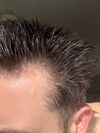
A 23-year-old male is experiencing diffuse hair loss and miniaturization, possibly due to high IGE levels after using tofacitinib. He seeks advice and has not yet consulted a dermatologist.
A 28-year-old shared surprising hair regrowth progress after 20 days using topical minoxidil, micro needling, GHK-cu, and BPC-157 injections. The user noted a significant reduction in their bald spot and overall hair improvement.
AnagenInc is ready to produce a hair loss treatment called GT20029 if there is enough demand. People are discussing combining it with other treatments like finasteride and minoxidil, and some are concerned about the legitimacy and safety of gray market products.
Hair loss treatments discussed include Minoxidil, Finasteride, and RU58841. HMI-115, a monoclonal antibody drug, is in phase 1 and 2 trials for different conditions, but its availability on the gray market is unlikely due to high production costs.
The conversation is about someone looking for specific side effects reported in clinical trials for GT20029, a hair loss treatment. No results or data were found on the clinical trials site.
Finasteride and dutasteride are discussed for hair loss, with concerns about their effects on neurosteroids and potential side effects like depression. Alternatives like topical estrogen and lifestyle changes are considered, with varying opinions on mental health and hair regrowth.
A 33-year-old male is experiencing thinning at the temples and hairline, with increased shedding over the past year. The user suspects androgenetic alopecia (AGA) despite AI suggesting a maturing hairline.
The conversation discusses the availability of GT20029, a new topical hair loss treatment with fewer side effects than Minoxidil or finasteride. Users suggest using finasteride to preserve hair until GT20029 becomes available.
The conversation discusses GT20029, a drug in Phase II trials that targets androgen receptors with minimal systemic effects, and TDM-105795, a growth stimulant with a different mechanism than minoxidil that may revive papilla stem cells. Both are potential new treatments for hair loss.
HMI 115 did not work as expected for hair regrowth in humans, unlike in macaque monkeys. There is anticipation for further research on prolactin's role in hair loss, with expectations that pharmaceutical companies will likely solve this before universities.
A user who shared progress pictures of their scalp using a microscope camera, demonstrating the difference between healthy and miniaturized hair. Various explanations for the cause of this were discussed, such as DHT build-up in scalp sebum causing an autoimmune response leading to inflammation and eventual hair loss, with some suggesting a do-it-yourself treatment involving adding ascorbic acid powder to shampoo.
The conversation humorously discusses hair loss treatments, mentioning Minoxidil, finasteride, and RU58841. It jokingly credits a person for the potential success of a treatment called GT20029.
Copper peptides, specifically GHK-Cu, are discussed as a potential addition to hair loss treatments, possibly working synergistically with Minoxidil to convert vellus hair into terminal hair. The effectiveness and credibility of copper peptides are questioned due to the lack of widespread discussion and potential conflict of interest from the product's creator.
Hair loss treatments discussed include microneedling, minoxidil, tretinoin, finasteride, dutasteride, pumpkin seeds, saw palmetto, and scalp massage. The consensus is that finasteride or dutasteride is necessary for significant regrowth, while other methods may only slow hair loss.
The conversation discusses the delay in bringing FAK inhibitors and Stanford's hydrogel to market for hair transplants, with a preference for FAK inhibitors over Verteporfin due to their superior potential in preventing scarring. The user expresses frustration over the slow progress and hopes for faster development by companies like FAKnostics.
PP405 is a safer alternative to JXL069 for hair loss treatment because it penetrates the skin effectively and degrades in the blood, avoiding systemic toxicity. JXL069, when forced into the body, can cause dangerous side effects like lactic acidosis due to its inability to degrade safely.
A dermatologist checked for hereditary hair loss using blood tests and plans to perform a trichogram. The user had slightly low Vitamin D3 levels, and the trichogram may help confirm androgenetic alopecia.
GT-20029 is discussed as a potential hair loss treatment, with concerns about its safety and systemic absorption compared to finasteride. Users express skepticism about its effectiveness and safety, noting that it may not surpass existing treatments like finasteride and minoxidil.
The conversation discusses the effectiveness of an eyebrow serum containing Myristoyl Pentapeptide and Biotinoyl Tripeptide for hair growth. The user seeks information on other topical products with similar peptides for hair growth.
The conversation is about which blood markers to test before starting a 5-AR inhibitor for hair loss. The user mentions already testing Total T, Free T, SHBG, Estradiol, Haematocrit, Red blood cell count, and White cell count, and asks if DHT or additional markers are needed.