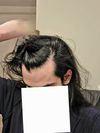
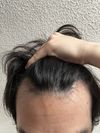
A 30-year-old male is experiencing hair loss and is concerned about his receding hairline, seeking advice on his Norwood scale classification. He is apprehensive about using Minoxidil and finasteride as treatments.
The user is trying alternative hair loss treatments like caffeine shampoo and dermarolling before considering minoxidil or other advanced treatments, and has noticed an increase in vellus hairs and some strong terminal hairs after two months of daily caffeine shampoo use. They plan to continue the treatment and document progress.
The conversation discusses a new model for understanding androgenetic alopecia (AGA), linking it to dietary and lifestyle factors similar to PCOS, and highlighting the role of DHT, vascular damage, and inflammation. Treatments mentioned include Minoxidil, finasteride, and RU58841.
A woman with AGA and CTE has been taking multiple hair loss treatments including spironolactone, dutasteride, finasteride, bicalutamide, birth control, and minoxidil without success. Steroid injections, however, dramatically and immediately stopped her hair loss, though the effect lasts less than a month.
AMP-303, a new injectable treatment for androgenetic alopecia, showed promising results in increasing hair count and density with minimal side effects. The treatment demonstrated significant hair regrowth and durability, offering new hope for those with hair loss.
Low-Level Laser Therapy (LLLT) is seen as a safe and effective method for maintaining hair and promoting regrowth in androgenetic alopecia (AGA) and male pattern baldness (MPB), with devices like the HairMax LaserComb® and iRestore helmet being popular. Some users and professionals are skeptical about its long-term effectiveness and cost.
JW0061 shows superior hair growth results compared to existing treatments, with significant increases in hair follicles. The Wnt/β-catenin pathway is crucial for hair growth, and JW0061 activates this pathway effectively.
PP405 and hair cloning are discussed as potential treatments for reversing hair loss from Norwood 7 to Norwood 1. Hair cloning is seen as a more permanent solution, while PP405's effectiveness and long-term effects remain uncertain.
GT20029 showed promising results for hair growth in a Phase II trial, with the 1.0% twice-weekly regimen being the most effective. Some users expressed skepticism and humor about the product's effects and market availability.
PP405 shows promise in activating dormant hair follicles and increasing hair counts but lacks detailed efficacy data compared to minoxidil and finasteride. Opinions are mixed, with some optimism and skepticism about its effectiveness.
PP405's effectiveness in increasing hair density is questioned due to a small sample size, despite investment from Google Ventures. Users express skepticism and suggest waiting for more conclusive results.
Rating treatments for hair loss, with the help of GPT-4, according to efficacy, evidence and tolerability; a combination of chemicals from research papers, custom compounds, and some suggestions from other users were included.
The conversation is about a user assessing their hair loss as Norwood 1.5 and discussing their use of oral minoxidil and finasteride for 2.5 years, which improved their hair density. They are content with their current progress but hope to reach Norwood 1.
Topical melatonin may help reduce hair loss and increase hair thickness in people with androgenetic alopecia (AGA), with some studies showing positive results. It can be mixed with minoxidil for application, and its effectiveness might be enhanced when used with micro-needling, but results may vary among individuals.
TDM-105795 showed promising hair growth results, with higher efficacy than placebo and minimal side effects. It activates dormant hair follicle stem cells and may maintain gains without immediate loss, unlike minoxidil.
A Korean laser helmet increases hair growth by 44% compared to a placebo. Users discuss its cost-effectiveness, clinical support, and compare it to treatments like finasteride and minoxidil, focusing on wavelength and energy density.
The conversation introduces a specialized chatbot for ChatGPT Plus users that provides advice on hair loss treatments, drawing from research and community insights. It mentions treatments like RU58841, the "big 4" (likely minoxidil, finasteride, ketoconazole, and tretinoin), dutasteride mesotherapy, topical melatonin, microneedling, and rapamycin.
The potential hair regrowth benefits of ASC-J9, a synthetic modified version of curcumin that is said to be more effective than Minoxidil and Finasteride. Reports from users suggest good thickening and temple regrowth with topical use at 0.025% concentration.
A 27-year-old experienced significant hair regrowth after a hair transplant with 4349 grafts, supported by minoxidil and finasteride, improving his confidence. He plans to update on further progress at 9–12 months.
Hair loss treatment should target dermal white adipose tissue (DWAT) to restore hair follicles. Potential remedies include tocopherol (vitamin E), botox, rosiglitazone, niacin, kojyl cinnamate esters, and ADP355.
Using finasteride and peptides, including GHK-Cu, improved hair thickness and regrowth. The user also used a KLOW blend and CJC/IPA for better sleep and recovery.
The conversation discusses a hair loss treatment formulation containing cyclosporin, minoxidil, and tacrolimus, and mentions ongoing research on hair color reversal. The treatment showed high efficacy in restoring hair color in trials with 40 to 50 people.
A user experienced androgenic alopecia starting at the vertex without frontal hairline recession and is seeking information on this pattern. Another user noted that vertex or diffuse hair loss is common among men.
A user shared their year-long hair loss treatment using minoxidil, microneedling, and scalp massages, reporting moderate hair growth and stabilization. They suggest starting early with less harmful methods and consider adding finasteride or dutasteride if needed.
New hair loss treatments like GT20029, Clascoterone, and PP405 are being discussed, with concerns about how to apply multiple topicals alongside existing treatments like minoxidil and finasteride. Suggestions include creating a routine, mixing treatments, or minimizing redundancy in treatment stacks.
The user experienced significant hair regrowth using a regimen of minoxidil 5% twice daily, finasteride 1 mg daily, microneedling, ketoconazole 2% twice a week, and occasional castor and coconut oil, along with daily scalp massages. They are optimistic about reversing their Norwood 5/6 hair loss.
Bimatoprost 1% and 3% solutions showed better hair regrowth than minoxidil 5%. The user plans to test a homemade bimatoprost solution on their scalp and share results.
The user is experiencing hair loss and has tried various treatments including topical and oral finasteride, minoxidil, dutasteride, and ketoconazole, but continues to lose hair. They are considering alternative solutions like hair systems due to the lack of improvement and a scalp condition called CVG.
The user had a hair transplant with 2,000 grafts in 2017, and after four and a half months of using finasteride, minoxidil, derma rolling, and Boton shampoo, they are seeing hair regrowth including the return of their widow's peak. They are considering switching to RU58841 and a deeper derma rolling treatment.