Search
for
Sort by
Community Join
750-780 / 1000+ resultscommunity Finasteride + Ashwagandha. Inputs ?
Finasteride and Ashwagandha are discussed as potential treatments for hair loss, with mixed opinions on Ashwagandha's effectiveness and safety. Some users report no benefits from Ashwagandha, while others caution against its use due to potential liver issues.
community Has anybody longterm experience with Dutasteride Mesotherapy and can share his story?
Dutasteride mesotherapy is being discussed as a hair loss treatment, with some users not seeing results and considering adding oral finasteride and minoxidil. Dutasteride injections are used as a complement to oral treatments, not as a standalone solution.
community HT my last resort. How many grafts would i need?
A 21-year-old experiencing significant hair loss is considering a hair transplant and has been using finasteride and biotin, with plans to switch to dutasteride and oral minoxidil for better regrowth. They are seeking advice on the number of grafts needed, with suggestions ranging from 2,500 to 6,000, and are exploring different clinics and treatment options.
community i hate how much i’m stressing about hair loss
Someone who is starting to experience hair loss and is considering multiple treatments, such as minoxidil, finasteride, dutasteride, and a hair transplant, to manage it. Replies provide advice on how to approach these treatments safely and effectively.
community Injectable and biofunctionalized fibrin hydrogels co-embedded with stem cells induce hair follicle genesis.
community Injectable and biofunctionalized fibrin hydrogels co-embedded with stem cells induce hair follicle genesis.
community Injectable and biofunctionalized fibrin hydrogels co-embedded with stem cells induce hair follicle genesis.
community The guy should have been on fin
Hair loss treatments mentioned: finasteride, dutasteride, and hair transplant. Misunderstandings in conversation involve wordplay on "bill," "check," and "to pay" sounding like names and phrases.
community Minoxidil is connecting the hair on the inner part of my arms
This conversation is about a user who has been using Minoxidil for nine months and just noticed hair growing on the inner part of their arms. Responses to this post suggest that they should continue using it, with an increase in frequency from 5% twice a day, as well as trying finasteride if needed.
community Olumiant alternative for Alopecia Areata?
A user with alopecia areata is considering treatment options like injections or Olumiant but is concerned about cost and whether delaying treatment will lead to permanent hair loss. They are seeking alternative treatments that are more affordable for a college student.
community a hair cream that claims to reverse hairloss. need ur opinion guys
A user is skeptical about a "miracle hair cream" claiming to reverse hair loss and seeks opinions on its effectiveness. They are already using finasteride, minoxidil, and dermastamping weekly but want additional help for temple hair growth.
community can we add minoxidil sulfate to the mesotherapy with dutasterid
The conversation discusses the possibility and safety of adding minoxidil sulfate to mesotherapy with dutasteride. Users are inquiring if anyone has tried this combination.
community Why the fuck dont my temples/ vertcle bars become more thicker?
A user is frustrated with slow and thin hair regrowth at the temples despite using Minoxidil for six months, along with dermastamping, oiling, vitamins, and exercise. They are seeking advice on why vellus hairs are not thickening.
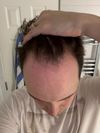
community Need help deciding what to do about my hair
The person is considering shaving their head due to hair loss but is unsure about the decision and concerned about potential regret. They are not interested in medication due to side effects and cannot afford a transplant, seeking advice and personal experiences.

community 4 months process, 3740 grafts
A user shared their 4-month hair transplant progress with 3740 grafts, showing before and after pictures. They had a generally good experience, except for the anesthesia part.
community Started war against AGA, who’s gonna win ?
The conversation discusses various treatments for hair loss, including minoxidil, finasteride, and topical dutasteride, with users debating their effectiveness and side effects. Despite the treatments, many believe androgenetic alopecia (AGA) ultimately prevails in the long term.
community 27M Struggling with 5-Month Treatment Limit on Minoxidil and Finasteride, Seeking AR Blocker Advice
A 27-year-old male is experiencing a recurring pattern of hair loss after 5 months of using oral minoxidil and finasteride, despite initial success. He is considering using topical androgen receptor blockers like RU58841, pyrilutamide, or clascoterone to address potential androgen receptor hypersensitivity.
community When someone posts a scalp tension theory
Hair loss theories discussed include poor blood flow, scalp tension, inflammation, and DHT. Treatments mentioned are massaging scalp, minoxidil, finasteride, and RU58841.
community 1 year and 2 months on fin and no regrowth
The user has seen no regrowth after 1 year and 2 months on finasteride, despite increasing the dose, and is inquiring about the potential of future treatments like verteporfin and gt20029 for hair regrowth.
community Tattooing Hair Loss Drugs into your Scalp
Tattooing hair loss drugs like minoxidil and dutasteride into the scalp is discussed as an alternative to daily pills, with mixed opinions on its effectiveness and convenience. Some users report positive results, but concerns about cost, potential side effects, and the procedure's discomfort are noted.
community Does this look like regrowth??
Hair regrowth using oral minoxidil, finasteride, and microneedling. User reports progress with no side effects and improved hair density.
community Experiences maintaining hair on alfatradiol?
community Does an increase in testosterone increase hairloss?
Finasteride and minoxidil are effective for hair growth, but increasing testosterone, even naturally with ashwagandha, may increase DHT, potentially affecting hair loss if predisposed to male pattern baldness. Testosterone replacement therapy (TRT) can be beneficial for energy and muscle gain but may expedite hair loss if already prone to it.
community Occipitalis Muscle Tension Theory
Scalp tension from the occipitalis muscle is theorized to contribute to hair loss, but most believe DHT and genetics are the main causes. Treatments like finasteride and minoxidil are considered more effective than addressing scalp tension.
community Hair loss whodunit: help me find the culprit!
The user is experiencing hairline thinning despite using finasteride, minoxidil (solution and foam), dermastamping, and tretinoin. They suspect minoxidil or tretinoin might be causing the issue but are unsure.
community Fun thought experiment about halting hair loss permamently
A user proposed genetically engineering scalp stem cells to stop androgen receptors from causing hair loss. Others discussed the feasibility, existing research, and potential issues with this approach, including targeting the correct cells and unintended effects.
community Does DHT Cause Complete Baldness?
Hair cloning technology is advancing, with clinical trials for improved methods expected by 2028 and 2029, potentially offering a solution for hair loss if donor follicles remain. Organtech's expansion into other biotech areas may secure funding, but the effectiveness of cloning depends on the availability of androgen-resistant donor follicles.
community 24 months on from Hair Transplant 👌🏼
A user shared before and after photos 24 months after a hair transplant, but others accused the photos of being fake and airbrushed. One user mentioned that having a beard hair transplant with androgenetic alopecia is a bad idea.
community New Jersey doctor offers new kind of hair loss treatment. Here's how it works. - CBS New York
Dutasteride mesotherapy is discussed as a hair loss treatment, with opinions on its effectiveness compared to oral dutasteride. The treatment is noted for being expensive, potentially painful, and more popular in Europe, with some users questioning its advantages over traditional methods.