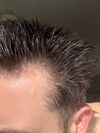
A 27-year-old male with diffuse hair loss, including the donor area, did not respond to finasteride, dutasteride, or minoxidil. He suspects his hair loss may be linked to a mild connective tissue disorder, possibly affecting the structural support of hair follicles, rather than being purely hormonal.
A 24-year-old woman being diagnosed with androgenic alopecia (AGA) who is scared and confused about her hair loss, and the treatment options of Minoxidil, finasteride, RU58841, spironolactone, and possibly a biopsy.
HMI-115, a potential treatment for hair loss that has been reported to produce significant regrowth in bald areas. It is the closest thing to a cure currently available and has raised hope that it could make hair transplants obsolete.
Hair loss is linked to cellular physiology and the IGF-1 to TGF-B1 ratio, not just androgen sensitivity. The theory lacks evidence, while finasteride and minoxidil are effective treatments.
A 37-year-old male resolved scalp folliculitis by adopting a low-histamine diet and taking Vitamin A, Zinc, and Fish Oil, leading to better skin health and thicker hair. He warns about the potential toxicity of excessive Vitamin A intake.
A user with diffuse hair loss for a decade tried various treatments, including LLLT Helmet, supplements, topicals, and hair transplants. They found relief from scalp inflammation and itching using a topical solution made from crushed Xeljanz pills mixed with ethyl alcohol.
A user experiencing diffuse thinning since age 18 describes their hair as unhealthy, dry, thin, and hard, with texture changes cycling between good and bad every few weeks. They are not on any medication, only taking vitamins and supplements.
The user is experiencing one-sided diffuse thinning and has been using finasteride and liquid minoxidil for 4-5 years with minimal results. They are considering whether to save for a hair transplant or address scalp sensitivity and irritation first.
New product Tomorrowlabs HSF targets hair loss through HIF pathway indirectly by removing scalp iron. Minoxidil and Stemoxydine also relate to HIF pathway.
Chinese researchers have successfully created hair follicles in vitro, potentially offering unlimited hair for transplantation and a cure for hair loss. They plan to test these follicles in vivo on human scalps.
The conversation discusses HMI-115, a potential cure for hair loss. Users share mixed opinions, with some expressing skepticism and others sharing anecdotal evidence of its effectiveness, including photos of significant hair regrowth from a trial participant.
A woman discovered her long-term hair loss was due to undiagnosed anemia, with ferritin levels as low as 9. After starting iron supplements, she saw significant hair regrowth, especially in previously bald areas, though some spots remain unchanged.
User experienced hair loss after surgery and was diagnosed with TE. The doctor recommended PRP therapy, Finasteride, Anatrix pro Hair Serum, a multivitamin, and a lotion and shampoo containing Zinc Pyrithione.
Adipose-derived stem cells with ATP improved hair regrowth in male and female mice with androgenetic alopecia. The most effective treatments were low dose stem cells with ATP for males and medium dose stem cells with non-liposomal ATP for females.
A user is exploring VEGF gene therapy to enhance hair transplant results, considering measuring hair shaft diameter and growth rate. Suggestions include using phototrichograms and possibly adding PRP, though its effectiveness is uncertain.
A person shared their hair regrowth journey using HIMS topical treatments with finasteride, minoxidil, hormone replacement therapy (HRT), and microneedling. They also discussed their transition as a transgender woman and the positive impact of HRT on hair recovery.
The conversation discusses hair loss treatments, focusing on vitamin D and B12 deficiencies, and mentions using finasteride. It also suggests getting a biopsy to differentiate between MPB and other conditions.
The potential availability of a new hair loss treatment called HMI-115, which has shown promising results in experiments on monkeys but is not yet available to the public. Replies cautioned against using unproven substances from shady labs.
A dental technician claims malocclusion causes pattern hair loss due to poor scalp circulation. Users debate this, noting treatments like finasteride, minoxidil, and microneedling focus on DHT and blood flow.
The conversation discusses using topical liposomal finasteride for hair loss, with concerns about high DHT levels. The user's DHT level is above the normal range, which may affect hair health.
A 33-year-old male is experiencing thinning at the temples and hairline, with increased shedding over the past year. The user suspects androgenetic alopecia (AGA) despite AI suggesting a maturing hairline.
OP experienced significant hair regrowth after recovering from iron deficiency anemia and starting minoxidil. They suspect anemia contributed more to their hair loss than androgenetic alopecia (AGA).
Dermatologists use treatments like oral minoxidil, finasteride, and RU58841 for male-pattern baldness, considering side effects and patient preferences. Photobiomodulation is noted as mildly effective but costly, while PRP is debated for its effectiveness compared to microneedling.
Hair loss is primarily genetic, and nutrient deficiencies are unlikely to be the cause. DHT inhibitors can slow hair loss, but concerns about side effects are common.
A 21-year-old male diagnosed with telogen effluvium and male pattern baldness started taking finasteride, which initially slowed hair shedding and slightly thickened hair. The doctor recommended iron and vitamin D supplements, and the user is considering minoxidil but wants to stabilize shedding first.
The user experienced hair improvement using a topical finasteride, minoxidil, and tretinoin combo, along with supplements like zinc, copper, magnesium, vitamin D3, K2, iodine, and boron. They believe these changes are due to addressing mineral deficiencies and possibly thyroid issues, despite skepticism from others.
A 21-year-old male suffering from male pattern baldness is using topical finasteride and minoxidil, and oral minoxidil. His bloodwork shows normal DHT levels and slightly high testosterone, leading to discussions about the role of DHT sensitivity in hair loss, the potential impact of finasteride on his DHT levels, and the suggestion to proceed with oral finasteride due to his high testosterone.