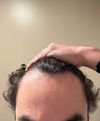
A 26-year-old male showed hair improvement after 6 months of daily 0.5mg dutasteride and 5mg oral minoxidil. He thanked the tressless community and haircafe for their support.
The conversation is about treatments for androgenetic alopecia, focusing on hyperresponders. Treatments include Minoxidil, finasteride, RU58841, leg training, and cold therapy.
The user has tried many hair loss treatments including dutasteride, oral and topical minoxidil, topical finasteride, PRP, and microneedling without much success and is now using RU58841, seeing initial vellus hair growth but no further improvement after 5 months. They are inquiring about the effectiveness of RU58841 after 6-12 months of use.
A person with a full head of hair chose to laser it off, sparking disbelief and discussions about hair loss treatments like Minoxidil and Finasteride. Many users questioned the decision, suggesting it might be a troll post or an extreme reaction to balding concerns.
The user shared a 1-month progress picture showing improvement in hair thickness and new growth after using Hims oral finasteride (1.1 mg) and minoxidil (3 mg), with no side effects, and also mentioned using ketoconazole shampoo and a rosemary hair mask. They plan to post updates at 6 and 12 months.
A 35-year-old man had a 6400 graft hair transplant in Turkey after years of baldness, using finasteride, oral and topical minoxidil, and scalp micropigmentation. He is satisfied with the progress and plans further SMP touch-ups to enhance results.
A user shared their 16-month hair regrowth progress using oral and topical minoxidil, dutasteride, derma rolling, and occasional keto shampoo. The conversation includes positive reactions and jokes about their impressive results.
Rotenone, a natural plant extract, may promote hair growth by increasing LDH activity and blocking MPC in the scalp, but it carries risks due to its toxicity. The suggested formulation includes Barbasco extract, DMSO, propylene glycol or PEG-400, ethanol, and a carrier oil.
RU58841, an anti-androgenic compound, showed early promise for treating alopecia but faced challenges after its patent in 1997. Despite advancing to Phase II trials, safety concerns and financial struggles led Aventis to abandon its development. Proskelia, which later merged into ProStrakan, couldn't prioritize the drug, leading to its eventual stagnation and failure to reach the market.
User shows temple area progress after hair transplant, using DUT every other day and oral Min 2.5 daily. Another user asks about number of grafts and cost.
User discusses tight scalp causing hair loss and suggests treatments like scalp massages, PRP, saw palmetto, and eucapil. They share their experience with saw palmetto and eucapil and consider adding PRP and scalp massages for better results.
A user is comparing Capillus Ultra and Capillus ONE for hair loss treatment, questioning if the number of diodes matters. Another user suggests the OMG helmet as the only worthwhile option.
Hair growth caps and helmets using low-level laser therapy (LLLT) show potential for treating androgenetic alopecia, but more research is needed. Users often combine these devices with treatments like minoxidil and finasteride for better results.
JW0061 shows superior hair growth results compared to existing treatments, with significant increases in hair follicles. The Wnt/β-catenin pathway is crucial for hair growth, and JW0061 activates this pathway effectively.
A user shared their successful hair regrowth journey using oral minoxidil, dutasteride, and eucapil, with additional benefits from MTF hormone replacement therapy. They advised consulting specialists and considering individual responses to treatments.
A user questions the authenticity of a cheap minoxidil product due to packaging errors and unusual smell, considering returning it. They also reference an FDA report for further information.
User is 16, experiencing hair loss, and using minoxidil and alfatradiol. Shedding decreased, new hairs growing on temples, but unsure if alfatradiol is effective or if future shedding will occur.
The user switched from finasteride to dutasteride and is using minoxidil and RU58841 for hair loss treatment. They are satisfied with the progress and considering a hair transplant, despite some initial shedding after the medication change.
Kintor's GT20029, a treatment for hair loss, has completed Phase 1 successfully, showing promise as an androgen receptor degrader that could potentially regrow hair. It is considered more effective than Pyrilutamide, with infrequent dosing and minimal systemic absorption.
Topical 2-deoxy-D-ribose (2dDR) regrows hair in mice almost as well as 2% Minoxidil. However, 2dDR may contribute to oxidative stress and hair loss due to the formation of advanced glycation end products (AGEs).
RootBioTec, a basil hairy root extract, claims to reduce hair loss by 31% in two months by inhibiting 5α reductase II and stimulating hair follicles. There is limited independent information available about its effectiveness.
A 20-year-old is experiencing hair thinning and is considering Clascoterone and Minoxidil as treatments, avoiding finasteride due to concerns about fertility and hormones. A suggestion was made to use Clascoterone for local DHT targeting and combine it with Minoxidil for maintenance and regrowth while avoiding systemic side effects.
The group buy for CB-03-01, a topical anti-androgen for hair loss, was postponed and refunded due to issues with the product's form and solubility. The product, also known as Breezula, is an alternative to finasteride with fewer side effects, but its official release is delayed until 2021.
A sugar gel called 2-deoxy-D-ribose (2dDR) shows potential for promoting hair regrowth by increasing blood supply to hair follicles, similar to Minoxidil, but its effectiveness in humans is unproven. It may benefit those who don't tolerate Minoxidil, but it is not a replacement for treatments like Finasteride or RU58841.
The user experienced significant hair regrowth using Trestolone, GHK-Cu, and Minoxidil. They avoided Finasteride due to concerns about side effects and noted that their approach reduced androgenic load, contributing to hair regrowth.
A 10 month update on the effectiveness of a hair loss treatment regimen involving minoxidil, finasteride, dermarolling and nizoral. Questions were asked about using minoxidil alone, dermaroller length, age, and when results were seen.
A user discusses a novel hemp extract for hair regrowth, which showed superior results to finasteride and minoxidil. The formula includes CBD, CBDV, THCV, delta 9 THC, cannabigerol, and cannabinol, combined with menthol, peppermint oil, ethanol, Emu oil, HFA 134A propellant, and dimethicone.