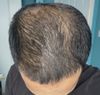
The user experienced no major negative symptoms from Propecia but noted ball throbbing and emotional inertia. They also used Minoxidil and observed increased focus and prolonged moods.
A 33-year-old man is concerned about potential hair loss, comparing his hairline to his father's and noticing increased shedding and thinning. He is considering treatments like Minoxidil and Finasteride but is unsure if he has male pattern baldness.
The user had a hair transplant 5 years ago and is currently using 1 mg finasteride and topical minoxidil but is not seeing an increase in hair volume. They are considering another transplant to improve hair volume.
The conversation is about switching from brand-name Avodart to generic Dutasmart for hair loss treatment, with concerns about shedding and side effects. The user also discusses using oral Minoxidil and plans to increase the dose for better results.
Extended-release oral minoxidil (VDPHL01) shows promising results for hair growth with improved safety, achieving significant hair count increases and minimal side effects compared to placebo. The treatment is designed to maintain effective concentrations while reducing side effects, making it a safer option for those who cannot tolerate standard minoxidil.
The user experienced significant hair regrowth using topical finasteride and minoxidil but faced a prolonged shedding phase, leading them to increase the finasteride dose and add oral dutasteride. Despite concerns about shedding, they remain hopeful for regrowth and are supplementing with Vitamin D.
The user switched from finasteride to 1mg dutasteride daily due to continued hair loss and is also using minoxidil and rosemary oil. They are seeking advice on whether to increase the dutasteride dosage for better regrowth.
PP405 is moving to late-stage trials, showing potential for hair regrowth, with 31% of male patients experiencing a 20% increase in hair density. Veradermics is developing an oral minoxidil version, and there is interest in combining treatments for better results.
Oral minoxidil and creatine can be used together, but it's advised to start one at a time to monitor side effects. Creatine may increase DHT levels, potentially causing more hair shedding, while minoxidil can lower blood pressure, so hydration and monitoring for dizziness are important.
The conversation is about obtaining topical tretinoin in Canada for hair loss treatment. Tretinoin is discussed for its ability to increase the absorption of minoxidil.
The user is considering whether to continue their current hair loss treatment, which includes Minoxidil and possibly Finasteride, or switch to Dutasteride or increase Minoxidil. They have seen slight improvement on the left side but not on the right.
A user with low-normal testosterone levels is considering starting finasteride and minoxidil for hair loss but is concerned about hormone imbalance. They are advised that finasteride targets DHT, not testosterone, and could start with minoxidil while making lifestyle changes to naturally increase testosterone.
A male in his thirties with a Norwood 2 hairline questions if gym gains and supplements like creatine cause hair loss. Responses suggest that while exercise can slightly increase testosterone and DHT, genetics primarily determine hair loss, and treatments like finasteride are recommended for DHT control.
A 35-year-old man is considering adjusting his hair loss treatment, currently using 0.5 mg dutasteride and 5% topical minoxidil, with inconsistent application. He is advised to add oral minoxidil for consistency and possibly increase the dutasteride dosage while continuing Ayurvedic treatments for hair texture.
A new hair loss treatment, PP405, showed promising Phase 2a results with 31% of patients experiencing over 20% hair density increase without systemic absorption, avoiding hormonal side effects. The treatment is expected to be expensive, with Phase 3 trials starting mid-2026, and there is skepticism about the data's strength.
The user started taking 1mg finasteride daily in February 2023 and added 2.5mg oral minoxidil in October 2025, noticing significant hair regrowth primarily from finasteride. The addition of minoxidil helped thicken the hairline and increase baby hairs.
The user is experiencing gradual hair growth using 5% minoxidil, 0.01% finasteride, vitamins, capixyl serum, niacin, and weekly microneedling, with plans to increase finasteride dosage. Despite some side effects, they remain optimistic about hair transplant results, focusing on the crown and temples.
A 19-year-old is experiencing hereditary hair thinning and is considering switching from topical to oral minoxidil due to convenience and starting finasteride at a low dose to minimize side effects. A suggestion was made to start with 0.25 mg of finasteride daily and gradually increase to 0.5 mg, while oral minoxidil requires a prescription.
The user is using dutasteride and minoxidil foam for hair regrowth, applying minoxidil once daily due to side effects from the liquid form. They plan to increase dutasteride dosage and possibly apply minoxidil twice daily, while also using ciclopirox olamine shampoo and sulfur soap.
A 21-year-old experienced significant hair regrowth using oral finasteride for 7 months, initially with minoxidil but later stopped due to inconvenience. He had no major side effects, except a temporary increase in sex drive, and plans to continue finasteride.
The user has been using 0.5mg finasteride daily for two years without side effects but is considering switching to dutasteride or increasing finasteride to 1mg for better results. They are unsure whether to proceed with dutasteride or increase the finasteride dosage.
A 24-year-old is struggling with hair loss despite using treatments like dutasteride, oral minoxidil, RU58841, and considering a hair transplant. They are advised to continue medication, possibly increase dosages, and explore additional treatments like tretinoin and tacrolimus.
A person experienced hair loss after switching from finasteride to dutasteride and returned to finasteride, adding oral minoxidil. Dutasteride may increase scalp testosterone, worsening hair loss for some individuals.
A 25-year-old male has been using Minoxidil foam for 3 years and topical Finasteride for 2 years to address hair loss, with plans to increase Finasteride concentration. He is considering additional treatments like microneedling and RU58841, while seeking advice on whether to switch back to oral Finasteride despite concerns about side effects.
Pelage Pharmaceutical raised $120 million to continue research on PP405, a promising hair loss treatment that showed a 20% increase in hair density in 31% of men during a Phase 2a trial. The treatment was well-tolerated, with no systemic absorption, and Phase 3 trials are planned for 2026.
After 3 months of using oral finasteride with oral minoxidil, shedding has started, and facial and body hair is growing back thinner. The user is questioning if a dosage increase is needed.
A 21-year-old male has been using dutasteride, minoxidil, ketoconazole shampoo, and microneedling for hair loss, with plans to increase minoxidil dosage. He is experiencing no side effects and is planning a trichoscopy to assess hair regrowth.
PP405, developed by Pelage Pharmaceuticals, can reactivate dormant hair follicle stem cells and increase hair growth by 20% in eight weeks, unlike minoxidil or finasteride. However, skepticism remains about its effectiveness and availability, with concerns about funding and the timeline for broader access.
The user experienced significant hair regrowth after 5 months using Minoxidil and Finasteride, specifically Hims chewables. They noted an increase in depression as a side effect.