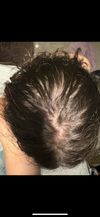
A male in his early 20s with CCCA (scarring alopecia) started treatment with Finasteride, Fluocinolone, and Doxycycline. Steroid injections were suggested but not yet done.
The post discusses the high cost of a topical hair loss treatment from Happy Head, which contains finasteride, minoxidil, retinoic acid, and hydrocortisone. The user is seeking cheaper alternatives, specifically asking if there are compounding pharmacies that can recreate the same or similar formulation.
The user is considering using topical finasteride for thinning hair around the middle part, vertex, and crown, and is unsure if the whole scalp is thinning. Another user suggests oral finasteride is more effective than topical, and recommends consulting a dermatologist for proper treatment.
A 29-year-old reports positive hair recovery after 7 months using liposomal topical finasteride and minoxidil, low-level light therapy, and vitamins, following a 3600 graft DHI procedure. They experienced no side effects from the topical treatment, unlike with oral finasteride.
Minoxidil works by opening potassium channels, leading to reduced blood pressure and potential side effects like reflex tachycardia. It is used for hair growth and affects blood pressure at high doses.
Pyrilutamide is a selective AR antagonist with a high binding affinity, making it effective in competing with DHT for androgen receptors. The 1% concentration is more effective than the 0.5%, but the latter may suffice for mild hair loss; the drug is considered a good option for those avoiding 5AR blockers due to side effects.
The conversation humorously discusses the unfairness of hair loss, highlighting various treatments like finasteride, minoxidil, red light therapy, and experimental drugs, while contrasting with people who have great hair despite unhealthy lifestyles. The original poster mentions experiencing side effects from switching to oral finasteride.
Procapil is marketed as a natural hair loss treatment but lacks strong evidence and is industry-biased. Minoxidil and Finasteride are the only FDA-approved treatments for androgenetic alopecia.
The user is using a hair loss treatment involving dutasteride, minoxidil, finasteride, microneedling, and supplements like multivitamins, D3 K2, and Omega 3 fish oil. They are considering adding tretinoin and are open to suggestions while managing gut issues.
Hair loss treatments include finasteride, minoxidil, microneedling, dutasteride, CB-03-01, RU-58841, and experimental options like KY-19382 and stem cell therapy. Some treatments are considered ineffective or risky, such as ketoconazole, PRP, and low-level laser therapy.
Topical finasteride that doesn't penetrate the skin could potentially treat hair loss without side effects. Current challenges include finding a formulation that remains on the scalp without increasing blood levels.
The user plans to enhance their hair loss treatment with oral minoxidil, finasteride tablets, laser cap therapy, and various supplements. They are also considering a hair transplant and exploring reputable sources for these products.
Some users report encouraging results with laser caps for hair loss, while others see no improvement. Treatments mentioned include low-level laser therapy, Minoxidil, and finasteride.
The user shared their 7-month progress using a topical solution of finasteride and minoxidil for hair loss, noting some improvement in hair thickness but acknowledging poor photo quality. They plan to switch to a combination of topical dutasteride, finasteride, and minoxidil, hoping for better results.
The conversation is about a hair loss serum mix containing 5% capixyl, 3% redensyl, and procapil. The user is asking for recommendations or opinions on the effectiveness of this product.
User asks about CB-03-01 for hair loss treatment and mentions using topical Dutasteride, TRT, and considering mixing CB-03-01 with Fluridil. CB-03-01 is sold at a high price, and user considers trying a lower concentration.
User experienced slow gains with topical fin+min, switched to topical dut+min, and considered adding Eucapil. Another user suggested DUT may be less effective topically due to high molar mass and mentioned Fluridil as a weak anti-androgen that could help.
The conversation discusses switching from oral to topical treatments for hair loss, specifically using a mix of retinoic acid, finasteride, and minoxidil, after oral treatments like dutasteride and finasteride were ineffective. The user is concerned about the cost and potential impact of dandruff on the absorption of topical treatments.
User plans to switch from oral to .005% topical finasteride, using a solvent from minoxidilmax and later Essengen-F. They will monitor DHT levels and seek advice on solvents and sleep caps.
The conversation is about the difficulty in obtaining GT20029, a hair loss treatment, due to patent issues and the need to resort to group buys or Chinese labs for acquisition. Specific treatments mentioned include Minoxidil, finasteride, and RU58841.
Affordable 92-LED caps may be more effective for hair growth than expensive 270-laser caps due to higher power output and irradiance. The LED caps deliver more energy to the scalp, making them a cost-effective alternative for red light therapy.
The conversation discusses using topical Calcipotriol and Valproic Acid for hair loss, focusing on their mechanisms involving the VDR receptor and Wnt/beta-catenin pathway. Specific treatments mentioned are Minoxidil, Finasteride, and RU58841.
A user shared a new hair loss treatment protocol including topical dutasteride, latanoprost, caffeine, minoxidil, tretinoin, and triamcinolone acetonide. Others discussed the effectiveness and availability of these treatments, with some suggesting simpler oral alternatives.
The conversation discusses Procapil, a treatment for hair loss containing Apigenin and Oleanolic acid. Users are sharing their experiences and asking if anyone has tried it.
The user is experiencing scalp irritation from a compounded treatment of finasteride, minoxidil, and tretinoin. They are considering switching to a non-alcohol, propylene glycol-free formula with a lower tretinoin percentage to reduce irritation.
A 41-year-old South Asian individual feels hopeless about hair loss and cannot use oral finasteride or dutasteride due to existing gynecomastia. They are seeking advice on alternative treatments.
Finasteride may be losing effectiveness for the user after 4.5 years, possibly due to intense workouts or a synchronized hair shedding cycle. Suggestions include switching to Dutasteride or continuing with Finasteride while considering a hair transplant for hairline density.
Dr. Muñoz's discovery suggests that targeting potassium channels in fibroblasts could reactivate hair growth, offering new treatment possibilities for alopecia. Potential strategies include using minoxidil, diazoxide, and other potassium channel openers, as well as bioelectric devices and direct growth factor applications.