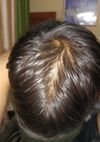
The user experienced significant hair regrowth using oral finasteride and topical minoxidil, but switching between oral and topical minoxidil led to hair loss and uncertainty about future treatment. They are considering sticking with oral minoxidil and finasteride, possibly adding dutasteride or opting for a hair transplant.
The conversation discusses using ZIX, a combination of Zinc Sulfate and Vitamin B6, for hair loss. The user is considering liquid forms for better absorption and scalp health.
Minoxidil was applied to a single miniaturized hair follicle over four months, resulting in less miniaturization but not yet terminal growth. The user used a 5% minoxidil solution, specifically the Regaine brand, and observed changes using a handheld WiFi microscope.
Spraying or drinking topical minoxidil is dangerous and less effective than oral minoxidil. Proper oral minoxidil, like Loniten®, is recommended for safety and effectiveness.
Topical finasteride may reduce more scalp DHT but is seen as inconsistent and messy compared to oral finasteride. Users report mixed results with both forms, with some preferring oral for its convenience and consistent dosing, while others find topical effective but harder to apply.
A user is considering switching from oral to topical treatments for hair loss due to side effects like watery semen and erectile dysfunction. They are currently using oral finasteride and minoxidil and are concerned about potential sexual side effects with topical use.
The user shared progress on hair loss treatment between September and November using oral finasteride, topical minoxidil, dermarolling, a LaserComb, caffeine shampoo, Nizoral, scalp massages, and both oral and topical biotin. The conversation discusses the effectiveness of these treatments.
Hair looks thinner in sunlight, and users discuss using hair fibers, minoxidil, finasteride, and considering dutasteride for hair loss. Hair fibers like Toppik help conceal thinning, and some users suggest additional treatments like derma stamping and micro-needling.
Using tretinoin with minoxidil may improve absorption but results vary; some users see improved follicle growth while others notice no significant difference. Applying tretinoin before minoxidil is suggested by some users.
The conversation discusses using Minoxidil combined with Azelaic Acid and Tretinoin to promote beard growth. Specific treatments mentioned are Minoxidil (Min), Azelaic Acid, and Tretinoin.
Dutasteride mesotherapy may stabilize hair loss and improve hair without significantly affecting serum DHT levels, but it can still have systemic effects. Users discuss using topical and oral dutasteride, with some experiencing side effects and considering hair transplants.
The user has been using oral minoxidil (5mg), finasteride (1mg), and biotin for 4 months with minimal progress in hair regrowth. Other users suggest patience, considering alternative treatments, and note that biotin may not significantly contribute unless there's a deficiency.
The conversation discusses the pros and cons of buying a mixed topical bottle of minoxidil and finasteride versus separate products for hair loss treatment. Concerns are raised about the finasteride dosage and the inclusion of tretinoin in one of the products.
The conversation is about personal experiences with Nifeishi rosemary mint oil for hair loss and requests for an ingredient review to assess its quality. Specific treatments mentioned are Minoxidil, finasteride, and RU58841.
Tazarotene's potential to enhance Minoxidil conversion, similar to Tretinoin, is questioned. Users discuss the lack of information and seek further details.
The conversation is about a user's progress in treating diffuse hair thinning using a topical regimen including finasteride, minoxidil, ketoconazole, microneedling, saw palmetto, collagen, and vitamins, along with lifestyle changes. The user plans to switch from topical to oral finasteride for potentially better results.
The conversation is about the progress of clinical trials for SCUBE3, a potential hair loss treatment. Specific treatments mentioned include Minoxidil, finasteride, and RU58841.
The user is considering liposomal minoxidil due to non-response and side effects from other treatments. They are exploring tretinoin with topical minoxidil as an alternative.
Isopropyl alcohol should not replace ethanol in homemade topical finasteride serums due to potential toxicity with frequent use. Denatured ethanol, also known as parfum or cosmetic alcohol, is a safer alternative.
The user is exploring alternatives to finasteride and dutasteride due to concerns about side effects, and is using rosemary and jojoba oil, ketoconazole, minoxidil, microneedling, multi-peptide serum, saw palmetto, and stinging nettle for hair loss. They are also considering CB 03 01 and spironolactone.
Use tretinoin three times a week, dermaroll once a week, and apply minoxidil daily, but avoid using all three on the same day. Tretinoin is preferred over hydrocortisone and should not be used immediately after dermarolling.
Sulforaphane, found in broccoli sprouts, promotes hair growth by degrading DHT. Users discuss its potential benefits and joke about unconventional application methods.
Burdock root and marigold are suggested as natural alternatives for hair growth. Onion juice, castor oil, and rosemary oil are also mentioned as treatments.
CHK-Cu (copper peptide) and C-60 (branched carbon chain) are discussed as potentially more effective than minoxidil for hair regrowth. Some users are skeptical about the claim that DHT isn't the root cause of hair loss, and others are trying these products to see if they work.
PRP therapy cannot make oral minoxidil's effects permanent, as minoxidil does not stay permanently in the system. Dosage of oral minoxidil is typically increased gradually, but there is a limit, and it should not be increased indefinitely.
The conversation discusses the optimal amount of Propylene Glycol in Minoxidil for better absorption. It focuses on enhancing the effectiveness of Minoxidil in treating hair loss.
Fatty acid metabolic signaling can activate epithelial stem cells for hair regeneration. Oleic and palmitoleic acids showed the best results, but practical application on humans remains uncertain.
A 20-year-old diffuse thinner has been using finasteride for 8 months and is considering adding minoxidil to their routine. A user suggests incorporating minoxidil for quicker regrowth, despite the hassle of daily application, while continuing finasteride.