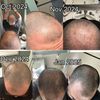
The conversation is about someone noticing hair regrowth after using a scalp massager and considering a hair transplant. People suggest using finasteride or dutasteride, but there's debate on their effectiveness and side effects. Some see progress, while others are skeptical without consistent photo evidence.
The user successfully managed hair regrowth by using a combination of finasteride, dutasteride, minoxidil, and specific shampoos to treat seborrheic dermatitis. They emphasize the importance of maintaining a healthy scalp and are considering food intolerance tests to further address inflammation.
The user is experiencing hair regrowth using a combination of oral finasteride, a minoxidil/finasteride topical spray, and dermarolling. They plan to continue this regimen and may consider adding dutasteride if needed.
Alfatradiol is often discussed at a 1% concentration, but studies typically use 0.025%. Some users report success using it as a topical treatment alongside other hair loss treatments like finasteride.
The conversation discusses topical androgen receptor blockers for hair loss, mentioning Clascoterone, Pyrilutamide, GT20029, and RU58841. Ketoconazole's effectiveness and application methods are also debated.
The user started taking 1 mg finasteride daily in September 2024 and began derma stamping twice a week, noticing progress initially but now experiencing increased scalp visibility. They are considering adding oral or topical minoxidil to their routine for further improvement.
The conversation discusses alternatives to 5AR inhibitors for hair loss treatment, suggesting options like minoxidil, KX-826, pyrilutimide, microneedling, and topical bicalutamide. Concerns about side effects and the effectiveness of these treatments are also highlighted.
The user experienced reduced hair loss after switching from finasteride and dutasteride to consuming fruit seeds like pumpkin and flaxseed, but others suggest the improvement is likely due to the delayed effects of the medications. There is skepticism about the seeds' effectiveness in blocking DHT compared to the medications.
A 28-year-old male reported significant hair regrowth after 5 weeks using a regime including Minoxidil, Ketozolin shampoo, microneedling, hyaluronic acid, saw palmetto, pumpkin seed, MSM, frankincense, zinc, multivitamins, and vitamin D. He also noted improvements in digestion, dry eyes, and skin health, and observed beard growth from microneedling.
A user shared their one-month progress using Minoxidil and RU58841 for hair loss, noting significant shedding after micro-needling and seeking opinions on their regrowth. They stopped micro-needling and added RU58841 to their treatment.
A user is very satisfied with their hair transplant results, despite choosing a straight hairline against the doctor's advice for a more natural look. Some commenters think the hairline looks artificial, while others discuss the importance of a natural-looking hairline and inquire about any medications used post-transplant.
User tried dutasteride, topical finasteride, oral minox, dermawounding, saw palmetto, pumpkin seed oil, and ketacozonole for hair loss. Improvement was temporary, now trying RU58841 and seeking help.
A 32-year-old male with diffuse thinning and seborrheic dermatitis has been using finasteride for 8 months without improvement. He is considering COQ10 + PQQ supplements for scalp inflammation and hair loss.
Kintor's phase III trial for pyri (KX-826) showed promising safety and efficacy results, with no drug-related sexual dysfunction reported. Users discussed their experiences with pyri, Minoxidil, Dutasteride, and concerns about the validity of the study results.
The conversation discusses the effectiveness of reducing DHT for hair loss treatment and explores alternative approaches like reducing androgen receptor sensitivity. Specific treatments mentioned include finasteride, dutasteride, pyrilutamide (KX-826), GT20029, and RU58841.
Hair therapy advertisements claim to use a mix of fallopia multiflora, ginseng, angelica sinensis, and vitex rotundifolia for hair growth. A user dismisses it as fake.
The post discusses a hair loss treatment regimen using saw palmetto, pumpkin seed oil extract, EGCG (green tea) extract, grape seed oil extract, rosemary oil extract, and Zix. The user plans to use these DHT-blockers and 5AR inhibitors for six months and report the results.
The conversation discusses skepticism about a new hair loss treatment called project K, which claims to replicate a chemical from UCLA research but is suspected to be a scam. The original poster plans to continue using oral minoxidil, finasteride, and dutasteride, along with microneedling, for hair regrowth.
GT20029, a new hair loss treatment, shows promising results but only a slight improvement over placebo. People are cautiously optimistic, discussing its potential and combining it with existing treatments like Minoxidil and Finasteride.
The conversation discusses hair regrowth after nearly 7 months of using 1mg finasteride and dermarolling, with some users noticing thicker hair and improved density. Minoxidil was suggested but ruled out due to the user's cats, and a hair transplant was mentioned as a potential solution for completely bald areas.
Breezula shows promise in stabilizing hair loss and potentially promoting regrowth at the one-year mark, offering hope for those who can't tolerate 5AR inhibitors. Its local targeting of androgen receptors could be a significant advancement if it avoids systemic side effects.
NMN shows promise in promoting hair growth by reducing oxidative stress and weakening androgens. It may be a beneficial addition to hair loss treatments like Minoxidil and Finasteride.
RU58841 showed promise for treating androgenic alopecia but research was halted due to financial and organizational changes. There were no significant safety concerns reported in human trials.
A user is considering a hair loss treatment lotion containing minoxidil, adenosine, caffeine, melatonin, and azelaic acid, questioning the interaction between caffeine and adenosine receptors. Another user suggests adding a topical anti-DHT ingredient like spironolactone, noting it should not be taken orally by men.
The conversation discusses using 2-deoxy-d-ribose (2DDR) for hair regrowth, with users sharing mixed experiences and side effects like hair loss in new areas and increased anxiety. The original poster plans to continue testing and comparing it to minoxidil, noting potential instability in 2DDR formulations.
The conversation is about hair regrowth using topical minoxidil, microneedling, and vitamin supplements. The user is hesitant to use DHT blockers like finasteride due to concerns about hormonal side effects.
The conversation is about the timeline for Kintor's phase 3 trials for GT20029 and the potential release of the product in three years. It also mentions treatments like Minoxidil, finasteride, and RU58841.
RU58841 was ineffective for OP, who is considering adding KX-826 with finasteride. User8 suggests KX-826 may help when combined with minoxidil and dutasteride.
The relative strength of Pyrilutamide compared to RU58841 in terms of androgen receptor binding affinity. It has been noted that Pyrilutamide is 4x stronger than RU58841, with a higher binding affinity than DHT itself.