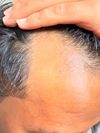
User discusses a promising topical Procyanidin B2 treatment for hair loss. Users share mixed experiences and mention effective treatments like finasteride, minoxidil, and LLLT.
The user struggles to cover their entire scalp with 1 ml of RU58841 while using dutasteride and oral minoxidil for hair loss. Suggestions include using a syringe for precise application, applying twice daily, and considering the use of more than 1 ml to ensure full coverage.
The user is using a solution of 5% minoxidil and 0.1% finasteride with micro-needling and is considering adding 1mg oral finasteride. They notice small hairs on their forehead and are questioning if these indicate potential regrowth.
The conversation discusses alternatives to minoxidil for beard growth, focusing on a product called Neofollics Beard Growth Serum, which claims to be effective without using minoxidil. Concerns are raised about its ingredients and effectiveness, especially considering pet safety.
The conversation discusses creating a foam version of RU58841 for easier application on thick hair, comparing it to minoxidil foam. The user currently uses dutasteride, minoxidil, and needling for hair loss treatment.
Capilia Longa and Scandinavian Biolabs are discussed, with skepticism about their effectiveness and value. The conversation suggests avoiding these products due to high cost and perceived lack of results.
The conversation discusses the molecular structures of compounds that reduce DHT levels, including finasteride and Ashwagandha. It explores the potential of using Ashwagandha topically as a 5a reductase inhibitor.
The conversation discusses using zinc sulphate and azelaic acid to inhibit 5 alpha-reductase activity, which could potentially treat androgen-related skin conditions like hair loss. Combining these with vitamin B6 could enhance the effect, potentially offering an alternative to finasteride.
People are discussing the potential benefits and drawbacks of a new time-release oral minoxidil (VDPHL01) for hair loss, with considerations about its cost, efficacy, and side effects compared to current treatments like 2.5mg doses and topical applications. Some users express interest in trying it if it proves effective and affordable, while others are cautious due to potential side effects or are satisfied with their current regimen.
The user visited a trichologist due to ineffective topical finasteride treatment for hair loss. The trichologist recommended a new regimen including a two-month course of locoidon (cortisone 0.1%), followed by a solution containing minoxidil, hydrocortisone butirrate, estrone, progesterone, tocopherol acetate, trichosol, and transcutol.
The conversation discusses making DIY topical finasteride using a hair tonic with various ingredients and suggests alternatives like Jatamansi powder, Sandalore, and products like Bare Anatomy Expert Advanced Hair Growth Serum and RevivHair Max Hair Stimulating Serum. It also mentions using topical dutasteride and minoxidil for hair growth.
A user shared their experience with a dermatologist's special minoxidil formula containing vitamin E, pantenol, rosemary, and finasteride, which improved their hair loss better than commercial minoxidil. Another user confirmed that the presence of finasteride in the formula is a significant difference.
The conversation discusses hair loss treatments, specifically using topical finasteride and minoxidil combined with microneedling, along with supplements like collagen, vitamin C/D, and saw palmetto. The user also mentions using a DHT-blocking shampoo and experimenting with cold showers and contrast therapy for hair health.
RU58841 for hair loss, discussing sources, application methods, and carriers like PG + ethanol or liquid minoxidil. Users share experiences with premixed solutions and powder forms, noting price differences and storage importance.
Topical liquid minoxidil may be safe to consume in small amounts, but it needs liver processing to become effective for hair growth. Therefore, oral pills might be more effective.
The user is considering storing Fluridil in a different container for easier application and asks if it can be mixed with Minoxidil or if hair styling products will affect its potency. They also inquire about the order and timing of applying these hair loss treatments.
The user experienced stable hairline but diffuse thinning after switching from oral finasteride to a topical solution of minoxidil and finasteride. They are concerned about the effectiveness of the topical treatment and are considering other options due to a recent decline in hair density.
User seeks help calculating dosages for liquid minoxidil (2% and 5%) and generic finasteride (5mg tablets) to treat hair loss. They want to know how to achieve 2.5 mg of minoxidil and 1 mg of finasteride per ml of solution.
The user experienced good hair growth results using a combination of finasteride, minoxidil, and a topical formulation, but faced temporary numbness as a side effect. They manage this by microdosing oral finasteride and minoxidil and using the topical formulation sparingly.
The conversation discusses using 0.1% retinol as a potential substitute for 0.01% tretinoin with minoxidil for hair loss treatment. It mentions that tretinoin is not easily available in some countries, and retinol might be less effective but less harsh on the scalp.
The conversation discusses hair loss treatment using finasteride, minoxidil chews, 0.5 dermarolling, 2% ketoconazole, and a silk bonnet. The user reports positive progress and plans to continue the regimen.
A user shared their experience with hair loss treatments, including I-PRF injections, mesotherapy, and a topical solution containing Minoxidil and Finasteride. After experiencing side effects, they decided to stop the medicinal treatments and focus on natural alternatives like I-PRF, microneedling, and essential oils.
User takes topical finasteride/minoxidil with little results, asks if microneedling helps for temple regions and if 0.5mm is enough. Replies suggest microneedling is effective and 0.5mm works, sharing personal regimens.
Combining minoxidil, pyrilutamide, and copper peptide is questioned, with advice to apply them separately to avoid reactions. Finasteride and minoxidil are recommended for effectiveness.
The user is undergoing Mesotherapy and Low-Level Laser Therapy for hair loss, with plans for multiple sessions. They are also using oral finasteride, topical minoxidil, dutasteride, and hair fibers.
A compound called MTP3 from the Monoterpene family was found to be safe and highly effective at treating hair loss by inhibiting the FGF5 gene, but its identity is undisclosed for commercial reasons. No specific treatments like Minoxidil, finasteride, or RU58841 were discussed.
Pyrilutamide, a possible hair loss treatment, ceasing to be traded due to patent laws; and the hope that this indicates it may be a legitimate treatment.
Aminexil, nanoxidil, stemoxydine, and kopexil are discussed as alternatives to minoxidil for hair growth, with concerns about dependence. Minoxidil is noted for its effectiveness in transitioning hair growth phases, but dependence is mainly linked to androgenic alopecia.