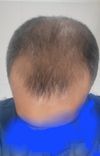
Hair loss treatments, specifically Pyrilutamide and Minoxidil/Finasteride/RU58841. Participants discussed their experiences with them and the results they have seen so far.
The user experienced side effects from daily 1 mg Finasteride and switched to 0.5 mg every other day, supplemented with creatine, tongkat ali, tribulus terrestris, vitamin D3, bromantane, l-tyrosine, and caffeine. They also use weekly 1.5 mm microneedling and daily 50 mg RU58841, except on microneedling days, to manage hair loss.
The user has been using Minoxidil 5% since August and has noticed hair regrowth, with the left temple showing more concentrated growth and the right side having scattered single hairs. Some hairs are turning black, but the right side doesn't yet appear as full as the left.
The user is experiencing hair thinning and is using minoxidil, dutasteride injections, and red light therapy with little success after 4.5 months. Suggestions include switching to finasteride instead of dutasteride injections.
Male pattern baldness (MPB) may be influenced by androgen receptors in scalp hair follicles and potentially poor blood flow. Transplanted hair is not immune to DHT, and factors like inflammation and scalp tension might also contribute to hair loss.
AH-001 is a new topical treatment designed to degrade androgen receptors, targeting the root cause of androgenetic alopecia without the side effects of oral treatments like finasteride. It has shown a strong safety profile and good local tolerability in early trials.
User tried oral dut 0.5mg, oral min 5mg, topical RU 80mg, and weekly microneedling at 1.5mm for hair loss. Others commented on the significant improvement and potential for future hair transplant.
Addressing hair loss by focusing on posture, blood flow, and craniofacial development. Methods include improving posture, cardiovascular activity, scalp massages, healthy diet, meditation, using minoxidil, and addressing craniofacial issues.
User shared progress pictures after 5 months using 5 mg oral minoxidil, a topical formula with 8% minoxidil, 0.1% finasteride, and 0.01% tretinoin, and a 1.5 mm Dermapen every other week. The conversation discusses the effectiveness of this regimen for hair loss.
My hairline, I am only 23.
This conversation is about a user's experience with treatments for androgenic alopecia, including finasteride, dutasteride, RU, minoxidil, progesterone, melatonin, LLLT, oral minoxidil, and Pyrilutamide. They have tried many treatments over the course of two years without seeing much success, and they are considering getting a hair system as a last resort.
Triple Hair Inc. developed a new topical treatment, TH07, combining Finasteride, Latanoprost, and Minoxidil for androgenic alopecia. Users discussed its effectiveness compared to other treatments and shared their own product combinations.
The conversation discusses using topical dutasteride with a dermapen for hair loss treatment. The user is deciding between liposomal and mesosomal formulations for this purpose.
The user is seeking an alternative solvent for pyrilutamide due to skin irritation from ethanol and propylene glycol. They experienced similar issues with topical minoxidil.
The conversation discusses a patent filed by Shiseido for cloning Dermal Papilla (DP) cells to treat hair loss. The method involves using viral vectors to maintain the cells' growth-inducing properties, differing from Replicel's approach with Dermal Sheath Cup (DSC) cells.
The user has been using 5% minoxidil foam for 5 months with noticeable results and is considering adding finasteride. Suggestions include adding finasteride, using hair fiber spray, and trying microneedling for better results.
The conversation discusses hair loss treatments, specifically Setipiprant, finasteride, and bimatoprost. Setipiprant is suggested for maintenance, while bimatoprost is for regrowth, and combining them with dermarolling is recommended for better results.
The conversation discusses how to mix pyrilutamide for hair loss treatment, suggesting a mixture of 500mg pyrilutamide with 70% ethanol and 30% propylene glycol, and a potential application dose of 1mL. The user has not personally used pyrilutamide but has researched its preparation and application based on others' experiences.
The conversation is about hair loss treatments. The user considers using a foam with Saw palmetto, caffeine, and EGCG, but another user suggests just using finasteride.
The user discusses their hair loss experience, exploring various hypotheses including thyroid levels, vitamin D, DHEA, nutritional deficiency, diabetes, seborrheic dermatitis, lack of nutrition to hair follicles, chronic inflammation, female pattern hair loss causes, cortisol, and prolactin levels. They are currently using finasteride, beta-sitosterol, and have tried topical dutasteride and microneedling therapy.
Lab-grown hair using iPSCs is being explored, but practical applications are limited. Finasteride is suggested as the only current effective treatment.
Creating a liposomal gel with Pyrilutamide for hair loss to reduce systemic effects, similar to Xyon's gel. The discussion includes concerns about ingredient sourcing and the benefits of targeted topical treatments.
The conversation discusses the differences between KB solution and PG + Ethanol solution for RU58841 in treating hair loss. It compares the effectiveness and properties of these two solutions.
The conversation discusses hair regrowth progress from Norwood scale 4 to 2.5 over a year using daily 8.5-9% RU58841, topical Dutasteride 0.1%, RU58841 5% 1.5 times a week, and daily caffeine redensyl scalp treatment.
PP405 is expected to be more expensive than finasteride and minoxidil initially due to patent protection, but not as costly as life-saving medications like Ozempic. The price may decrease after the patent expires, but initially, it might be around $100 per month, making it potentially unaffordable for many.
The user is seeking alternatives to propylene glycol and glycerin for mixing with RU58841 due to allergies and greasiness. Suggestions include reducing glycerin and considering stemoxydine as a solvent.
User is a Norwood 2-2.5, using 1.25 mg finasteride and 5% minoxidil lotion daily since June last year, experiencing significant regrowth. They are considering additional treatments like saw palmetto, microneedling, dutasteride, aminexil, stemoxydine, mesotherapy, ketoconazole shampoo, and alfatradiol to improve hair thickness.
The user halted hair loss using 0.01% topical liposomal finasteride daily, with no side effects or regrowth, and recently added 5% minoxidil and low-level laser therapy. They recommend this conservative approach for those hesitant about finasteride.
The user is one month into their FUE treatment and has just undergone PRP treatment at American Mane in Miami. They plan to start using minoxidil and LLT, take xpecia with saw palmetto, and try Exosome from ExoScrt and PRP for better hair growth results.
The user is experiencing hair improvement in the central and back areas after using finasteride, minoxidil, and a galenic lotion, but the temple area is worsening. They suspect the lotion might be causing the issue and are considering stopping its use.