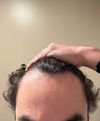
A user who has been using Pyrilutamide for 5 months with no results, and other users suggesting they switch to RU58841 or stick to their treatment plan for at least one year.
User questions credibility of a hair loss "cure" found by a non-expert and warns against wasting money on unproven supplements. Others discuss trying natural extracts and the importance of researching the enzyme 3ADH for potential hair growth benefits.
Latanoprost at 0.1% concentration is used to increase hair counts, often mixed with Minoxidil and Finasteride. Users report noticeable results in about 3 months.
After 10 months, the user's hairline and midscalp look thick following a 6100 graft FUE hair transplant in Turkey. They plan to address the crown in a few months.
A combination of pyrilutamide, minoxidil, and alfatradiol is proposed as an effective alternative to finasteride for treating mild to moderate hair loss, claiming to stabilize hair loss and improve thickness without finasteride's side effects. Some users are skeptical about the effectiveness and approval of these treatments, while others are interested in trying them due to finasteride's side effects.
The user's 42 month experience using finasteride for hair loss, their opinion on minoxidil use and the potential of pyrilutamide and another Chinese drug as treatments.
The conversation discusses using Pyrilutamide 1% as a potential treatment for hair loss, with some users combining it with minoxidil and finasteride. Experiences vary, with some reporting shedding and no progress, while others remain hopeful for future results.
Hair loss treatment involves gland treatment with iodine, liver extract, wild American ginseng, and black cohosh, along with crude oil scalp massage. The approach aims to stimulate hormones and improve blood circulation to promote hair growth.
A man in his 40s treating his slow balding with a daily regimen of 2.5% spironolactone topical solution and Piroctone Olamine Shampoo. Despite initial hair shedding, he experienced no side effects and plans to continue the treatment for at least a year.
The post discusses a hair loss treatment regime using Nizoral, a laser helmet, dermaroller, bentonite clay mask with essential oils, and ketoconazole shampoo. The user avoids finasteride and minoxidil due to concerns about side effects and pet safety.
The review discusses traditional hair loss treatments like minoxidil and finasteride, and newer options like Low-Level Laser Therapy, microneedling, and platelet-rich plasma for androgenetic alopecia. It highlights the need for more high-quality trials to assess these treatments' effectiveness and standardized protocols for emerging therapies.
The conversation discusses using USB microscopes for scalp photos and provides a link to an overview of trichoscopy. Treatments mentioned include Minoxidil, finasteride, and RU58841.
The user is concerned about hair loss and is using treatments like dutasteride, microneedling, and topical finasteride, while considering adding RU58841. They are also using Minoxidil on the temples and are worried about testosterone-related hair loss.
Pyrilutamide/KX-826 is being discussed for its effectiveness in hair regrowth, with some users reporting positive results, especially in early hair loss cases. Users have combined it with treatments like Minoxidil, and some experienced initial shedding before seeing regrowth.
The user is using a regimen for hair loss that includes topical and oral minoxidil, finasteride, a Musley holistic formula, homemade oil, and scalp massages. They are questioning if there is any progress in hair regrowth.
A 27-year-old male with diffuse hair loss, including the donor area, did not respond to finasteride, dutasteride, or minoxidil. He suspects his hair loss may be linked to a mild connective tissue disorder, possibly affecting the structural support of hair follicles, rather than being purely hormonal.
The user is experiencing potential hair regrowth after 3 months of using 0.5mg Dutasteride, 2.5mg Minoxidil, and 2% Ketoconazole shampoo, along with supplements like pumpkin seed oil and vitamin D. They notice tiny hairs on their scalp and seek opinions on whether this indicates regrowth.
The user has been using a combination of treatments including Dutasteride, Minoxidil, RU58841, ketoconazole shampoo, microneedling, and low-level laser therapy to address hair loss but continues to experience shedding and density loss. Despite high testosterone and iron levels, the user is frustrated with the lack of improvement and is considering adjusting treatment or exploring other options like a hair transplant.
The conversation discusses managing hair loss and scalp issues, with users sharing experiences using treatments like dutasteride, finasteride, ketoconazole, sulfur soap, and topical anti-androgens. Suggestions include trying sulfur soap, scalp massages, spironolactone, and dietary changes to reduce sebum production and dandruff.
Pyrilutamide is an experimental hair loss treatment, with users discussing its availability and cost from sources like Anagen Inc, Actifolic, and MinoxidilMax. Some users express concerns about product authenticity and suggest waiting for further trial results to assess its safety and effectiveness.
The conversation discusses experiences with Dutasteride Mesotherapy for hair loss. Users share their results and compare it to other treatments like Minoxidil and Finasteride.
The user is using RU58841 for hair regrowth on the temples and is considering adding minoxidil. They are questioning the potential for vellus hairs to develop into fuller hair and the possibility of reactivating dormant follicles.
Kintor's Pyrilutamide results for hair loss treatment will be released soon. The treatment may replace current treatments like finasteride and minoxidil without systemic side effects.
Combining Finasteride with topical Quercetin, Onion/Garlic juice and Peppermint Oil to reduce Wet Prostate Weight in Rats. Luke10191 asked the user LITUATUI to update them on progress after trying this combination of treatments for hair loss.
Pyrilutamide is seen as effective for maintaining hair without regrowth, while Minoxidil is known for growing new hair but causes shedding of old hairs. There is a question if using Pyrilutamide would inhibit the hair regrowth effects of Minoxidil.
The user has been managing hair loss with microneedling, Nutrafol, topical finasteride/minoxidil foam, LLLT, and Nizoral, and plans to add oral minoxidil. They are seeing improvement and are cautious about using oral finasteride due to past gynecomastia concerns.
Exploring different treatments for hair loss, such as cosmeRNA and HMI-115 which are small interference messenger RNA that inhibits the DHT receptor and an antibody that binds to the prolactin (PRL) receptor respectively; and researching mechanism and environment of hyperresponders.
The conversation discusses the ineffectiveness of tablet forms of dutasteride for hair loss due to poor absorption compared to soft gel capsules. It suggests switching to FDA-approved soft gel capsules for better results, as tablets may not adequately suppress DHT levels.
A 20-year-old is experiencing hair thinning and is considering Clascoterone and Minoxidil as treatments, avoiding finasteride due to concerns about fertility and hormones. A suggestion was made to use Clascoterone for local DHT targeting and combine it with Minoxidil for maintenance and regrowth while avoiding systemic side effects.
A user discusses a topical prescription for hair regrowth containing Minoxidil, Finasteride, and Latanoprost, noting Latanoprost's side effect of promoting eyelash and eyebrow growth. Others share experiences and information about Latanoprost, highlighting its origins as a glaucoma drug and potential side effects.