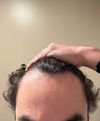
User reports 12-week progress with HIMS spray, Minoxidil, micro-needling, and biotin. Notable baby hairs on crown and temples, hoping for further improvement.
A 20-year-old is experiencing hair thinning and is considering Clascoterone and Minoxidil as treatments, avoiding finasteride due to concerns about fertility and hormones. A suggestion was made to use Clascoterone for local DHT targeting and combine it with Minoxidil for maintenance and regrowth while avoiding systemic side effects.
The conversation is about incorporating tretinoin into a topical minoxidil routine for better hair loss treatment. The user is considering compounded minoxidil sprays with tretinoin from brands like Keeps and Roman.
The user has been using a topical combination of finasteride, minoxidil, and dermastamping for three months to address hair loss. They are considering adding tretinoin and are discussing the effectiveness of topical versus oral treatments.
The conversation discusses using gartanin from mangosteen mixed with castor oil to degrade the androgen receptor for hair loss treatment. Alternatives like setipiprant, minoxidil, and dermastamping are also mentioned, with concerns about cost and potential side effects.
The post discusses using Carnitine Tartrate, Potassium Chloride, and Niacin to reduce hair shedding, with the user experiencing significant improvement. The user also suggests considering a ketogenic/paleo diet for those with insulin resistance-related hair loss.
The user is considering liposomal minoxidil due to non-response and side effects from other treatments. They are exploring tretinoin with topical minoxidil as an alternative.
Ethosomes are suggested as an effective delivery method for topical finasteride solutions, requiring the addition of a phospholipid like soya lecithins. The user questions why do-it-yourself solutions don't commonly use ethosomes despite their potential benefits.
A user is experiencing temple hair recession and is seeking alternatives to finasteride. They are considering castor oil, coconut oil, and derma rolling, and have seen some improvement with Zenegen.
The conversation is about seeking user experiences with Traya for hair loss treatment, focusing on the effectiveness and convenience of its doctor, diet, and product approach. The user is conducting research and requests feedback on what worked or didn't work.
Low-Level Laser Therapy (LLLT) is seen as a safe and effective method for maintaining hair and promoting regrowth in androgenetic alopecia (AGA) and male pattern baldness (MPB), with devices like the HairMax LaserComb® and iRestore helmet being popular. Some users and professionals are skeptical about its long-term effectiveness and cost.
The user started a hair loss treatment with a topical solution containing 0.1% Dutasteride, 7.5% Minoxidil, 0.0125% Tretinoin, and Biotin, along with a multivitamin, Ashwagandha, CBD oil, Retinol, and Caffeine Solution. They experienced some shedding and scalp irritation, leading to a reduction in the use of the caffeine solution.
Liposomal carriers for topical finasteride offer better targeting, reduced side effects, and less irritation compared to alcohol-based solutions, but availability and cost may limit their use. Minoxidil can dissolve in liposomal carriers, enhancing delivery and stability.
Chime Biologics and Hope Medicine are speeding up the launch of a first-in-class antibody drug, HMI-115, for endometriosis and androgenic alopecia. The treatment involves a series of subcutaneous injections, has shown promising results in phase 1, and continues to promote hair regrowth even after the treatment is stopped.
Topical finasteride with hydroxypropyl chitosan shows significantly less serum absorption and minimal DHT reduction compared to oral finasteride. Users need the specific chitosan formulation to avoid side effects seen with regular ethanol+PG solutions.
Finasteride, Minoxidil, Bioneer CosmeRNA, Technoderma, Kintor, Hope, Breezula, and Follicum treatments showed increases in hair count, with Technoderma showing the highest increase at 24.3 hairs/cm². Amplifica has not yet published results.
Using tretinoin with minoxidil may improve absorption but results vary; some users see improved follicle growth while others notice no significant difference. Applying tretinoin before minoxidil is suggested by some users.
The user is seeking help with using Ell-Cranell for hair loss treatment. They are unsure about the correct application method and dosage. They also inquire about combining microneedling with topical alfatradiol and question a study that referred to alfatradiol as a hair growth inhibitor in male mice.
A user's experience with microneedling monotherapy and potential treatments such as finasteride, minoxidil, Stemoxydine, rosemary oil, peppermint oil, and RU58841 for reversing hair loss.
A 30-year-old man experienced significant hair loss after starting testosterone replacement therapy (TRT), which did not improve with daily finasteride and minoxidil. He is considering restarting TRT and is seeking advice on using pyrilutamide or RU58841 to prevent further hair loss.
User "al_ick" shares progress with topical fin, min, tret, and micro needling for hair loss, showing good results. They use hims fin and min combination spray, applying 5-7 sprays for better coverage.
ET-02 showed significant hair growth in five weeks, outperforming minoxidil, with a non-hormonal mechanism that avoids side effects of treatments like finasteride. A phase 2 trial is planned to further assess ET-02's efficacy and safety.
Exploring different treatments for hair loss, such as cosmeRNA and HMI-115 which are small interference messenger RNA that inhibits the DHT receptor and an antibody that binds to the prolactin (PRL) receptor respectively; and researching mechanism and environment of hyperresponders.
The conversation is about hair loss treatment progress using a combination of 0.1% finasteride, 0.025% tretinoin solution, and 2.5mg oral minoxidil. Users express positive reactions and hope for similar results.
The user experienced side effects from low-dose topical finasteride and is considering using clascoterone (CB-03-01) despite concerns about its risks and cost. They seek advice on its effectiveness and potential side effects compared to other treatments like alfatradiol and fluridil.
GHK-Cu and Acetyl Tetrapeptide-3 are ineffective for hair regrowth according to user experiences. Effective treatments mentioned are finasteride, dutasteride, and minoxidil.
The conversation discusses natural DHT blockers like rice bran oil, which may reduce 5α-reductase activity similarly to Minoxidil and Dutasteride. One user argues that finasteride is more reliable and effective than natural alternatives.
The conversation discusses using a combination of DHT gel, dutasteride, pyrilutamide, and minoxidil to promote beard growth while minimizing hair loss. Users suggest consulting a doctor and considering genetic factors before proceeding.