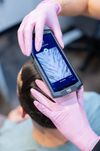
The conversation discusses using USB microscopes for scalp photos and provides a link to an overview of trichoscopy. Treatments mentioned include Minoxidil, finasteride, and RU58841.
Finasteride and Nizoral shampoo with Ketoconazole are used for hair loss treatment. Liquid Chromatography–Mass Spectrometry (LC-MS) is recommended over Enzyme-Linked Immunosorbent Assay (ELISA) for more accurate DHT testing.
The conversation discusses using very low dose topical finasteride to achieve specific serum DHT reduction percentages. It concludes that finasteride dosage increases linearly between 5-30% DHT reduction but requires exponential increases for reductions up to 70%.
A user recommends using a microscope to assess hair density and track hair loss progress, finding it useful for evaluating treatment effectiveness, particularly with dutasteride and minoxidil. They advise against obsessing over hair loss and emphasize focusing on other meaningful life aspects.
High frequency ultrasonography and HR-MRI can help identify hair shedding causes like inflammation and fibrosis. The conversation discusses the potential of using these technologies to evaluate treatments like Verteporfin for hair regeneration.
The conversation discusses using 23andme to determine if someone might respond well to minoxidil for hair loss treatment, and mentions the user's personal experience with micro-needling and minoxidil.
A new light therapy claims to reduce hair loss markers by 92% using a specific wavelength range. Users discuss the cost and effectiveness of devices, with some expressing skepticism and others considering alternative treatments like red light therapy and vitamin D exposure.
Using a microdose of finasteride on the scalp with minoxidil as a carrier may have positive effects with minimal side effects. The user is also considering the effects of sulforaphane or broccoli sprouts on hair loss.
The conversation discusses the sale of a premixed KY19382 solution for research purposes, highlighting previous unsuccessful group buys and the formulation process. Prices and purchasing options for KY19382 solutions and powder are provided.
The post and conversation discuss different methods of applying hair loss treatments directly to the scalp. The original poster suggests using a 1ml TB Syringe & Ophthalmic Cannula for precise application, while others share their own methods, including sprays, droppers, and simple syringes.
Ultrasound imaging can predict hair shedding and assess hair growth stages by analyzing hair follicle characteristics. The conversation also discusses using ultrasound for personal hair analysis and mentions the potential use of infrared emission for hair treatment.
The user added melatonin to their 5% minoxidil solution for hair growth, using a concentration of 0.0033%, which equates to roughly 2mg for a 60ml bottle. They later reported no significant difference and planned to continue the treatment for a few more months before potentially stopping to observe any changes in shedding.
Topical finasteride concentrations are likely much higher than necessary for effective follicular DHT suppression, with current standards being 100-1000 times above the theoretical minimum. Lower concentrations (0.001-0.0025%) might still work locally while minimizing systemic exposure.
A user wants to dilute a melatonin sublingual spray to 0.0033% for use as a topical hair loss treatment. They ask if distilled water can be used for dilution and how much is needed for stability over months.
The user is experimenting with topical melatonin for hair loss by dissolving melatonin tablets in a solution, but is having trouble with dissolution and is curious about others' methods of application and any effects on energy levels. They mention considering mixing with minoxidil but have not done so, and suggest that melatonin is best used at night.
Keratin microspheres may offer additional mechanisms to combat hair loss compared to minoxidil. The process to create these microspheres is relatively simple and can be done at home with basic equipment.
Nanoxidil is considered to have better absorption and fewer side effects than minoxidil, with added DHT blockers. The user is questioning if switching to the more expensive Spectral.DNC-N is worthwhile compared to cheaper options like Kirkland minoxidil.
A dermatologist checked for hereditary hair loss using blood tests and plans to perform a trichogram. The user had slightly low Vitamin D3 levels, and the trichogram may help confirm androgenetic alopecia.
Analyzing data on pyrilutamide, a potential hair loss treatment, as well as the effectiveness of other treatments such as Minoxidil, Finasteride, and RU58841.
A user who shared progress pictures of their scalp using a microscope camera, demonstrating the difference between healthy and miniaturized hair. Various explanations for the cause of this were discussed, such as DHT build-up in scalp sebum causing an autoimmune response leading to inflammation and eventual hair loss, with some suggesting a do-it-yourself treatment involving adding ascorbic acid powder to shampoo.
A user is developing a tool to track hair density, aiming to help those using treatments like minoxidil. They seek feedback on the tool's usefulness and are considering a low-cost model to cover expenses.
A user tried the Rapid Minoxidil Response Test (TrichoGene) and found they don't respond to topical Minoxidil, so they added tretinoin. The test is available internationally, and another user is considering ordering it.
OP mixed RU58841 with minoxidil and initially saw crystals, but realized they were bubbles. They asked for advice on application frequency for a 5% solution.
The user wants to reduce their dose of topical finasteride to 0.1-0.2mg and is considering mixing 0.2ml of their current finasteride + minoxidil serum with 0.8ml of a minoxidil-only serum for better scalp coverage. They are asking for advice on whether this method is effective or if there's a better way to dilute the finasteride solution.
Minoxidil was applied to a single miniaturized hair follicle over four months, resulting in less miniaturization but not yet terminal growth. The user used a 5% minoxidil solution, specifically the Regaine brand, and observed changes using a handheld WiFi microscope.
A user bought questionable RU58841 powder from AliExpress and seeks a way to test its composition in Europe. Another user suggests using Janoshik for testing.
Users discuss the effectiveness of low-dose topical finasteride (0.005-0.05%) for hair loss, often combined with minoxidil. Some report stable results or new growth, but it's unclear if improvements are due to finasteride or minoxidil.
Using roll-on bottles for applying minoxidil and RU58841 improves application efficiency and reduces product waste. Topical treatments are used continuously, except on microneedling days.
Topical finasteride as a potential alternative to oral finasteride for reducing DHT levels on the scalp with fewer side effects, and other hair loss treatments such as minoxidil.