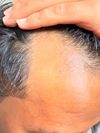
Minoxidil alone gave one user only short fuzzy hair after a year. They're now trying a 0.5 microneedling roller and seeking opinions on its effectiveness after using minoxidil.
The user has been using Minoxidil and Finasteride for over a year with limited success and is now trying microneedling. They seek advice on using hyaluronic acid to help the microneedling pen glide smoothly on the scalp.
The conversation is about the use of microneedling, specifically with a derma stamp, for hair regrowth. Users discuss their experiences, pain levels, and the satisfaction of taking control over hair loss, with some mentioning the use of Minoxidil to enhance results.
The user has been using oral Minoxidil, Finasteride, and Biotin for hair recovery and is considering adding topical Minoxidil and dermastamping to improve results. It is suggested to use micro-needling once a week with a 24-hour gap before applying topical Minoxidil.
The user experiences irritation from alcohols in minoxidil and is considering alternatives like trichosol mixed with polyethylene glycol or DMSO. They seek advice on the best nonirritating option.
Microneedling with exosomes is being considered for hair regrowth, but concerns exist about their effectiveness and safety, especially since exosomes degrade quickly and lack FDA approval. The user is seeking alternatives for non-responders to minoxidil and dutasteride, as exosomes may not provide additional benefits.
Microneedling can enhance hair growth results when combined with finasteride and minoxidil, with noticeable improvements in 1-2 weeks. The derminator 2.0 is recommended for best results.
The user is using a solution of 5% minoxidil and 0.1% finasteride with micro-needling and is considering adding 1mg oral finasteride. They notice small hairs on their forehead and are questioning if these indicate potential regrowth.
Microneedling's effectiveness for hair regrowth is debated, with mixed results from studies. Some believe it helps with blood flow and scalp health, while others see it as largely ineffective.
The user has been using 5% minoxidil once daily and microneedling with a 1.5 mm dermaroller weekly for three months, considering increasing minoxidil usage but avoiding finasteride due to libido concerns. Another person suggests considering other treatments like RU58841, alfatradiol, topical finasteride, clascoterone, or saw palmetto since not using a DHT blocker could be less effective.
The user has been using minoxidil, finasteride, and microneedling for two years, resulting in significant hair regrowth and plans for a 4000 graft hair transplant. The treatments have strengthened the donor area, making a hair transplant feasible.
Microneedling, when combined with finasteride and topical minoxidil, can enhance hair regrowth for male pattern baldness, especially at the temples. Users report varying success with needle depths between 0.5mm and 1.5mm, with stamps preferred over rollers to minimize scalp damage.
A 7-month update of hair regrowth achieved by using daily topical finasteride and minoxidil, combined with weekly microneedling. It is also noted that the results are different for females.
A user did not respond to finasteride, dutasteride, and oral minoxidil for hair loss after four years of treatment and is considering scalp micropigmentation (SMP). Other users suggest the hair loss pattern may indicate alopecia areata and recommend seeing a dermatologist.
The user shared progress pictures after using oral minoxidil 2.5mg, oral finasteride 0.25mg three times a week, and weekly 1.5mm microneedling for two months. They reported positive results in hair growth.
miR-205, a tiny RNA, can stimulate hair growth by softening aging hair follicle stem cells in mice. Future tests aim to see if this can work in humans.
User shared progress pictures after 2 months of using 5% topical minoxidil, microneedling, and recently adding 0.01% topical finasteride. The minoxidil solution also contains caffeine, azelaic acid, retinol, adenosine, biotin, and niacinamide.
A 26-year-old uses topical minoxidil, oral finasteride, and Nizoral shampoo for hair thinning and is considering microneedling but is unsure about the best approach. Users suggest using a 1.0mm dermaroller once a week, cautioning against overuse due to potential scarring, and some recommend combining microneedling with minoxidil for better absorption.
Microneedling may enhance hair regrowth by transferring stem cells to dormant follicles, improving the effects of minoxidil. Users discuss using microneedling with needle lengths around 1.5mm to stimulate hair growth.
The conversation humorously acknowledges the role of mice in testing Minoxidil for hair loss while also discussing the ethics of animal testing. Some users argue against animal testing, citing cruelty, while others defend its necessity for medical advancements.
A user shared progress pictures after using 1mg Finasteride daily, 5% Minoxidil twice daily, Nizoral Shampoo, and weekly microneedling at 1.5mm depth for two months, reporting no side effects and discussing their routine and supplements. Commenters reacted positively, with one advising caution with creatine and another endorsing the benefits of microneedling.
The user reported hair regrowth using microneedling with a Dr.Pen Ultima M8 over six months, without additional treatments like minoxidil or finasteride. They followed a schedule of varying needle depths and noted lifestyle changes to reduce stress.
Using a dermaroller with topical minoxidil and oral finasteride regrows hair and improves temple areas. Users highlight the benefits of microneedling tools and stress the importance of consistency and proper sanitation.
The conversation is about hair regrowth using micro-needling, RU58841, oral and topical minoxidil, ketoconazole shampoo, and dutasteride. Users suggest that noticeable results take longer than two weeks, though one user mentions seeing baby hairs.
The conversation is about experimenting with microneedling and growth factor topicals for hair growth, avoiding Minoxidil due to shedding concerns. The treatment includes microneedling, growth factor topicals, finasteride, biotin, and a caffeine shampoo.
The user is using Minoxidil, Finasteride, microneedling, and plans to add low-level laser therapy (LLLT) to treat hair thinning. They shared progress pictures showing results from May 8th to June 7th.
The conversation is about a hair regrowth regimen that includes using minoxidil, peppermint oil, a red light hat, and microneedling. The user is seeking advice on the effectiveness and frequency of these treatments.
The conversation is about a user sharing their positive experience with Scalp Micropigmentation (SMP) for hair loss, highlighting the natural look achieved by a specialized artist. The procedure cost $2600 and was done by Alex Corona in Panama City Beach, FL.
Topical finasteride and minoxidil, combined with microneedling, are recommended for treating thinning hair areas, with 1-2 sprays daily being effective and having fewer side effects than oral finasteride. Starting microneedling at 1.0mm is advised for effectiveness while minimizing invasiveness.