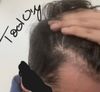
The conversation discusses hair regrowth and miniaturization, with the user transitioning to oral dutasteride and oral minoxidil, and occasionally using topical minoxidil. The user observes baby hairs near the hairline but less on the scalp, indicating possible regrowth and shedding.
The user has been microneedling weekly for almost 8 months without seeing progress and is experiencing shedding. They are also using finasteride daily and Kirkland minoxidil twice a day, and had a hair transplant after starting finasteride.
The conversation discusses hair loss treatments, including topical and oral minoxidil, finasteride, RU58841, and microneedling. Users suggest adding oral dutasteride or finasteride for more effective results.
Minoxidil may not be effective due to low sulfotransferase activity, and the user considers adding tretinoin to the regimen. They are unsure about the timing and combination with microneedling.
User shared 126-day progress using Fin/Min/Niz/Microneedling for hair loss. Others discussed microneedling depth, results timeline, frontal coverage, and switching to Dutasteride.
TGF-B affects hair growth, both causing stem cell division and death depending on amounts. Amplifica's treatment injects Scube3 to increase TGF-B for hair growth.
A user reported significant hair regrowth after 3 months using 1mg oral finasteride, 1ml 5% topical minoxidil, and microneedling, along with biotin, vitamin D, iron, and zinc supplements. They are optimistic about continued progress despite initial skepticism.
2-deoxy-D-ribose, a sugar molecule, is found to be 80%-90% as effective as Minoxidil in promoting hair growth, showing potential for alopecia treatment. Concerns include high cost, lack of human studies, and possible side effects like diarrhea and nausea.
A person had success with micro-needling for hair growth but stopped and noticed hairline recession. They plan to restart treatment at age 40, using micro-needling, oral minoxidil, finasteride, a laser cap, topical minoxidil with tretinoin, collagen, and other supplements.
A 27-year-old Asian male is treating hair loss with 1mg oral finasteride, topical minoxidil twice daily, and 1.5mm microneedling weekly. The discussion is about his progress with these treatments.
The conversation discusses using minoxidil, vitamins, and microneedling for hair loss treatment over two months. Users inquire about the specific vitamins used and the ease of microneedling.
The conversation discusses a study comparing microneedling combined with minoxidil versus biotin/panthenol for hair loss. Results suggest biotin/panthenol may be superior to minoxidil, though the sample size was small.
A 24-year-old uses microneedling, tretinoin, topical and oral minoxidil, and oral finasteride for hair growth, noticing baby hair growth and initial side effects that resolved. Another user shares a similar regimen, excluding finasteride.
A 30-year-old is seeking advice on hair loss treatment, currently using oral minoxidil, finasteride, mesotherapy, and a supplement. They are experiencing shedding and are anxious about the effectiveness of the treatment, asking if they should continue or consider other options like topicals or microneedling.
User hoodoomoovoo discusses their interest in stem cell research and its potential for hair loss treatment. They share links to studies and mention ongoing trials, expressing optimism for a future solution to hair loss.
The user experienced significant hair regrowth using 1mg of finasteride three times a week, with mild side effects like gynecomastia and breakouts. They are considering starting minoxidil.
The user has been using Minoxidil and Finasteride for four years, added microneedling, and is considering increasing microneedling frequency and possibly using Dutasteride. They are seeking advice on improving hair regrowth and better tracking progress.
A 40-year-old shared 12-month hair regrowth progress using topical 5% Minoxidil with Finasteride, improved lifestyle, Nizoral shampoo, and microneedling. The user noticed improved hair density despite slow progress.
The user improved their hair loss from stage 5 to stage 3 using Minoxidil, Finasteride, and a Dermapen. They saw results after 6 months, experienced a shedding phase, then saw more gains, advising others not to be discouraged during the shedding phase.
The user is experiencing a difficult shedding phase after starting a hair loss treatment with oral finasteride, topical minoxidil, and microneedling. Despite the shedding, they remain hopeful for regrowth and plan to continue the treatment, encouraged by others' positive results.
Ninan50 uses 0.6 minoxidil, 0.05 finasteride, biotin, and dermarolling for hair loss. Plans to increase to 0.7 minoxidil and 0.125 finasteride, with positive progress seen.
A 31-year-old experienced significant hair regrowth using Minoxidil 5% topical twice daily and Finasteride 0.625mg daily, with additional microneedling. The user reported initial shedding, improved hair thickness, and no major side effects, impressing their dermatologist with the results.
The conversation is about experimenting with microneedling and growth factor topicals for hair growth, avoiding Minoxidil due to shedding concerns. The treatment includes microneedling, growth factor topicals, finasteride, biotin, and a caffeine shampoo.
A 28-year-old male using Tugain 10 minoxidil, Finpecia 1mg finasteride, Cipla Ketoconazole shampoo, and dermarolling 0.5mm weekly for 3-4 months is seeing some hair regrowth. Encouragement is given to continue the regimen.
The user shared progress pictures showing hair regrowth after 9 months using 1mg oral finasteride, topical Minoxidil, and Stemoxydine. They experienced a recent shedding at the hairline but are seeing new hair growth.
The user experiences immediate hair shedding linked to stress, unlike typical telogen effluvium, and is seeking answers. A suggestion was made to use spironolactone and topical minoxidil to address potential DHT-related shedding.
Stem cell hair restoration lacks scientific evidence and is often considered a scam. Effective hair loss treatments include hair transplants, Minoxidil, and Finasteride, but stem cell treatments are not proven.