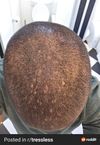
Topical treatments like minoxidil and finasteride are preferred for hair loss due to ease of use and natural appearance. Hair systems are considered high-maintenance and less genuine.
The conversation humorously discusses two resilient hair strands that resist DHT, with mentions of minoxidil and finasteride as ineffective treatments. Users joke about cloning the hairs and the mystery of baldness.
Rating treatments for hair loss, with the help of GPT-4, according to efficacy, evidence and tolerability; a combination of chemicals from research papers, custom compounds, and some suggestions from other users were included.
A 21-year-old male with a thyroid condition noticed his hair thinning uniformly without a receding hairline. He is considering using a 5ARI to prevent further baldness if he starts TRT.
A 33-year-old attempted hair regrowth after 10 years of baldness using topical finasteride, minoxidil, micro-needling, a laser cap, and later oral dutasteride. They noticed some regrowth, especially vellus hairs, and are considering a hair transplant or other treatments despite side effects.
A user is considering a hair transplant in a "mohawk" pattern with scalp micropigmentation (SMP) on the sides and back, questioning its feasibility and appearance. Others discuss donor region quality, potential scarring, and alternative treatments like dutasteride and RU58841.
PP405 and ABS-201 are promising treatments for male pattern baldness. PP405 shows rapid hair growth in human trials, while ABS-201 shows significant regrowth in animal studies but is still in early human trials.
The conversation humorously discusses using "pure willpower" as a method to combat hair loss, alongside treatments like dutasteride, finasteride, and RU58841. The original poster claims that this unconventional approach, involving shouting affirmations and avoiding distractions, has led to noticeable hair regrowth.
The user is concerned about hair loss despite taking finasteride and has a hair transplant scheduled. They experience scalp itching and burning, which hasn't been relieved by various treatments, and another user suggests using ghk-cu & ahk-cu serum and Koshine kx-826/pyrilutamide for relief.
Finasteride and Nizoral shampoo with Ketoconazole are used for hair loss treatment. Liquid Chromatography–Mass Spectrometry (LC-MS) is recommended over Enzyme-Linked Immunosorbent Assay (ELISA) for more accurate DHT testing.
Hair loss may be linked to the TRPS1 gene and protein, not just DHT. Amplifica's AMP-303 targets mesenchymal stem cells and shows promise in treating hair loss, unlike Pelage's PP405.
The user experienced significant hair regrowth after using 1.25mg finasteride for 7 months, with no side effects, and is considering whether to keep or remove a previous SMP (scalp micropigmentation). They avoided minoxidil due to dandruff and sensitive scalp concerns, and they use a specific dandruff shampoo once a week.
PP405 is a potential hair loss treatment that may reactivate dormant hair follicles, with Phase 3 trials expected. Some users are cautious, suggesting using finasteride in the meantime, while others are skeptical about PP405's effectiveness.
A user created a web app called TrichoMetrics to track hair loss using photos and metrics like density and thinning. The app supports tracking treatments like Minoxidil and finasteride, with features for setting baselines, comparing progress, and logging treatment adherence.
The user noticed small circular hairless spots after a buzz cut and has been using finasteride, dutasteride, and oral minoxidil for hair loss. They are experiencing continuous shedding and thinning, and it is suggested they consult a dermatologist for a scalp examination and possible biopsy to determine if it's alopecia areata or androgenetic alopecia.
The user is trying alternative hair loss treatments like caffeine shampoo and dermarolling before considering minoxidil or other advanced treatments, and has noticed an increase in vellus hairs and some strong terminal hairs after two months of daily caffeine shampoo use. They plan to continue the treatment and document progress.
The conversation discusses hair loss treatments, including finasteride, microneedling, minoxidil, and PTD-DBM. The user has not noticed significant regrowth and is considering cost-effective options like valproic acid.
Dutasteride raises scalp testosterone by 99%, which may not be ideal for those sensitive to all androgens. Some argue finasteride's balancing act might be better, while others believe dutasteride is superior for hair regrowth.
A user shaved their transplanted hair during quarantine and shared positive results after one year, using Minoxidil 5%. They had 1,500 hairs transplanted via the DHI method with no visible scarring.
Pelage executives' hairlines were discussed, with speculation about them using PP405 for hair regrowth. Concerns were raised about using untested drugs, with some suggesting executives might not risk using them without safety data.
A 31-year-old man with a long history of hair care is considering a hair transplant and is worried about using Finasteride and Minoxidil due to potential side effects. He seeks advice on whether to start Finasteride before or after a transplant and how to test for sensitivity to these treatments.
The post discusses a successful hair loss treatment involving a hair transplant, finasteride, and minoxidil. The user underwent a 2000 graft hair transplant at the hairline in a clinic in Sweden.
Hair growth can be induced without stopping DHT, as seen with Minoxidil. HMI115 may work by promoting follicle growth, not targeting the root cause of hair loss (DHT).
The conversation discusses a user's experiment of "burning the scalp" to treat hair loss, with mixed opinions on its effectiveness. Some suggest returning to proven treatments like finasteride and minoxidil, while others note slight improvements in hair density.
The conversation is about potential causes of hair loss and treatments, including topical and oral minoxidil, finasteride, and dutasteride, with a focus on checking for vitamin deficiencies and conditions like Lichen Planopolaris. It also discusses the skepticism around certain tests and the success of hair transplants.
A 31-year-old male considering returning to finasteride at a lower dose or using topical finasteride to assess his Norwood scale for a potential future hair transplant. He previously stopped finasteride due to side effects and has been shaving his head.
The conversation discusses the scalp tension theory as a potential factor in hair loss, alongside DHT, inflammation, and other mechanisms. Treatments mentioned include finasteride, minoxidil, and botox injections, with some users exploring additional methods due to varying effectiveness.
The conversation discusses the "bleach test" for minoxidil, where minoxidil turns yellow when mixed with bleach. The user tested liquid minoxidil, rogaine foam, and minoxidil tablets, all of which turned yellow, suggesting a reaction specific to minoxidil.
Hair loss theories discussed include poor blood flow, scalp tension, inflammation, and DHT. Treatments mentioned are massaging scalp, minoxidil, finasteride, and RU58841.