Search
for
Sort by
Community Join
30-60 / 1000+ resultscommunity Anyone been a non responder to topical min but responded to tretinoin and min combination?
Combining minoxidil with tretinoin may help those who don't respond to minoxidil alone. Some users report better results with this combination, along with oral minoxidil and finasteride.
community 3/9/26 to 7/5/26 results - Oral Min + Fin + GHK-Cu (SubQ)
community How deep do you microneedle and do you bleed?
The conversation discusses microneedling for hair loss, with the original poster experiencing pinpoint bleeding after using needles of 1.25mm and 0.5mm, possibly due to adding GHK-Cu to their treatment regimen. They are inquiring if others bleed at similar depths.
community Diffuse thinning chronicles pt. 2
A 27-year-old Asian male is treating hair loss with 1mg oral finasteride, topical minoxidil twice daily, and 1.5mm microneedling weekly. The discussion is about his progress with these treatments.
community scalp inflammation and itching
community Non responsive diffuse thinning
The user has been experiencing diffuse hair thinning despite using finasteride, minoxidil, dermarolling, clobetasol cream, and PRP sessions. They seek advice on additional treatments and are advised to check vitamin D, iron, and thyroid levels.
community 8 month update. Topical fin/min, topical dut, mk677, RU, micro needling
User shared 8-month hair loss treatment progress using topical fin/min, topical dut, mk677, RU, and microneedling. They experienced watery semen as a side effect but saw significant improvement in hair growth.
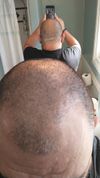
community (M49) 4 month progress - Fin 1 MG, microneedle once a week
The user reported noticeable hair improvement over four months using 1 mg of finasteride and weekly microneedling. Progress photos from October 2024 to January 2025 show positive changes.
community C60 + microneedling – on off days from Pyrilutimide
User discusses using C60 serum with microneedling at 1.75mm and asks if it's safe. Current routine includes daily Pyril on temples, weekly microneedling, and C60 serum on non-Pyril days.
community What do you think? M24 Fin + Minox + Microneedling
A 24-year-old has been using finasteride, oral minoxidil, and microneedling for hair loss. They reduced minoxidil due to heartburn and are considering a hair transplant.
community Deciding between oral & topical min. Please post photos of Hypertrichosis
User deciding between oral and topical minoxidil, concerned about hypertrichosis and myocarditis interaction. They're using topical finasteride, LLLT, natural oils, dermastamping, and scalp massage, and considering adding oral minoxidil.
community 4 weeks progress with Min+Fin+Microneedling (10 weeks total)
The user is using Minoxidil, Finasteride, microneedling, and plans to add low-level laser therapy (LLLT) to treat hair thinning. They shared progress pictures showing results from May 8th to June 7th.
community Molecular mechanisms triggered by Micronedlling -- Intersting Publication to better understand Dermarolling
This post and conversation are about the molecular mechanisms triggered by microneedling, specifically its effects on inflammation, tissue remodeling, epithelial proliferation, differentiation, and collagen synthesis. The discussion highlights the potential benefits of microneedling for hair loss treatment.
community Has anyone seen results from only microneedling? (Ie. no fin or mx) Or microneedling + tretinoin only?
People are discussing if microneedling alone or with tretinoin is effective for hair loss without using minoxidil or finasteride. They are questioning the viability of these treatments by themselves.
community Am I gaining? 1 month of microneedling + min + fin
The user is questioning if they have gained hair after one month of microneedling, Minoxidil, and finasteride. A reply suggests their hair looks fine and they should stop worrying.
community My experience and a discourse on “DUPA”
How diffuse unpatterned alopecia (DUPA) is not an invitation to self-diagnose oneself with aggressive AGA and that seeking a specialized dermatologist may help people experiencing hair loss. Treatment options discussed include topical clobetasol propionate, oral minoxidil, and discontinuing finasteride.
community Can anyone advise me on the best brand of 2% Minox to use and mix with pyrilutamide powder
Best 2% Minox brand for mixing with pyrilutamide powder and retinoic acid sought. Advice on specific treatments discussed.
community Oral min+fin(M21) 3 months progress
community deeper understanding of microneedling
community Mineral deficiencies vs MPB vs Thyroid
The user experienced hair improvement using a topical finasteride, minoxidil, and tretinoin combo, along with supplements like zinc, copper, magnesium, vitamin D3, K2, iodine, and boron. They believe these changes are due to addressing mineral deficiencies and possibly thyroid issues, despite skepticism from others.
community 5 and months finasteride and microneedling
A 35 year old male who has seen good results from Finasteride and microneedling, with minimal side effects. Replies to the post ask about the device used for microneedling, discuss the progress made, and offer encouragement.
community What if a NW7 transplanted the rest of their hair into a "mohawk" pattern and did SMP on the side and back of their head?
A user is considering a hair transplant in a "mohawk" pattern with scalp micropigmentation (SMP) on the sides and back, questioning its feasibility and appearance. Others discuss donor region quality, potential scarring, and alternative treatments like dutasteride and RU58841.
community 4 months into micro, got worse on the areas I needle
The user reports that after 4 months of microneedling, 10 months of Minoxidil, 2 years of finasteride, and using ketoconazole 3 times a week, their hair has become less dense in the treated areas. Despite initial shedding and continued treatment, they have not seen improvement and feel their body is resistant to the medications.

community Seeking Analysis: Receded Temple Closeups for Scarring or AGA Signs
The conversation is about analyzing receded temple closeups for signs of fibrosis, scarring, or androgenetic alopecia (AGA). Specific treatments like Minoxidil, finasteride, or RU58841 are not mentioned in the conversation.
community 2 month update. Fin+minox+ketoconazole+dermarolling+mk677+zink&d3
A user reports significant hair density increase and new growth at the temples after two months of using finasteride, minoxidil, ketoconazole, dermarolling, MK-677, zinc, and vitamin D3, with shedding stopping a week ago. They recently added MK-677 to their regimen.
community Anyone else have sneezing reflex when starting microneedle?
Microneedling can cause a sneezing reflex due to tingling in the nose. Users report this reaction, especially in the temple region.
community Kintor has released an investor relations memo regarding Chinese Phase III trials for Pyrilutamide
Kintor's Pyrilutamide (KX-826) showed hair growth in Chinese Phase III trials but did not significantly outperform placebo. The treatment was safe with no major adverse reactions reported.
community 10 day solo pyrilutamide update
The user started using pyrilutamide for hair loss on January 24, applying 1ml daily without other treatments, and after 10 days noticed reduced hair shedding and improved hair quality, with plans to continue for at least 6 months. They experienced chest pain initially, which could be related to starting methylphenidate or pyrilutamide, but the pain has since subsided.
community Pyrilutamide or RU Monotherapy?
Using Pyrilutamide or RU as monotherapy for hair loss? Share experiences.