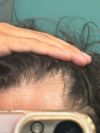
Minoxidilmax offering a 0.5% Pyrilutamide solution and debating the cost, effectiveness, and safety of using it alone or with other treatments such as Finasteride and Minoxidil.
The conversation discusses hair regrowth progress after 2.5 months using pyrilutamide and minoxidil. Participants note visible improvement in a short time.
The conversation is about a user's progress in hair regrowth using finasteride and minoxidil for 9 months, followed by dutasteride and minoxidil for 4 months, and recently adding RU58841. The user reports no side effects and anticipates further improvement.
PP405 is progressing to Phase 2b trials, with results expected in late 2025 or early 2026, and potential Phase 3 trials in 2026. Some users experienced side effects from finasteride and are hopeful for PP405 as an alternative treatment.
User doing PRP with exosomes for hair loss, sees possible regrowth after two treatments. Another user suggests providing before and after pictures for better assessment.
Pyrilutimide and CB-03-01, two treatments for hair loss, have similar clinical trial results despite different binding affinities to androgen receptors. Factors other than binding affinity, like the time a drug stays bound to the receptor, may influence their effectiveness.
A potential new hair loss treatment, HMI-115, and the possibility of discontinuing finasteride in favor of it. The conversation also includes discussion about other benefits of using finasteride.
Dr. Bloxham's 9-month update on FUT scar revision with Verteporfin shows promising results. Excitement is high for FUE, which appears highly effective based on Dr. Barghouthi's findings.
Pelage Pharmaceuticals announced positive Phase 2a trial results for PP405 in hair loss therapy. The conversation discusses the delay in publishing full results and the need for further trials and approvals.
A human trial involving verteporfin for hair regeneration, with the results showing some regrowth of 1-2 hairs in an area where a follicular unit was extracted. The conversation also suggested that future studies should involve higher doses and more frequent injections.
The user mixes their own RU58841 solution and found that increasing the ethanol content improved absorption and reduced scalp itching. A study on minoxidil showed that penetration increased with higher ethanol concentrations, reaching maximum penetration at 90% ethanol.
A new topical treatment, PP405, shows promising results for hair regrowth, potentially outperforming existing treatments like finasteride and minoxidil. However, it may still need to be combined with DHT blockers for optimal results, and its long-term effectiveness remains uncertain.
Genetics mainly cause hair loss, but diet, stress, smoking, and alcohol can worsen it. Treatments include finasteride, minoxidil, and lifestyle changes like a healthy diet and avoiding caffeine.
Scalp micropigmentation as a treatment for hair loss, and the importance of choosing a reputable practitioner to get a natural look. Different treatments such as laser removal were also discussed in relation to long-term maintenance.
Users discussed the effectiveness of Everychem's solution, similar to PP405, with some reporting improved hair thickness and new growth. Concerns were raised about safety and the legitimacy of the product, with some users advising against purchasing research chemicals.
The user has been using minoxidil, finasteride, dermastamping, and Nizoral for hair loss with initial success but is considering adding PRP due to slowed progress. Concerns about PRP include potential ineffectiveness and whether it could harm existing hair growth or interfere with current treatments.
The user is considering a second hair transplant or scalp micropigmentation to address thinning in the crown area and hide scars from a previous transplant. They have been using finasteride and minoxidil for three years but are concerned about the appearance of their donor area and the effectiveness of scalp micropigmentation.
The conversation is about a person using dutasteride and minoxidil for hair loss, considering adding RU58841 and PP405 for more density. They are seeking advice on using these treatments and exploring other options like GT20029.
The conversation discusses interest in participating in PP405 trials for hair loss treatment, with users expressing uncertainty about eligibility due to location. Participants are eager for updates and willing to pay for shipping if trials are limited to America.
PP405 is a potential hair loss treatment that may activate dormant hair follicles, but there are concerns about its effectiveness, cost, and side effects. Users discuss treatments like minoxidil, finasteride, and RU58841, expressing skepticism about PP405's long-term success and accessibility.
A user is experiencing uneven hair thinning and has tried topical minoxidil without success and finasteride with adverse effects. They are considering microneedling and PRP treatments while avoiding finasteride, and another user suggests trying dutasteride as an alternative.
Users discuss the release of Pyrilutamide 1% outside China and its potential effectiveness compared to 0.5%. They also mention using Minoxidil, Finasteride, and RU58841 for hair loss treatment.
The post and conversation are about a user who made their own Platelet-Rich Plasma (PRP) for hair loss treatment at home, using their own blood and a centrifuge. The responses vary, with some users supporting the DIY approach to save money, others expressing concern about the safety and effectiveness of the method, and a few joking about the lengths people will go to combat hair loss.
The person is using 1mg of finasteride daily, 2mg of minoxidil, and weekly dermarolling with a 1mm needle. They sometimes use topical minoxidil as well.
The user shared progress pictures after 4.5 months of using 0.5 mg finasteride and 2.5 mg minoxidil daily for hair loss, considering increasing the finasteride dose after 6 months. Some attribute the improvement to the hair transplant, while others inquire about changes in crown density.
PP405 is viewed skeptically, with some seeing it as overhyped and potentially ineffective compared to existing treatments like minoxidil and finasteride. While it shows some promise in activating dormant hair follicles, many believe it won't replace hair transplants or significantly outperform current options.
The user is using Dutasteride (90.5mg) and Minoxidil (2.5mg) for hair loss since October 2025 and is seeking feedback on progress by comparing photos from October 2025 and January 2026. They are asking for opinions on whether the treatment shows improvement.
PRP treatments for hair density show mixed results, with some users seeing minor improvements but not significant regrowth or halting of hair loss. Combining PRP with treatments like minoxidil, finasteride, or dutasteride may enhance results, but it is not a miracle solution.
A 23-year-old male has been experiencing hair loss since 2022 and has used minoxidil and dutasteride with reduced shedding but no hair regrowth. He is considering PRP with mesotherapy and red light therapy, GFC, or exosomes, with a preference for exosomes due to efficiency and a reputable clinic.