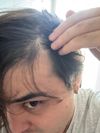
Mixing tretinoin with minoxidil for hair loss treatment. Some users prefer separate application or professional compounding due to potential solubility issues.
Combining minoxidil with tretinoin may help those who don't respond to minoxidil alone. Some users report better results with this combination, along with oral minoxidil and finasteride.
The conversation discusses the safety and effectiveness of a hair loss drug, GT20029, and the possibility of infrequent application, with users hoping for once-daily use and speculating on the drug's duration of effect on the scalp. Specific treatments mentioned include Minoxidil, finasteride, and RU58841.
GT20029 is a potential treatment for androgenetic alopecia, addressing the root cause by targeting androgen receptors, unlike Minoxidil or Finasteride. It is seen as a preventative measure rather than a regrowth agent, with hopes for market release soon.
The user experienced significant hair regrowth on temples and beard using a combination of Dutasteride, Tretinoin, and topical Minoxidil, but stopped oral Minoxidil due to heart pain. The user switched from Finasteride to Dutasteride due to aggressive hair loss.
The user did not respond to minoxidil and is considering using tretinoin to improve results. They also explored finasteride, microneedling, adapalene, red light therapy, and oral minoxidil as potential treatments.
The conversation is about a transgender individual's experience with hair regrowth using topical minoxidil and hormone replacement therapy (HRT), expressing concern about the slow growth and thin appearance of their hair. Some responses encourage patience and highlight the variability of results, while others discuss the role of HRT and its effects.
A 30-year-old man experienced significant hair loss after starting testosterone replacement therapy (TRT), which did not improve with daily finasteride and minoxidil. He is considering restarting TRT and is seeking advice on using pyrilutamide or RU58841 to prevent further hair loss.
Combining tretinoin with minoxidil may improve absorption by exfoliating the scalp, but results vary. Users suggest starting with low frequency to avoid irritation, and some recommend additional treatments like finasteride or microneedling.
Minoxidil 5% combined with 0.01% tretinoin may be as effective as using minoxidil twice daily. Users discuss switching to oral minoxidil for consistency, with concerns about side effects.
The user received trichotest results indicating finasteride is ineffective for them, and they plan to use dutasteride mesotherapy and add cetirizine to minoxidil. They seek advice on incorporating dutasteride into their regimen.
The user has scheduled a hair transplant after stabilizing hair loss with finasteride and minoxidil, considering additional dermarolling. They are advised to use 2500-3000 grafts conservatively for temple filling without lowering the hairline too much.
The user has been using minoxidil, finasteride, and microneedling for two years, resulting in significant hair regrowth and plans for a 4000 graft hair transplant. The treatments have strengthened the donor area, making a hair transplant feasible.
Oral minoxidil is considered unsafe due to severe side effects and requires close medical supervision, while oral finasteride is viewed as safe and effective. There is debate over the fear-mongering around finasteride and the downplaying of minoxidil's risks, with some users advocating for proper health screenings before use.
The user underwent a hair transplant in Boston, initially dissatisfied with the results, but later achieved significant improvement in hair density and natural appearance after consulting a different surgeon. They used finasteride, minoxidil, and low-level laser therapy as part of their treatment.
The user is using Minoxidil, RU58841, CB-03-01, WAY-316606, Ketoconazole, MK-677, and derma stamping to treat hair loss and has noticed new hair growth, especially around the temples and hairline. They apply different treatments at various times of the day and have seen improvements in skin condition and body hair texture.
User shares 8-month hair growth progress using 2.5mg oral minoxidil and 2ml topical minoxidil/finasteride mix. Others comment on noticeable improvement and discuss user's journey and treatment details.
A user experienced significant hair regrowth after 3 months of using 2.5mg oral minoxidil but also noticed unwanted body hair growth. Suggestions included switching to dutasteride or adding finasteride to address hair loss more effectively.
The user experienced significant hair regrowth after one year on male-to-female hormone replacement therapy (HRT) and nine months using minoxidil and finasteride. They noted a reduction in body hair and attributed much of the hair regrowth to the addition of minoxidil.
A user is seeking advice on how often to use a minoxidil solution with 0.025% tretinoin, considering using it every other evening instead of regular minoxidil twice a day. They are asking for experiences and opinions on this usage frequency.
Oral minoxidil is causing significant blood pressure fluctuations and increased heart rate, leading the user to consider switching to topical minoxidil and tretinoin. The user plans to consult a cardiologist and is likely to stop using oral minoxidil.
The user shared a 6-month update on using topical minoxidil 5% twice daily and dutasteride 0.5 mg weekly, reporting improved hairline and temple regrowth with no side effects. Microneedling was also mentioned as a helpful addition to the treatment.
Using Tretinoin with Minoxidil may increase Minoxidil's absorption and improve hair growth results. The user is seeking advice on how to apply both treatments effectively.
Hair loss progress discussed, treatments used include oils, scalp massages, serenoa pills, and dermastamp. User asks for advice without mentioning minoxidil or finasteride.
A user's 3-month experience with pyrilutamide to reduce hair shedding, and how it may not be strong enough to stop the thinning of their hairline. Other users mentioned the effectiveness of minoxidil and finasteride for treating hair loss.
The conversation is about hair loss and the use of minoxidil (Minoxidil) and finasteride (Fin) as treatments. The conclusion is that some users have seen success in maintaining their hair with minoxidil, but there are varying opinions on the effectiveness of the treatments.
The conversation discusses hair loss treatments, specifically the use of dutasteride, finasteride, and the potential of mesotherapy. The user experiences hair loss despite low DHT levels and considers localized dutasteride treatment, while others suggest consulting a dermatologist and exploring other causes like malabsorption.
The conversation discusses positive initial trial results for GT20029, a topical compound for hair loss that degrades androgen receptors, potentially requiring only weekly application. Participants express hope for this treatment to be more effective and convenient than current options like Minoxidil, Finasteride, and RU58841.
The user is seeking a replacement for topical minoxidil during a six-day vacation, considering options like intense massage or oral minoxidil. They are looking for advice on managing hair loss without topical solutions.
User experienced telogen effluvium and diffuse thinning, started using 5% minoxidil two months ago, and resolved several deficiencies. They report noticeable improvement in hair health and plan to update progress in a month.