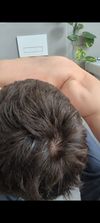
The user uses finasteride, minoxidil, and ketoconazole for hair loss. They are concerned if applying moisturizer before minoxidil affects its absorption or efficacy.
A user shared a 6-month update on using a daily tablet combining finasteride, minoxidil, biotin, and vitamins C, B5, and B6 to address hair thinning. They are pleased with the results, despite experiencing some facial hair regrowth as a side effect.
User regrew lost hair using microneedling, minoxidil, finasteride, Nizoral, fish oil, and collagen peptide. Progress was slow but constant, and patience was important.
Redensyl, which is a topical alternative to Minoxidil for hair loss. It may have advantages such as not making the hair greasy and lasting longer after discontinuing use than minoxidil. There are some positive reports from users, but also some negative ones, so it's unclear how effective this treatment will be in comparison to Minoxidil and other treatments like Finasteride or RU58841.
A user takes 5mg oral minoxidil, oral dutasteride, topical tretinoin, stemoxydine, topical minoxidil, and uses dermarolling for hair loss but sees less impressive, patchy regrowth compared to others. Another person suggests some online results may be enhanced with hair fibers, not just medication.
A 35-year-old man has used finasteride for 12 years and oral minoxidil at 5 mg for 2 years, achieving significant hair regrowth and density without side effects, avoiding a hair transplant. He recommends consistency with medication and highlights the effectiveness and affordability of oral minoxidil.
The user has been using finasteride for 6 months with decent results and recently added topical minoxidil. They are concerned that salicylic acid in their skincare products might reduce minoxidil's effectiveness.
The conversation discusses using 1.5mm microneedling to improve responses to Minoxidil for hair loss. One user humorously suggests more aggressive microneedling.
The conversation discusses hair loss treatments, mentioning minoxidil, finasteride, RU58841, VDPHL, GT20029, and follicle cloning as potential solutions. It also reveals that the discussion about PP405 was an April Fool's joke.
A 21-year-old man experienced positive hair regrowth results after using a homemade topical solution containing 0.030% finasteride and 5% minoxidil for four months. He reported no side effects with the Trichosol-based solution, unlike previous issues with alcohol-based formulas.
A user shared progress pictures after 50 days of using a compound with 10% minoxidil, 0.1% finasteride, and biotin, expressing satisfaction with the results. Another user commented positively on the progress.
Minoxidil and finasteride are used for hair regrowth, but initial shedding can be distressing. Consistent use is important, and many users eventually see regrowth and thickening.
Significant hair regrowth was achieved over six months using minoxidil, finasteride, microneedling, biotin and collagen shampoo, and MSM powder. The user feels more confident and may consider a hair transplant if necessary.
Minoxidil increases blood supply to the scalp, strengthening dormant follicles and extending the growth phase, but may increase scalp activity that can be countered with DHT blockers. Women experiencing side effects from finasteride or dutasteride for hair loss might consider alternatives like estrogen, especially if on birth control.
Trying out a new exosome treatment for male pattern baldness, in addition to increasing vitamin intake and using existing treatments such as Nizoral and scalp drops. The user has no expectations that the new treatment will work but is giving it a try anyway.
Some individuals do not respond to oral minoxidil for hair loss, despite it generally working by improving blood flow to hair follicles. Factors like metabolism, drug interactions, and individual variations in the drug's activation may influence its effectiveness.
At this point.
In this conversation, users discussed the risks of drinking topical minoxidil and suggested alternative treatments such as obtaining a prescription for oral minoxidil or finasteride.
Switching from topical to oral minoxidil caused heavy shedding and thinner, brighter hair. The user is seeking advice on whether hair can recover to its previous state.
The user discusses their experience with minoxidil for hair loss, noting that drinking coffee may reduce its effectiveness. They observed better results with the liquid solution and no coffee compared to using the foam solution and drinking coffee.
Using Tretinoin with Minoxidil may increase Minoxidil's absorption and improve hair growth results. The user is seeking advice on how to apply both treatments effectively.
The conversation discusses the use of oral minoxidil for hair loss, with some users suggesting combining it with finasteride for better results. Opinions vary on the effectiveness of minoxidil alone, especially for younger individuals, while others emphasize the importance of finasteride in treating male pattern baldness.
PP405, a topical LDH inhibitor, has shown to stimulate hair follicle stem cell proliferation in humans with moderate hair loss. They are advancing to more detailed trials this year.
Minoxidil foam can be used with styling products, but it's best to wait before applying fibers. Switching to night application may help maintain hairstyle.
Minoxidil helped regrow hair from NW3 to NW2 in 5 months despite initial shedding, with additional use of Vitamin D3/K2 on the scalp. Users discuss patience during shedding and the importance of continuing treatments like Minoxidil and Finasteride.
The conversation discusses hair regrowth using oral minoxidil and RU58841, with visible baby hairs appearing after two months. One user questions the choice of RU58841 over finasteride.
Minoxidil and finasteride work through different mechanisms; minoxidil-dependent hair requires continued use to maintain growth, while finasteride prevents further hair loss but cannot sustain minoxidil gains alone. Current treatments like minoxidil, finasteride, and others need indefinite use, as no permanent solution exists yet.
A user shared progress pictures showing significant hair growth over 3.5 months using Dutasteride, Minoxidil, and microneedling. They are pleased with the results but unsure how to style their growing hair.
The user used Minoxidil 5% for 18 months, seeing improved hair density but no change in the crown area. They are cautious about using Finasteride again due to past gynecomastia.