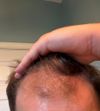
The conversation discusses using topical cetirizine for hair loss and questions its effectiveness and preparation. A user expresses interest in trying it if it can be dissolved in minoxidil.
RU58841 is not recommended for use around children due to potential exposure risks. Alternatives like CB-03-01 might be considered, but further research is advised.
A user shared their 3-year progress using 1mg finasteride and 5% topical minoxidil twice daily, reporting significant hair regrowth and some side effects like bloating, seborrheic dermatitis, and water retention. The user is happy with the results, noting improvements in both the crown and hairline.
Breezula's phase 2 showed reduced efficacy after 6 months, but phase 3 had positive results, causing confusion about any changes made to the drug. There is frustration over the long timeline for hair loss treatments, with some users expressing more interest in other potential treatments like GT-20029.
A dermatologist prescribed 0.5mg dutasteride every two days and 5mg Minoxidil daily for hair loss, suggesting dutasteride mesotherapy as an alternative. The discussion questions the effectiveness and cost of mesotherapy compared to oral treatments, with concerns about side effects and the dermatologist's approach.
Minoxidil sulfate is considered for those unresponsive to regular minoxidil, with some trying a 10% formulation from Folligenz. Concerns exist about the product's stability and transparency, but some users report positive initial results.
The conversation is about the best concentration of Tretinoin to use with Minoxidil for hair growth, with suggestions ranging from 0.025% to 0.05%. Users discuss personal experiences and plans to adjust Tretinoin concentration for better results.
The conversation discusses using Pyrilutamide, Alfatradiol 0.1%, and Minoxidil for hair loss treatment. Pyrilutamide is described as a strong antiandrogen, and Alfatradiol is noted for its effectiveness in inhibiting DHT on the scalp.
The user completed 6 months of using topical liquid minoxidil and oral finasteride, experiencing initial hair shedding followed by gradual regrowth after 2 months. They also dealt with dandruff and reported no negative impact on sex drive.
The user plans to start hair loss treatment with minoxidil, finasteride, and microneedling, considering oral minoxidil to avoid affecting their cat. They are concerned about potential shedding and the impact of vaping on hair loss.
Exosomes were used for hair loss treatment, showing results 33 days after the second session. The conversation also mentions Minoxidil, finasteride, and RU58841 as treatments.
The conversation humorously discusses hair loss treatments, mentioning "oral miraclegro," "topical roundup," "spectracide," "Cow Dung mesotherapy," and "weekly Foot stepping sessions." The user jokingly considers switching to "weed and feed" as a treatment.
A user's progress with hair growth using oral minoxidil, oral dutasteride and Nizoral shampoo every once in a while. Replies indicate that the user has seen good results from this treatment, including thickening and darkening of their hair.
Tretinoin may improve minoxidil's effectiveness for hair growth, but results vary; some users report no change or potential hair loss acceleration. Tretinoin is included in some topical hair loss treatments sold by dermatologists and online companies.
The conversation discusses whether using topical minoxidil in addition to oral minoxidil 5 mg daily will enhance hair growth. The user also applies a Biotinyl tripeptide cream/lotion and is concerned about the efficacy and side effects of oral versus topical minoxidil.
Dutasteride and oral minoxidil are not effectively stopping hair loss for the user, despite trying various treatments including ketoconazole shampoo. Suggestions include increasing dosages, considering alternative treatments, and consulting a doctor.
A user shared progress pictures showing significant hair growth after taking oral finasteride and oral minoxidil for 30 days. Other users expressed disbelief at the rapid results, with some attributing changes to camera effects.
The user experienced significant hair regrowth over four months using oral finasteride, oral minoxidil, micro-needling, and rosemary oil. They reported no side effects and emphasized the importance of continuing the treatment to maintain results.
A user experienced increased hair fall after starting Minoxidil tablets, despite following a comprehensive treatment plan for Seborrhoeic Capitis and Androgenetic Alopecia. They are unsure if the Minoxidil tablets are the cause and seek advice.
The conversation discusses using minoxidil with microneedling and considering tretinoin to enhance hair growth, especially for those who are weak responders to minoxidil. It also explores the potential of using tazarotene, a stronger retinoid, to boost minoxidil's effectiveness and addresses purchasing tretinoin from Germany.
Hope Medicine's announcement of the HMI-115 Phase II clinical trial for androgenetic alopecia in China; other related trials have been conducted or are ongoing in different countries, including Australia, US, and Europe. There is speculation that the product may be accepted across borders without additional testing.
Switching from oral to topical dutasteride can cause shedding due to changes in DHT levels, and it's recommended to overlap both treatments to minimize this effect. Topical dutasteride may cause scalp irritation, and the user is considering dutasteride mesotherapy as an alternative.
Dr. Reddy's Mintop Yuva 5 Minoxidil uses benzyl alcohol instead of ethyl alcohol or propylene glycol. The user is inquiring if this formulation causes dandruff or skin peeling and if its efficacy is affected.
Low-dose daily aspirin reduces the effectiveness of topical minoxidil in treating androgenetic alopecia. Aspirin inhibits sulfotransferase enzymes, which are necessary for minoxidil to work.
The conversation discusses alternative hair growth treatments to minoxidil, including Stemoxydine, Tretinoin, adenosine, Baicalin, castor oil, Latanoprost/bimatoprost, and Redensyl. Users share their experiences and opinions on the efficacy of these treatments.
The user is using minoxidil, finasteride, dermarolling, and other treatments for hair regrowth, showing promising results in the temple area. Despite some skepticism, there is optimism about potential improvement.
Different minoxidil formulations affect hair growth and side effects. Higher propylene glycol and pH levels improve effectiveness but can cause scalp irritation.
The user Consistent-Gene1334 shared their positive results in regrowing hair by using topical minoxidil and oral finasteride. Other users in the conversation praised the results and discussed the effectiveness of these treatments for diffuse thinning.