The conversation is about whether doctors are offering hair transplants using verteporfin. Dr. Bargouthi in Jordan and Dr. Bloxham in New York are currently conducting trials on it.
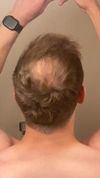
The conversation discusses struggles with diffuse thinning and hair loss treatments, including the use of dutasteride, minoxidil, and finasteride, with limited success. The original poster regrets having a hair transplant at 21 due to weak donor hair and ongoing thinning.
The user shared progress pictures of their hair growth after using finasteride, oral minoxidil, and undergoing a hair transplant with 4,200 grafts in Istanbul. They reported thicker hair and noticeable crown regrowth, with no side effects from the treatments.
AH-001 is a new topical treatment designed to degrade androgen receptors, targeting the root cause of androgenetic alopecia without the side effects of oral treatments like finasteride. It has shown a strong safety profile and good local tolerability in early trials.
The user is asking for opinions on whether their hair growth is due to Pantostin and hormone treatments. One commenter confirms regrowth and asks about the hormone treatments.
A user underwent a 3750 graft hair transplant in Turkey, initially promised 4500 grafts, and is satisfied with the results despite some concerns about donor site size and crown coverage. The user has been on medications like finasteride and minoxidil for about four months and may consider a second transplant in the future.
KX-826 is being considered as a potential alternative to finasteride for hair loss, but it is not expected to be more effective. Combining KX-826 with finasteride and minoxidil may provide better results than using it alone.
A user trying to avoid an expensive hair transplant, and the replies suggesting they wait two years on treatment before deciding if they need a transplant or not.
The user experienced significant hair regrowth using finasteride, minoxidil, and a 4,000-graft hair transplant performed by Dr. Nader in Reynosa, Mexico. The results were natural-looking, and the user plans a second transplant for additional density if needed.
A 30-year-old shared their successful hair restoration journey using a combination of liposomal topical finasteride and minoxidil, vitamins, and a second hair transplant in Greece, resulting in life-changing improvements without side effects. The user emphasized the importance of proper research for hair transplant clinics and expressed gratitude for finding an effective treatment protocol.
The conversation discusses avoiding caffeine after Platelet-Rich Plasma (PRP) treatment for hair loss because caffeine is a vasoconstrictor, which can reduce blood flow and hinder the healing process that PRP aims to promote.
The user experienced noticeable hair thickening and new growth after two months using a topical solution of minoxidil and finasteride. Continued improvement is expected, with potential for a full head of hair after further treatment and possibly a transplant.
A 23-year-old male is using topical minoxidil and oral finasteride for hair regrowth, noticing some progress on his temples and seeking advice on whether this indicates overall scalp improvement. Users suggest patience, as regrowth can take time, and advise against a hair transplant, noting that the current treatment seems effective.
Verteporfin reduces scar tissue in hair transplants but doesn't significantly regrow hair follicles. More testing is needed to determine its effectiveness.
The user experienced good hair regrowth over a year using finasteride every other day and topical minoxidil. Some users suggested additional treatments like derma stamping or switching to oral minoxidil for better results.
The user is considering switching from liquid to foam minoxidil for hair loss at the crown, while already using finasteride pills. They are also contemplating a hair transplant due to ongoing hair thinning.
The user has been using minoxidil, finasteride, dermastamping, and Nizoral for hair loss with initial success but is considering adding PRP due to slowed progress. Concerns about PRP include potential ineffectiveness and whether it could harm existing hair growth or interfere with current treatments.
The user is experiencing hair regrowth using daily 5% minoxidil and weekly microneedling, and plans to add finasteride soon. They are considering the effectiveness of once-daily minoxidil and adjusting microneedling needle size.
SCUBE3 is a promising new molecule that can restart hair growth by reawakening dormant hair follicles. Users express skepticism about its availability timeline, with some hoping for release by 2026.
Progress in hair loss treatments is slow, with current options like Minoxidil and finasteride being the most effective for now. A true cure, possibly involving stem cells or donor multiplication, is still considered far off.
Using high doses of testosterone with RU58841 to create an androgen-free environment for hair regrowth is suggested, but concerns about heart health and the effectiveness of this approach are raised. Alternatives like topical estrogen, progesterone, and other treatments like finasteride and dutasteride are discussed.
The conversation is about someone using finasteride and minoxidil along with microneedling as a treatment for hair loss, and there's a mention of scalp tattooing as an alternative or additional approach. Some responses mock the approach, while others inquire about the specifics of the treatment and its effectiveness.
The user recently started topical dutasteride and microneedling, and has been using RU58841 and Minoxidil for 16 months. They are curious if small black dots at their hairline indicate hair regrowth.
Veradermics' phase 2 trial of slow-release oral minoxidil shows promising hair regrowth with minimized side effects, gaining significant attention and funding. PP405 is also noted for its potential as a side-effect-free alternative.
The conversation discusses the potential of new hair loss treatments, with a focus on pyrilutamide, gt20029, and topical alfatradiol, and the possibility of improving their effectiveness through methods like increased concentration and microneedling. Dutasteride is also mentioned as a stronger option.
The user is considering switching from finasteride to dutasteride for hair loss. They are unsure if GT20029 can regrow hair, particularly on the temples. Another user mentions that regrowth on finasteride can take up to 2 years.
Current treatments like finasteride, minoxidil, and derma rolling are considered the best for hair loss, while new treatments such as GT20029, PP405, and others are in various trial phases with results expected in the coming years. There is cautious optimism about the affordability and effectiveness of these upcoming treatments.
A user who reported positive results from using 1.0mg Finasteride daily and 1.5mm Microneedling every two weeks for eight months, as well as advice about adding Minoxidil to further improve the regrowth process.
Hair loss and potential treatments, primarily focusing on Finasteride and Minoxidil. Other solutions discussed include PRP, dermarolling, LLP, and scalp tension relief.
Bimatoprost 1% and 3% solutions showed better hair regrowth than minoxidil 5%. The user plans to test a homemade bimatoprost solution on their scalp and share results.