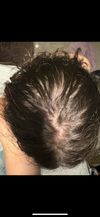
Users discuss finding reliable sources for RU58841, focusing on lab tests, batch consistency, and community reputation. Some mention using alternatives like pyrilutamide.
NMN shows promise in promoting hair growth by reducing oxidative stress and weakening androgens. It may be a beneficial addition to hair loss treatments like Minoxidil and Finasteride.
The trial for TDM-105795 has been completed, and it was in phase 2A. The discussion seeks input on the next phases, 2B or 3, based on safety and efficacy.
Tressless GPT is now free and accessible for hair loss advice. Treatments discussed include Minoxidil, finasteride, RU58841, dutasteride mesotherapy, topical melatonin, microneedling, and rapamycin.
A user started using RU58841 a month ago after using finasteride and minoxidil for nearly three years, hoping for hair regrowth at the temples. Other users suggest vitamin B supplements and microneedling to improve hair thickness, and one mentions the possibility of a hair transplant for the temples.
Kintor is producing a cosmetic with KX826, starting at 0.5% concentration and moving to 1%. The 0.5% concentration wasn't as effective as minoxidil and finasteride, but the 1% concentration shows promise.
The user successfully improved their hair from Norwood 3 to 0.5 using finasteride, topical minoxidil, microneedling, and a hair peptide, and plans to maintain it with dutasteride. They are leaving the forum due to emotional distress caused by the community.
A potential non-invasive topical treatment targeting the WNT Signaling Pathway for hair regeneration is being researched, with positive results on human hair follicle cells. Current effective treatments for hair loss include Minoxidil, finasteride, and hair transplantation.
User tried dutasteride, topical finasteride, oral minox, dermawounding, saw palmetto, pumpkin seed oil, and ketacozonole for hair loss. Improvement was temporary, now trying RU58841 and seeking help.
A 27-year-old male experiencing hair loss at Norwood 3 level has tried minoxidil and finasteride but stopped finasteride due to side effects. He is exploring alternatives like Dermapen, Regenepure DR Shampoo, saw palmetto, and considering aromatase inhibitors for managing side effects, while also seeking advice on DHT blockers.
Tretinoin and microneedling both enhance hair growth through different mechanisms, with microneedling being considered safe for long-term use. Optimal microneedling needle length varies, but 0.8 mm is suggested for hair growth, and a Dermastamp is recommended to avoid skin damage.
The user is seeking advice on maximizing hair growth while using oral finasteride, topical minoxidil, Nizoral, and microneedling, and is considering adding a laser diode cap, topical finasteride, retinol, and caffeine. Suggestions include using tretinoin with minoxidil for better absorption, switching to dutasteride, and considering RU58841 or pyrilutamide.
Eirion Therapeutics is recruiting for phase 1 of ET-02 in Texas, which showed promising hair growth results in non-clinical studies. ET-02 demonstrated significantly more hair growth compared to Minoxidil.
The conversation discusses hair loss treatments, specifically mentioning Minoxidil, finasteride, RU58841, and TB-500 Thymosin Beta-4. It critiques the credibility of biohacking claims.
PP405 and GT20029 are new hair loss treatments with different mechanisms from traditional options like Minoxidil and Finasteride. PP405 targets hair follicle stem cells to reactivate growth, while GT20029 works as an androgen receptor deleter, both requiring ongoing use for effectiveness.
The conversation is about selling KY19382 powder, a novel activator of Wnt/β-catenin signaling, and Kolliphor EL liquid for vehicle formulation. The seller offers worldwide shipping.
A 57-year-old man with male pattern hair loss and insulin resistance experienced hair regrowth and weight loss after using tirzepatide, without other hair treatments. Dysregulated glucose metabolism is linked to hair loss, with tirzepatide potentially improving hair density by normalizing insulin resistance.
The conversation is about seeking information on GT20029 from Kintor Pharmaceutical as a potential hair loss cure and inquiring about experiences with CosmeaRNA.
The user is considering using topical finasteride for thinning hair around the middle part, vertex, and crown, and is unsure if the whole scalp is thinning. Another user suggests oral finasteride is more effective than topical, and recommends consulting a dermatologist for proper treatment.
The user is using dutasteride, oral minoxidil, and topical minoxidil with tretinoin for hair loss. They are considering whether to continue this treatment or opt for a hair transplant for their temples.
Peptides, specifically GHK-Cu, are being considered for hair growth benefits, such as increasing blood flow to the scalp and preventing hair follicle shrinkage. A user reported starting GHK-Cu after hearing it made a friend's hair thicker.
The conversation discusses experimenting with microneedling for hair loss, specifically addressing non-responsiveness and the use of topical treatments like dutasteride, minoxidil, and tretinoin. The user seeks advice on effective frequency and depth combinations for better results.
The user experienced severe side effects with topical finasteride, continued using Minoxidil, and was advised to try topical dutasteride after a test suggested they might not respond to finasteride. They are hesitant to start the new treatment due to past side effects.
Magnesium L-Threonate may help treat balding by reducing DKK-1 expression without affecting DHT. Users discuss its potential effectiveness and application methods, with some considering trying it topically.
Topical finasteride concentrations are likely much higher than necessary for effective follicular DHT suppression, with current standards being 100-1000 times above the theoretical minimum. Lower concentrations (0.001-0.0025%) might still work locally while minimizing systemic exposure.
PP405 is a potential hair loss treatment that inhibits mitochondrial pyruvate carriers, increasing lactate dehydrogenase activity and stimulating hair follicle stem cells. In a phase 1 trial, 31% of participants showed over 20% hair density increase with PP405 treatment.
PP405 shows promise in stimulating new terminal hair growth by activating dormant follicles, with no systemic adverse effects observed in a short-term trial. However, long-term efficacy remains unproven, and further trials are needed to confirm its potential as a hair loss treatment.
The conversation discusses a user's plan to inject NAD+ and GHK-Cu into their scalp to improve hair health, with concerns raised about the risks of infection and necrosis. Alternatives like finasteride, dutasteride, microneedling, oral minoxidil, and scalp massages are suggested.
A user experienced a tingling sensation in their mouth after taking a cut finasteride pill, possibly due to inactive ingredients like mannitol or sodium lauryl sulfate. Tingling is not a common side effect or typical allergy sign, but monitoring for unusual reactions is advised.