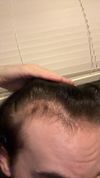
The conversation discusses the effectiveness of topical Rapamycin for hair regrowth and color restoration. Specific treatments mentioned are Minoxidil, Finasteride, and RU58841.
The conversation is about using pyrilutamide for hair loss, with the original poster also using minoxidil and nizoral for maintenance. The poster experienced side effects from finasteride and is seeking feedback from long-term pyrilutamide users.
The conversation discusses the use of topical finasteride and minoxidil for hair loss and inquires about the effectiveness of adding RU58841. Participants share experiences and opinions on the potential benefits of including RU58841 in their treatment regimen.
The conversation discusses using estradiol mesotherapy to replicate hormone replacement therapy results while minimizing systemic exposure. It also covers the use of Spironolactone cream, which reportedly has no systemic side effects, and the potential risks of using bicalutamide and Spironolactone in men.
Chime Biologics and Hope Medicine are speeding up the launch of a first-in-class antibody drug, HMI-115, for endometriosis and androgenic alopecia. The treatment involves a series of subcutaneous injections, has shown promising results in phase 1, and continues to promote hair regrowth even after the treatment is stopped.
PP405 is moving to late-stage trials, showing potential for hair regrowth, with 31% of male patients experiencing a 20% increase in hair density. Veradermics is developing an oral minoxidil version, and there is interest in combining treatments for better results.
Pyrilutamide shows promising hair growth results, but skepticism exists due to potential biases and lack of blinding in the study. Concerns about side effects and legitimacy of the product persist, with comparisons to finasteride and discussions on post-finasteride syndrome.
Norwood 7 hair loss is often excluded from trials to ensure treatments appear more effective and to reduce costs. Some believe treatments effective for Norwood 5 could work on Norwood 7, but companies prioritize market readiness.
Dutasteride mesotherapy, combined with peptides and exosomes, is being considered for hair loss treatment. One user suggests that oral finasteride or dutasteride mesotherapy may not be necessary if already taking oral dutasteride.
The conversation is about using natural DHT blockers like pumpkin seed oil and saw palmetto extract for hair loss. The user has been using minoxidil, derma rolling, vitamin D, and biotin but is considering finasteride next.
AMP-303, a new injectable treatment for androgenetic alopecia, showed promising results in increasing hair count and density with minimal side effects. The treatment demonstrated significant hair regrowth and durability, offering new hope for those with hair loss.
The conversation is about the effectiveness of Redensyl for hair loss and whether to continue using Minoxidil alone, despite planning for a hair transplant eventually. The user also mentions using dermarolling, PRP therapy, and Nutrafol.
Kintor plans to release pyrilutamide foam and a plant-based Koshine by year-end, with GT20029 progressing in their pipeline. Users are pleased about the absence of propylene glycol (PG) in the new products.
RU58841's potential side effects, particularly heart palpitations, are debated, with some attributing them to contamination with minoxidil. Users report mixed experiences, with some seeing no side effects and others cautioning about the lack of reliable data on RU58841's safety.
Pelage PP405 is a new hair loss treatment in trials, potentially reactivating dormant hair follicles without affecting hormones. Results are expected in February 2025, offering an alternative to minoxidil and finasteride.
A 26-year-old individual treating hair loss since 19, using a regimen of Finasteride, Cyproterone, Oral Minoxidil, Microneedling, Dutasteride, and newly added RU58841. They're seeking advice from other RU58841 users about their experiences.
Topical finasteride (P-3074) can inhibit scalp DHT by up to 70%, with some users experiencing systemic absorption similar to oral use. Users discuss varying application frequencies and concentrations, with some noticing side effects when overused.
Mesotherapy for hair loss, including treatments like finasteride and dutasteride, is discussed, with some users reporting pain and mixed results. Alternatives like PRP injections and topical treatments such as minoxidil, RU58841, and tretinoin are also mentioned as effective options.
Hair loss treatments discussed include Minoxidil, Finasteride, RU58841, and Nizoral shampoo. Nizoral's effectiveness is debated, with some suggesting it works as a weak antagonist for androgen receptors, while others attribute its benefits to anti-fungal and anti-inflammatory properties.
Kintor's Phase II U.S. trials for pyrilutamide and the process of pharmaceutical drugs coming to market, with a reply from someone who has just ordered 500mg of Pyrilutamide to start their own phase trials.
The user is using oral and topical minoxidil, finasteride, dutasteride, and considering adding rosemary and pumpkin saw palmetto to their regimen. They report significant hair growth, especially with dutasteride, and are considering increasing their dose and adding RU58841.
Nanoxidil is considered by some as a substitute for Minoxidil, but users report it as ineffective and expensive. Finasteride is recommended as a more effective treatment, often used with Minoxidil, microneedling, and ketoconazole.
Treating androgenic alopecia with minoxidil, finasteride, and antiandrogens, alongside exercise, cryotherapy, and natural substances to stimulate cold receptors for better hair growth. The method focuses on enhancing treatment effectiveness by considering environmental and behavioral factors and the role of cold receptors and muscle stress.
The conversation is about a user trying a new hair loss treatment, Ruxolitinib, alongside their existing regimen of finasteride, minoxidil, ketoconazole shampoo, and microneedling. They plan to apply Ruxolitinib to their temples daily for 1-2 months.
PP405 shows potential for hair growth by increasing terminal hair and converting vellus hairs, but results are modest and more waiting is needed. It complements existing treatments like minoxidil and finasteride, but won't replace them.
RU58841 is discussed as a potential treatment for acne and hair loss, with users debating its effectiveness and safety compared to other treatments like finasteride, minoxidil, and dutasteride. Concerns about RU58841's side effects and lack of clinical trials are raised, while some users share their personal experiences and routines involving RU58841 for hair loss.
Actifollic selling Pyrilutamide as a treatment for hair loss, with people debating its efficacy compared to Minoxidil and Finasteride in combination with RU58841.
Finasteride and dutasteride have potential risks, including post-finasteride syndrome, but are commonly used for hair loss. RU58841, minoxidil, and needling are suggested as alternatives, though all treatments carry risks.