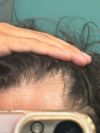
EDHARRINGTON's journey to regrow his hair using finasteride, topical minoxidil, and micro-needling treatments over 4 years, with others commenting their support and admiration for his results.
A 39 year old male who has been balding since 23 and is intolerant to finasteride, using microneedling with Derminator 2 once per week and minoxidil foam twice daily in an effort to increase thickness of vellus hairs on the crown and maintain hairline.
A 34-year-old man is using natural methods like rosemary and peppermint oil, micro-needling, and low-level laser therapy to manage hair thinning, avoiding medications like minoxidil and finasteride. Despite minimal visible progress, he values the non-medicated approach and remains consistent with his routine.
The user reports progress in hair regrowth using topical finasteride/minoxidil, microneedling, topical dutasteride, latanoprost, and MSM supplements. They express frustration over the lack of interaction on progress posts compared to trivial topics.
Hair loss treatments, specifically about the effectiveness of RU58841 compared to Pyrilutamide. Molecular weights and side effects were discussed in terms of efficacy and cost-effectiveness.
A new painless microneedle patch shows promise in reversing hair loss. The discussion focuses on potential new treatments beyond common options like Minoxidil, finasteride, and RU58841.
User Solid_Repeat5382 shared their experience with Pyrilutamide for hair loss, which initially reduced shedding but later lost effectiveness. They plan to switch back to RU58841 and finasteride, while continuing minoxidil and dermapen treatments.
Significant hair regrowth was achieved using RU58841, minoxidil, and microneedling during a high-dose steroid cycle. The user reported no side effects from RU58841 and plans to continue the regimen.
People discussed using finasteride and minoxidil for hair loss and mentioned additional treatments like microneedling, Nizoral, oils, vitamins, shampoos, natural treatments, and laser helmets. They shared their experiences with these treatments in combination with finasteride and minoxidil.
The user shared a two-year update on hair loss treatment using oral minoxidil, finasteride, and microneedling, noting significant progress after starting oral treatments and microneedling. They began treatment in early 2023 after noticing hair loss in late 2021.
The conversation is about a user preparing to join the ABS-201 clinical trial for hair loss treatment, which involves a prolactin inhibitor. The user plans to update others on their progress if enrolled.
After 7 months of using topical finasteride/minoxidil, microneedling, and Nizoral shampoo, the user believes they are seeing hair regrowth. They are seeking further advice to improve their results, excluding hair transplant options.
Hair loss treatments, specifically minoxidil (Minoxidil) and finasteride (Fin). The conversation includes comments about non-responders, the possibility of becoming a responder with grapefruit juice, disappointment, and acceptance of baldness.
A user's progress with hair loss treatments over 5 months, using topical finasteride (0.3%) and minoxidil (6%), as well as weekly microneedling sessions; other users have asked questions about the results and offered compliments.
Pelage PP405 is a new hair loss treatment in trials, potentially reactivating dormant hair follicles without affecting hormones. Results are expected in February 2025, offering an alternative to minoxidil and finasteride.
PP405 significantly improves hair density, outperforming finasteride, with 31% of users seeing over 20% improvement in four weeks. Concerns exist about its availability, cost, and long-term effects.
The conversation discusses hair loss, scalp buildup, and treatments like Nizoral shampoo, Minoxidil, and dietary changes to address seborrheic dermatitis and iron deficiency. The user plans to improve their hair condition with a good routine, Nizoral, and diet adjustments.
Various treatments like finasteride, minoxidil, dutasteride, and microneedling with PRP had no effect on hair loss. The user is considering laser diode caps as a potential option.
The user plans to enhance their hair loss treatment with oral minoxidil, finasteride tablets, laser cap therapy, and various supplements. They are also considering a hair transplant and exploring reputable sources for these products.
A user shared a video suggesting that 0.5mm microneedles are most effective for hair growth. Other users mentioned different microneedle lengths and advised consulting a dermatologist for personalized treatment.
A user is experiencing uneven hair thinning and has tried topical minoxidil without success and finasteride with adverse effects. They are considering microneedling and PRP treatments while avoiding finasteride, and another user suggests trying dutasteride as an alternative.
The user experienced hair regrowth and reduced shedding using saw palmetto, biotin, minoxidil, fish oil, and Nizoral, but hair loss resumed after discontinuing the regimen. They are considering reintroducing the regimen and possibly trying finasteride.
The user is currently using finasteride and minoxidil and is considering adding microneedling and either RU58841 or Pyrilutamide for potential hair regrowth. They previously used microneedling, RU58841, and oral minoxidil before their hair transplant.
Chinese company gets green light for Pyrilutamide Phase II trial for androgenetic alopecia. Androgen receptors downregulate in androgen deficient environments.
A 35-year-old who has been using topical and oral Minoxidil and Finasteride with dermarolling and Nizoral for four months, experiencing improved hair health but not yet full coverage on the crown. Others have responded encouragingly to this progress.
The conversation discusses using daily microneedling at 0.25mm and red light therapy to enhance hair regrowth, especially when traditional treatments like finasteride and minoxidil become less effective. The combination is said to improve hair density and thickness, with red light therapy being more cosmetic, while microneedling is essential for challenging areas.
Pp405 is discussed as a potential hair loss treatment, with humorous suggestions about rectal administration for increased effectiveness. Users joke about unconventional methods and express willingness to try anything for hair regrowth.
The user has been using topical minoxidil and finasteride for four months, along with microneedling and Nizoral, noticing thicker lashes and eyebrows but not much scalp hair growth. They apply the treatment twice daily with a 5% minoxidil and 0.3% finasteride solution.