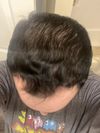
A 27-year-old Asian male is treating hair loss with 1mg oral finasteride, topical minoxidil twice daily, and 1.5mm microneedling weekly. The discussion is about his progress with these treatments.
A woman with AGA and CTE has been taking multiple hair loss treatments including spironolactone, dutasteride, finasteride, bicalutamide, birth control, and minoxidil without success. Steroid injections, however, dramatically and immediately stopped her hair loss, though the effect lasts less than a month.
A user experiencing scalp pain and diffuse hair thinning is taking finasteride and using Nizoral shampoo. They plan to continue finasteride for 6 months and consider adding minoxidil if no improvement is seen.
My hairline, I am only 23.
This conversation is about a user's experience with treatments for androgenic alopecia, including finasteride, dutasteride, RU, minoxidil, progesterone, melatonin, LLLT, oral minoxidil, and Pyrilutamide. They have tried many treatments over the course of two years without seeing much success, and they are considering getting a hair system as a last resort.
The user improved diffuse thinning without finasteride by using minoxidil foam, cold showers, gentle hair drying, 2% ketoconazole, sulfate-free tea tree oil shampoo, dermastamping, and supplements like Omega-3, Vitamin-D, Biotin, Keratin, Collagen, B3, Zinc, and Magnesium. The regimen was followed for about six months under dermatologist guidance.
Balding is challenging, and relying on medications like finasteride is often seen as a better option than constantly shaving or trying to compensate in other areas. Many feel that societal expectations to "own it" or drastically change oneself to cope with baldness are unrealistic and burdensome.
The conversation is about a person considering participating in a study for Clascoterone, a topical cream for hair loss, and seeking advice on potential side effects. They have mild hair loss and are not currently using other treatments like finasteride.
A woman with alopecia universalis shares her positive experience of being bald, finding it freeing and less worrisome. She also discusses her skincare routine using Korean products.
The post and conversation discuss the unpredictable nature of diffuse thinning, a type of hair loss. Users share personal experiences, with some mentioning treatments like oral finasteride and toppik, and the need for patience with these treatments.
Treating alopecia androgenetica with limited options, such as spironolacton, dutasteride, finasteride, minoxidil 5%, Rogaine foam for men, a shampoo with ketoconazol, iron supplement and dermarolling.
The user is concerned about regrowing a plucked widow's peak and is considering using Minoxidil. They have been using the Growplex pack for a month without noticeable results.
The conversation discusses unconventional methods for hair regrowth, including scalp trauma like burning or microneedling, and compares them to treatments like Minoxidil and Finasteride. It highlights skepticism about these methods and the body's unpredictable healing responses.
A user diagnosed with AGA is seeking advice on hair loss treatments, comparing topical Minoxidil, Spironolactone, and Finasteride to oral medications and natural methods like dermastamping, PRP, and LED light. They are concerned about side effects and effectiveness, especially given their existing fatigue.
A 43-year-old male has been using oral minoxidil, finasteride, and dutasteride for hair loss, with some stabilization and thin hair growth but no significant cosmetic improvement. He is considering increasing microneedling frequency and exploring other options, as he is concerned about the lack of terminal hair growth.
A user, 42 M, NW 5-6, used oral Dutasteride, Minoxidil, RU58841 topical, micro needling, Nizoral shampoo, saw palmetto gummies, vitamin D gummies, and scalp massages for 2 months. They noticed many small light hairs on previously bald areas and are questioning if these will darken or remain vellus hairs.
Microneedling and Platelet-Rich Plasma (PRP) are equally effective for treating androgenetic alopecia, with no additional benefits from PRP over microneedling. Both treatments are safe and well-tolerated.
A user is confused about a dermatologist's positive assessment of their scalp despite concerns about their hairline. They discuss using oral minoxidil, concerns about side effects from finasteride, and difficulty finding topical finasteride.
Low-dose daily aspirin reduces the effectiveness of topical minoxidil in treating androgenetic alopecia. Aspirin inhibits sulfotransferase enzymes, which are necessary for minoxidil to work.
The conversation discusses hair loss treatments, mentioning minoxidil, finasteride, RU58841, VDPHL, GT20029, and follicle cloning as potential solutions. It also reveals that the discussion about PP405 was an April Fool's joke.
The user is experiencing hair loss, possibly due to androgenetic alopecia and seborrheic dermatitis, and has tried ketoconazole shampoo without success. They are hesitant to use finasteride due to potential side effects and are seeking advice on managing their condition.
The conversation discusses the potential of new hair loss treatments, with a focus on pyrilutamide, gt20029, and topical alfatradiol, and the possibility of improving their effectiveness through methods like increased concentration and microneedling. Dutasteride is also mentioned as a stronger option.
Pelage is moving to Phase III clinical trials for PP405, a hair loss treatment, with results to be presented at a medical meeting. Users express skepticism and hope, comparing it to existing treatments like Minoxidil and finasteride, while discussing the potential for new hair growth in previously bald areas.
PP405 shows promise in stimulating new terminal hair growth by activating dormant follicles, with no systemic adverse effects observed in a short-term trial. However, long-term efficacy remains unproven, and further trials are needed to confirm its potential as a hair loss treatment.
Avoid burning or scarring the scalp for hair growth; instead, use treatments like finasteride, minoxidil, or consider a hair transplant. Microneedling should be done carefully, and extreme methods can cause harm.
The conversation discusses using topical Calcipotriol and Valproic Acid for hair loss, focusing on their mechanisms involving the VDR receptor and Wnt/beta-catenin pathway. Specific treatments mentioned are Minoxidil, Finasteride, and RU58841.
The user has been using finasteride and Alpecin shampoo for about three years, reporting thicker hair but an unchanged hairline. They are happy with their hair progress, noting the most improvement in the past five months, and mention a slight decrease in libido.
A 28-year-old male is experiencing hairline recession despite his family having full heads of hair. Suggested treatments include finasteride, minoxidil, and ketoconazole 2% shampoo.
After suffering from hair loss and trying various treatments like finasteride, minoxidil, RU58841, and scalp micropigmentation without lasting success, the individual found freedom and a renewed sense of self by shaving their head and accepting their baldness. They encourage others struggling with hair loss to not waste years searching for a cure and to consider embracing a shaved head as a positive solution.
DHT may inhibit hair growth by affecting mitochondrial function, leading to hair follicle miniaturization. Treatments like minoxidil and PP405 may promote hair growth by altering metabolic pathways, potentially counteracting DHT's effects.
A 22-year-old male experiencing hair loss suspects androgenetic alopecia (AGA) and possibly telogen effluvium (TE), with a noted improvement in scalp itch after adopting a gluten-free diet. He is advised to consider treatments like finasteride or minoxidil and to check iron and ferritin levels.