Search
for
Sort by
Community Join
30-60 / 1000+ resultscommunity Doubtful of RU58441's negative effects
RU58841's potential side effects, particularly heart palpitations, are debated, with some attributing them to contamination with minoxidil. Users report mixed experiences, with some seeing no side effects and others cautioning about the lack of reliable data on RU58841's safety.
community RU58841 works great!
community HMI 115 hasn't done phase one yet for AGA?
User asks if HMI 115 hasn't done phase 1 for AGA in humans. Conversation includes treatments Min, Fin, and RU.
community ABS-201 KOL Seminar: Dr. Ralf Paus on Human Ex Vivo Hair Regrowth Data
ABS-201 shows promise for male hair regrowth by blocking the prolactin receptor, with higher expected efficacy than current treatments. The discussion also covers dosing differences between macaques and humans for hmi115, highlighting a significant dosage disparity.
community For using ethanol for RU, do I use denatured or non-denatured?
The conversation discusses using non-denatured ethanol for RU58841. Treatments mentioned include Minoxidil, finasteride, and RU58841.
community Will Pelage include Norwood 7 hair loss in PP405 phase 3 trials to see its true regenerative potential?
Norwood 7 hair loss is often excluded from trials to ensure treatments appear more effective and to reduce costs. Some believe treatments effective for Norwood 5 could work on Norwood 7, but companies prioritize market readiness.
community Anyone read oral minoxidil's leaflet?
Oral minoxidil is discussed, highlighting potential cardiovascular risks at high doses, but users note that lower doses commonly used for hair loss are generally considered safe. Monitoring by doctors is advised, and some users report taking it without issues, comparing its risks to those of common medications like ibuprofen.
community Oral Minoxidil - The Hyper-Responder Concept
Minoxidil's effectiveness varies due to genetic differences in the SULT1A1 enzyme, affecting how well it converts to its active form, minoxidil sulfate. Hyper-responders may experience rapid hair growth and increased side effects, such as pericardial effusion, even at low doses.
community NW4 -> NW 2.5 (1yr progress) RU 8.5-9% ED and topical Dut .1% + RU 5% 1.5x a week. (+ caffeine redensyl scalp treatment ED)
The conversation discusses hair regrowth progress from Norwood scale 4 to 2.5 over a year using daily 8.5-9% RU58841, topical Dutasteride 0.1%, RU58841 5% 1.5 times a week, and daily caffeine redensyl scalp treatment.
community Why do the mice always win????
A new stem cell therapy shows promise in treating hair loss, but skepticism remains about its availability. Users humorously discuss the effectiveness of treatments on mice compared to humans.
community Stop the fear mongering of oral minoxidil its one of the best treatments available in 2020. It does not cause heart lesions or adverse cardiac effects like people claim. I am maintaining with just oral minoxidil with retrograde alopecia and diffuse thinning all over nw3 hairline
Oral minoxidil is considered a safe and effective treatment for hair loss at low dosages, with minimal cardiac risks. Users report positive results, though some experience side effects like increased heart rate and skin changes, and consulting a doctor is advised.
community Using licorice with minoxidil to offset lowering of blood pressure
Using licorice to counteract the blood pressure-lowering effects of oral minoxidil. Concerns about licorice affecting potassium levels and minoxidil's effectiveness were raised.
community Puffy eyes / fluid retention on Oral Minoxidil? Add an ACEi or ARB! *NOT MEDICAL ADVICE*
Oral Minoxidil can cause puffy eyes and fluid retention. Adding an ACE inhibitor or ARB, like Telmisartan, may help mitigate these side effects.
community 3 Month Mark Update, Fin 1mg/Min 2ml ED
community Could Minoxidil also be effective with Raynauds Syndrome
The conversation discusses using oral Minoxidil, a vasodilator, for both Raynaud's Syndrome and hair loss. It also inquires about other hair loss treatments that improve blood flow.
community one year progress - fin 0.5 daily, 2.5mg oral min, 1ml daily topical nin
The user had a failed hair transplant in 2018, didn't use medication, and experienced severe depression from further hair loss. They started treatment in 2022 with 0.5mg daily finasteride, 2.5mg oral minoxidil, 1ml daily topical minoxidil, and are considering low dose RU58841 and dermarolling.
community 15 months - 1mg fin only progress
A 22-year-old is using 1mg finasteride daily for hair loss, noting some scalp thickening but still experiencing visible thinning. They are considering oral minoxidil due to concerns about topical application with cats at home, and others in the conversation share positive experiences with oral minoxidil, reporting no side effects and significant hair regrowth.
community Using Antihypertensive drugs for hair loss
The conversation discusses the potential connection between baldness, heart disease, and high blood pressure. Treatments mentioned include Minoxidil, Spironolactone, and Finasteride.
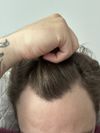
community Norwood scale ? 28m
A 28-year-old is assessing their hair loss on the Norwood scale, considering adding topical minoxidil and dermastamping to their current regimen of oral finasteride and minoxidil. They feel their hair loss is worsening and seek opinions on their condition.
community P-1075: a BETTER version of Minoxidil
P-1075 is a more potent hair growth agent than Minoxidil, but it poses significant heart risks, making it unsafe for use. Despite promising results in macaques, concerns about its cardiotoxicity in rats have halted its development.
community New Preprint: Retinoic Acid Supports Verteporfin-Induced Regeneration
community Community ranking on what new drugs/studies we are most hopeful about?
community Is there any true alternatives to minoxidil that doesn't effect heartrate?
A user with slight hair thinning is seeking alternatives to minoxidil due to concerns about heart rate effects, despite using finasteride without issues. They are looking for options that don't affect the heart.
community HLT Megathread on HMI-115 (key takeaways in comments)
HMI-115, a newly discovered hair loss treatment that could potentially be effective for those with diffuse thinning and telogen effluvium. It is based on prolactin receptor antagonist signaling and has already undergone Phase I trials in women, with potential commercialization by 2027.
community 2 weeks on Oral Minoxidil (loniten). 1.25mg/day
The user has been taking oral Minoxidil (1.25mg/day) for two weeks to treat hair loss, has experienced no side effects, and plans to increase the dose to 2.5mg/day after another two weeks. They are also monitoring their blood pressure and have not noticed any negative interactions with their pre-workout supplements.
community Why are there no proper phase 3 trials for RU
RU58841 lacks FDA approval due to financial and safety concerns, including potential cardiological side effects. The company abandoned further research, and users report adverse effects like heart palpitations and gynecomastia.
community Warning: Minoxidil usage around pets
Minoxidil is highly toxic to pets, especially cats and dogs, even in small amounts. Many users have switched to oral minoxidil to prevent accidental exposure to their pets.
community Pelage have presented only phase 2a. The rest of phase 2 for PP405 will be presented at a later medical meeting
PP405's phase 2a trial results were presented, focusing on safety and pharmacokinetics, with a future meeting planned to share the full dataset. The trial includes a randomized controlled portion and an open-label extension, with no indication of phase 2B completion.
community Topical latanoprost chance of eye color change?
The user is using oral minoxidil for hair growth and is considering adding topical latanoprost, but is concerned about potential eye color change. They are seeking advice on the effectiveness of latanoprost for hair thickening and the risk of eye color change.