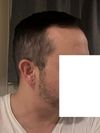
User noticed beard and sideburn hair loss, and thinning eyebrows, diagnosed with alopecia barbae and male pattern baldness, and prescribed Desonide cream. User seeks feedback on Desonide cream.
Clascoterone's full trial results are expected by mid-July 2026, but skepticism exists about timely release. Clascoterone is available at 5% from some telehealth companies.
The conversation discusses using Bimatoprost for eyebrow regrowth and its potential use on the hairline, with concerns about cost and side effects. Alternatives like topical Minoxidil are mentioned, but the user is worried about aging and acne.
The conversation discusses a hair loss and scalp care routine involving ciclopirox shampoo, benzoyl peroxide, clindamycin gel, clobetasol propionate, and calcipotriol to manage seborrheic dermatitis, folliculitis, and inflammation. It also touches on the role of diet and other treatments like oral minoxidil and pioglitazone for scalp health.
A 39-year-old from Bangalore shared his successful hair transplant journey, which included 3537 scalp and 1521 beard grafts, boosting his confidence. He also started medication alongside the transplant.
A user shared their satisfaction with a hair transplant done by Dr. Jimmy Cortez at Capilar Hair Center, but others in the conversation questioned the authenticity of the results, suspecting the use of hair fibers and deceptive advertising. Some found the hairline natural-looking, while others criticized it as artificial or unnecessary.
The conversation is about finding a clearnet vendor for clascoterone, also known as Winlevi, for hair loss treatment. The user is seeking recommendations via direct message.
Brian Dye's theory links skeletal malocclusion type II to hair loss, suggesting it's a blood flow issue. Treatments mentioned include minoxidil, finasteride, and anti-inflammatory drugs like benaxoprofen.
A person with hair loss since COVID-19 is considering treatments like finasteride and minoxidil but is hesitant due to potential side effects. Suggestions include visiting a dermatologist, using a ketoconazole shampoo, and considering that post-COVID hair loss might be an autoimmune response.
The conversation discusses the importance of scalp skin barrier health in hair follicle cycling, suggesting treatments like ceramides or niacinamide to support hair growth. It also mentions the use of finasteride for hair loss.
Exosome treatment for hair loss, derived from umbilical cord stem cells, is being considered as an option before a hair transplant. Users discuss the need for ongoing maintenance and share experiences with different exosome sources, including plant-derived options.
Bimatoprost is discussed for hair and eyelash growth, with users confirming its legitimacy and availability from Indian pharmacies. It is noted that the common concentration may not be effective for significant scalp hair regrowth unless mixed with Minoxidil.
The user is using topical dutasteride, finasteride, minoxidil, and tretinoin but seeing no results or side effects. They also microneedle every two weeks but experience little bleeding, questioning if a thick scalp is preventing treatment effectiveness.
A 35-year-old shared a 2-month update on their hair transplant of 3153 grafts, noting redness, itching, and some pimples, while using finasteride for over 12 years to maintain hair. Users discussed the effectiveness and timing of starting finasteride, with some suggesting consulting a doctor for young individuals considering the treatment.
A 32-year-old male with diffuse thinning and seborrheic dermatitis has been using finasteride for 8 months without improvement. He is considering COQ10 + PQQ supplements for scalp inflammation and hair loss.
Hair loss treatments discussed include promising Pyr available online and Verteporfin dosing after FUE for follicle regeneration, but no updates on SCUBE3.
The conversation discusses a hair loss treatment involving a hair transplant of approximately 2500 grafts to the frontal area, daily use of finasteride, twice-daily topical minoxidil, and daily caffeine shampoo since the hair transplant procedure. One person is skeptical about the improvement in the crown area with just finasteride and minoxidil.
A user shared their 12-month progress after a 3500-graft hair transplant at Heva Clinic in Istanbul, choosing not to use minoxidil or finasteride. The results were praised, with comments noting the natural look and significant improvement.
The user is pleased with their hair transplant results but is concerned about the vertex area. They use Minoxidil and finasteride daily and had the procedure at a clinic in Athens.
User on Dut, oral minox 20 mg, Saw Palmetto, Pumpkin Oil, RU, 8% topical minox, and topical fina for hair loss; top of head improves, but retrograde alopecia worsens. Asks for options besides exosomes and where to find topical melatonin.
Clascoterone's European release is expected in Q4 2026, with FDA approval anticipated by mid-2027. The discussion includes questions about the approval timeline and potential acceleration due to unmet needs.
A user is interested in seeing scalp tattoos as a response to hair loss, specifically looking for creative designs rather than scalp micropigmentation. They are considering this approach for their own Norwood 5 hair loss situation.
A 30-year-old man with hairline recession is considering using 1% Clascoterone cream on his hairline while awaiting a 5% Breezula product. He has been using oral Minoxidil for four years but stopped using Finasteride due to side effects.
The user visited a trichologist due to ineffective topical finasteride treatment for hair loss. The trichologist recommended a new regimen including a two-month course of locoidon (cortisone 0.1%), followed by a solution containing minoxidil, hydrocortisone butirrate, estrone, progesterone, tocopherol acetate, trichosol, and transcutol.
A case study that suggests verteporfin may be able to help regrow donor hairs after FUE extraction, and the potential implications of this result. Treatments discussed include Minoxidil, Finasteride, and RU58841.
Emerging hair loss treatments like PP405, a topical MPC inhibitor, show promise in activating stem cells for hair growth. The conversation seeks information on the development stages and accessibility of these treatments.
A user is very satisfied with their hair transplant results, despite choosing a straight hairline against the doctor's advice for a more natural look. Some commenters think the hairline looks artificial, while others discuss the importance of a natural-looking hairline and inquire about any medications used post-transplant.
The user is pleased with their hair transplant results after six months and seeks feedback. The conversation is positive, with others affirming the success of the procedure.
Verteporfin is being explored for its potential to improve hair transplant outcomes by reducing scarring and increasing donor hair follicles. There is skepticism about the results, with some claiming misleading presentation of evidence.